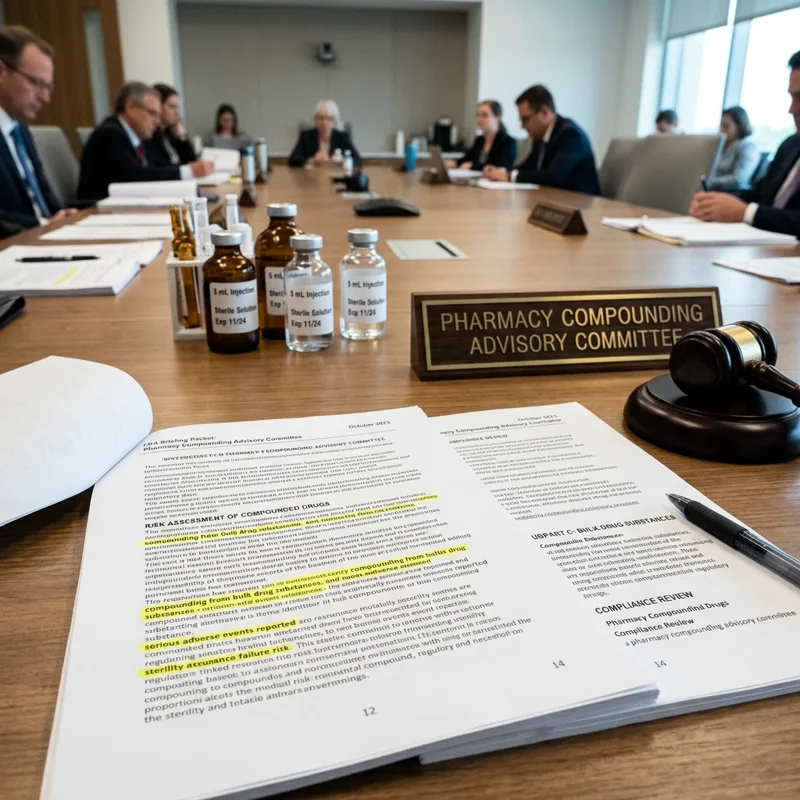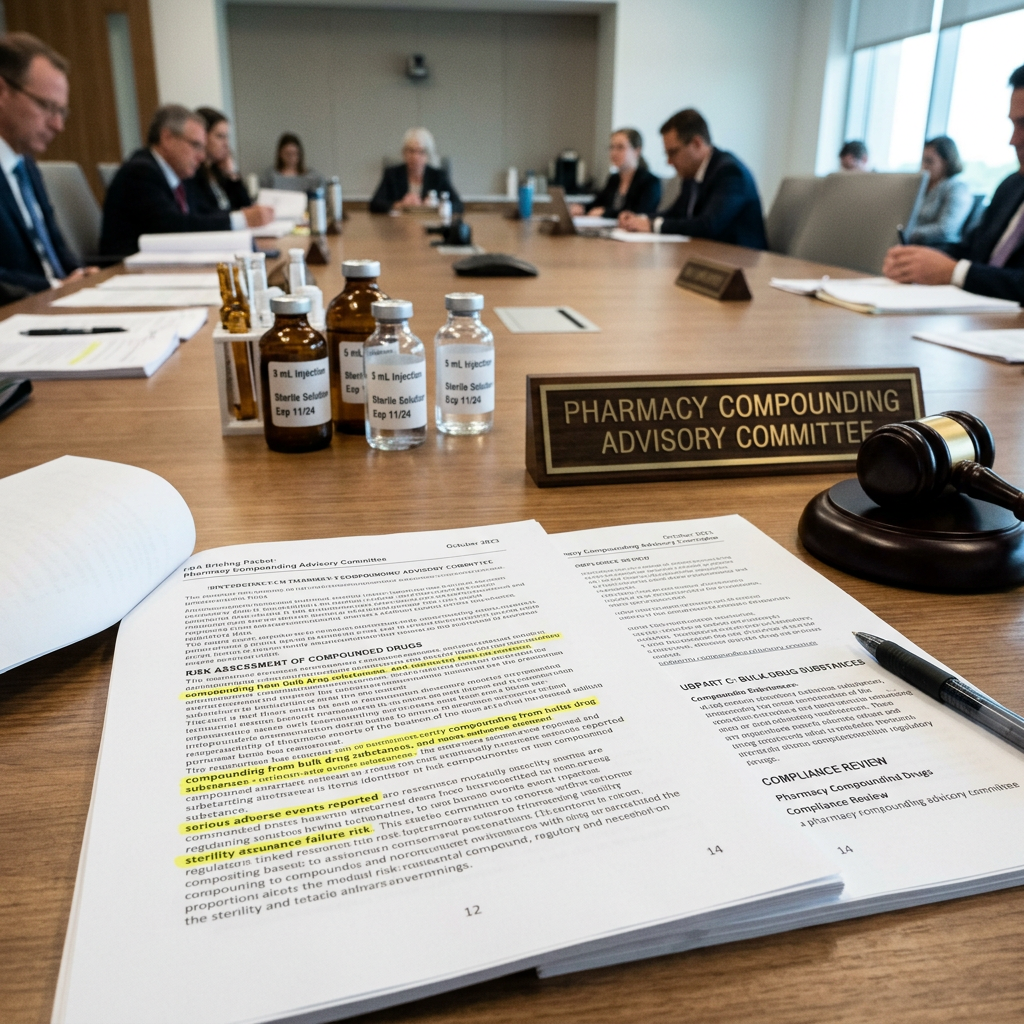

The FDA's Pharmacy Compounding Advisory Committee (PCAC) is convening on July 23–24, 2026, to evaluate seven peptides — including BPC-157, TB-500, MOTs-C, KPV, Semax, Epitalon, and Emideltide (DSIP) — for potential inclusion on the Section 503A Bulk Drug Substances List. The outcome will directly determine whether compounding pharmacies can legally prepare and dispense these peptides to patients.
The good news: this is a public process. The FDA has opened Docket FDA-2025-N-6895 specifically to receive comments from patients, practitioners, researchers, and advocates. Your submission becomes part of the official record reviewed by the Committee and the FDA. This guide walks you through every step — from understanding the deadlines to writing an effective comment and submitting it.
⏰ Critical Deadlines at a Glance
- June 30, 2026 — Deadline to register for an oral presentation at the meeting
- July 1, 2026 — FDA notifies whether your oral presentation request was approved
- July 9, 2026 — Comments received by this date will be provided directly to the Committee members
- July 22, 2026 — Docket closes (11:59 p.m. ET for electronic; postmarked on or before for mail). Comments after July 9 but by July 22 are still considered by FDA.
Bottom line: Submit by July 9 to ensure your comment reaches the Committee before they meet.
Why Your Comment Matters
Under Section 503A of the Federal Food, Drug, and Cosmetic Act, individual compounding pharmacies may prepare drug products — including peptides — from bulk drug substances only if those substances appear on FDA's approved "503A Bulks List." The PCAC evaluates each nomination and makes a recommendation to the FDA Commissioner, who makes the final decision.
Public comments are not symbolic. According to the Federal Register notice (FR Doc 2026-07361), all timely-filed comments become part of the official docket record and are factored into the Committee's deliberations. Comments submitted by the July 9 priority deadline are physically provided to each Committee member before the meeting begins.
The types of input the FDA is especially interested in include:
- Patient experiences with compounded peptide therapies (positive or negative)
- Clinical or scientific data on safety and efficacy
- Perspectives on therapeutic need and access to care
- Views from practitioners who prescribe or administer these peptides
- Pharmacist and compounder perspectives on quality and handling
According to STAT News, interest in these peptides has grown substantially in recent years, making this one of the most-watched PCAC hearings in the compounding space. A well-organized public comment campaign can meaningfully shift the narrative the Committee hears.
What the Committee Is Deciding
The PCAC will evaluate each peptide across two days, per the FDA advisory committee calendar:
July 23, 2026
- BPC-157 (free base & acetate) — evaluated for ulcerative colitis (UC)
- KPV (free base & acetate) — evaluated for wound healing and inflammatory conditions
- TB-500 (free base & acetate) — evaluated for wound healing
- MOTs-C (free base & acetate) — evaluated for obesity and osteoporosis
July 24, 2026
- Emideltide (DSIP) (free base & acetate) — evaluated for opioid withdrawal, chronic insomnia, and narcolepsy
- Semax (free base & acetate) — evaluated for cerebral ischemia, migraine, and trigeminal neuralgia
- Epitalon (free base & acetate) — evaluated for insomnia
As RAPS reports, this hearing represents one of the broadest single reviews of peptide compounding substances the FDA has undertaken, covering compounds with widely varying evidence bases and patient communities.
Step-by-Step: How to Submit an Electronic Comment
Electronic submission through Regulations.gov is the fastest, easiest, and recommended method for most people. Here's exactly how to do it:
Step 1: Go to Regulations.gov
Open https://www.regulations.gov in your browser. This is the official U.S. government portal for all federal rulemaking comments.
Step 2: Search for the Docket
In the search bar at the top of the page, type the docket number: FDA-2025-N-6895. Press Enter or click Search. You should see the docket titled "Pharmacy Compounding Advisory Committee; Notice of Meeting; Establishment of a Public Docket; Request for Comments — Bulk Drug Substances Nominated for Inclusion on the Section 503A Bulk Drug Substances List."
Step 3: Click "Comment"
Click on the docket listing to open it, then click the blue "Comment" button. You do not need to create an account to submit a comment, though creating a free account lets you track your submission and receive confirmation.
Step 4: Write Your Comment
You'll see a text box where you can type (or paste) your comment directly. You can also upload attachments (PDF, Word documents, images) if you have supporting data or research you want to include. Keep the following in mind:
- Be specific. Generic comments ("I support peptides") carry less weight than detailed, substantive ones. Reference specific peptides, conditions, or evidence.
- Share your experience. Patient and practitioner testimony about clinical experience is particularly valuable. You do not need to be a scientist.
- Cite sources where possible. If you reference clinical studies or prior FDA documents, include citations.
- Privacy warning: Any information you include in the body of your comment — including your name and contact details — will be posted publicly on Regulations.gov. If you want your name kept private, enter it only on the cover sheet, not in the comment body, and mark it "confidential" (see the paper submission section below for confidential submissions).
Step 5: Identify the Docket Number in Your Comment
At the start of your comment or in the subject line, include the docket number: FDA-2025-N-6895. This ensures your comment is correctly filed.
Step 6: Submit Before the Deadline
Click Submit. Electronic comments are accepted until 11:59 p.m. Eastern Time on July 22, 2026. However, to ensure your comment reaches the Committee before the meeting, submit by July 9, 2026.
After submission, you'll receive a tracking number. Comments typically appear in the public docket within a few business days.
Alternative: Written (Paper) Submission by Mail
If you prefer to submit by mail, or if your comment contains confidential information (such as proprietary research or sensitive patient data), send a written submission to:
Food and Drug Administration
5630 Fishers Lane, Rm. 1061
Rockville, MD 20852
Important: Include the docket number FDA-2025-N-6895 on your envelope and at the top of your letter. Paper submissions must be received (not just postmarked) on or before July 22, 2026.
Submitting Confidential Information
If your comment includes trade secrets, proprietary data, or sensitive personal medical information you do not want posted publicly, you must use the paper submission method and prepare two copies:
- Copy 1 (Confidential): The complete comment, including the sensitive information. Label the cover page with the heading: "THIS DOCUMENT CONTAINS CONFIDENTIAL INFORMATION."
- Copy 2 (Public): The same comment with all confidential information redacted or blacked out. This version will be posted on Regulations.gov.
Submit both copies to the Dockets Management Staff address above. Confidential information will not be disclosed except as permitted under 21 CFR 10.20 and applicable disclosure law.
How to Request an Oral Presentation
In addition to written comments, the FDA allocates approximately one hour per peptide session for oral public presentations. Speaking in person (or via teleconference) at the PCAC meeting is the most direct way to put your perspective in front of the Committee.
Who Can Present?
Any member of the public — patient, caregiver, physician, pharmacist, researcher, or advocate — may request time to speak. You do not need any special credentials.
How to Register
Contact the FDA's primary point of contact for this meeting:
Center for Drug Evaluation and Research, FDA
Phone: 240-402-2507
Email: PCAC@fda.hhs.gov
Your registration must include:
- A brief statement describing the general nature of the evidence or views you will present
- The names and addresses of all proposed participants
- Whether you prefer to present in-person or online (teleconference)
- The approximate amount of time you are requesting
Registration Deadline: June 30, 2026
All oral presentation requests must be received by June 30, 2026. The FDA will notify you by July 1, 2026 whether your request was approved. If more people register than can be accommodated, the FDA may conduct a lottery to select speakers.
Meeting Location and Format
The meeting will be held at the FDA White Oak Campus, Building 31 Conference Center, Silver Spring, MD. It will also be available via live webcast with captioning. Webcast links and background materials will be posted no later than two business days before the meeting at the FDA advisory committee calendar page.
Oral presentation time slots are scheduled as follows:
- July 23: ~10:15 a.m., 11:50 a.m., 2:15 p.m., and 4:00 p.m. ET
- July 24: ~10:20 a.m., 12:30 p.m., and 3:20 p.m. ET
Tips for Writing an Effective Public Comment
Not all comments carry equal weight. FDA staff and committee members read thousands of submissions and are looking for substantive, evidence-based input. Here's how to make yours count:
1. Be Specific About Which Peptide(s) You Are Addressing
Mention the specific compound by name — e.g., BPC-157, Semax, or TB-500 — and the specific indication being evaluated (wound healing, cognitive function, etc.).
2. Describe Personal or Clinical Experience
If you are a patient who has used a compounded peptide, describe your condition, the treatment, and the outcome. If you are a prescriber or pharmacist, describe the patient population you serve and your clinical rationale. Concrete, first-person accounts are among the most impactful inputs the Committee receives.
3. Reference Published Evidence
If you are aware of peer-reviewed research, clinical trials, or FDA documents relevant to a peptide, cite them. You don't need to be exhaustive, but linking your comment to the scientific record strengthens it considerably.
4. Avoid Mass Form Letters
The FDA distinguishes between individually crafted comments and identical form-letter campaigns. While both are accepted, original comments receive more substantive consideration. Use your own words, even if you are coordinating with a patient group.
5. Keep It Focused
Comments do not need to be long to be effective. A well-organized, 300–500 word comment that clearly makes a specific point is more useful than a sprawling multi-page essay. Use paragraph breaks and clear structure.
6. Do Not Include Protected Health Information (PHI) or Social Security Numbers
Everything submitted electronically is posted publicly. Never include your Social Security number, financial account numbers, or sensitive medical information that you would not want published online. If you need to include such information, use the confidential paper submission process.
What Happens After You Submit
Once your comment is filed, here's the process:
- Docket posting: Your comment will be made publicly viewable on Regulations.gov within a few business days, where anyone can read it.
- Committee review: Comments received by July 9 are compiled and provided directly to PCAC Committee members before the meeting. Comments received between July 9 and July 22 are reviewed by FDA staff and may still influence the process.
- PCAC deliberation: On July 23–24, the Committee discusses each peptide, hears oral presentations, and votes on recommendations for the 503A Bulks List.
- FDA decision: The Commissioner considers the Committee's vote — along with all docket comments — before making a final determination on which substances to add to or exclude from the 503A list.
- Rulemaking: Additions to the list typically require a final rule published in the Federal Register, after which compounding pharmacies may legally use those substances as bulk drug ingredients.
Note: Even if the meeting is cancelled for any reason, the Federal Register notice states that "FDA will continue to evaluate relevant information and consider comments submitted to the docket."
Quick Reference: All Submission Details
| Method | Details | Deadline |
|---|---|---|
| Electronic | regulations.gov — search docket FDA-2025-N-6895 | July 22, 2026 (11:59 p.m. ET) |
| Mail / Courier | Dockets Management Staff (HFA-305), FDA, 5630 Fishers Lane, Rm. 1061, Rockville, MD 20852 | Received by July 22, 2026 |
| Oral Presentation | Email PCAC@fda.hhs.gov or call 240-402-2507 | Register by June 30, 2026 |
| Priority Deadline | Comments provided to Committee members | July 9, 2026 |
You can view all filed comments (and track your own) by visiting Regulations.gov and searching for docket FDA-2025-N-6895. The docket is open to the public and displays all non-confidential submissions.
What Strong Comments Have in Common
Reviewers triage thousands of submissions. The ones that move are short, specific, and grounded in something the writer actually saw or measured. A comment that begins with the docket number and the peptide is easier to file than one that opens with a salutation. A clinical observation reported with a denominator carries more weight than the same observation reported without one. A reference to a published study with a DOI is more useful than a reference to a press release.
Effective comments tend to do three things in their first paragraph: identify the peptide(s) being addressed, identify the writer's relationship to the topic (patient, prescriber, pharmacist, researcher, quality lead), and state the writer's position. The rest of the comment supports that position with the specific evidence the writer is bringing to the record — a documented clinical case, an impurity profile, a safety observation, a published trial result, an institutional protocol.
Equally important is what to leave out. Marketing claims, generic statements of support, and submissions that read as broad endorsements without data tend to be discounted. So do submissions that imply substitution for an FDA-approved drug, since that is a separate enforcement question the agency is actively litigating in adjacent cases.
If you are submitting on behalf of an institution — a clinic, pharmacy, or research group — say so explicitly and identify how the position was developed. Comments grounded in institutional experience and aggregated data tend to land differently than individual statements, and FDA reviewers note both.
Frequently Asked Questions
What is the docket number for this public comment period?
The official docket number is FDA-2025-N-6895. Include this number in all submissions — electronic or written — to ensure your comment is correctly filed. You can find the docket at Regulations.gov by searching for this number.
What is the deadline to submit a public comment?
The docket closes on July 22, 2026 (11:59 p.m. ET for electronic submissions; received on or before that date for paper submissions). However, comments received by July 9, 2026 will be provided directly to the Committee members before the meeting. Submit by July 9 for maximum impact.
Do I need to be a medical professional to submit a comment?
No. Any member of the public — patient, caregiver, family member, researcher, pharmacist, or physician — can submit a public comment. Patient perspectives and lived experience are highly valued by the Committee and can be just as influential as clinical data.
Will my name and comment be made public?
Yes. All non-confidential comments submitted electronically are posted publicly on Regulations.gov exactly as submitted. If you include your name or contact information in the body of your comment, that information will be visible online. If you wish to keep your name private, submit by mail and note "confidential" on your cover sheet — not in the comment body.
Which peptides are being reviewed at the July 2026 PCAC meeting?
Seven peptides are under review: BPC-157 (for ulcerative colitis), KPV (for wound healing and inflammatory conditions), TB-500 (for wound healing), MOTs-C (for obesity and osteoporosis), Emideltide/DSIP (for opioid withdrawal, insomnia, narcolepsy), Semax (for cerebral ischemia, migraine, trigeminal neuralgia), and Epitalon (for insomnia).
How do I request to speak at the meeting in person or online?
Contact Takyiah Stevenson at the FDA by June 30, 2026: email PCAC@fda.hhs.gov or call 240-402-2507. Include a brief description of what you plan to present, the names and addresses of all participants, whether you prefer in-person (FDA White Oak Campus, Silver Spring, MD) or online, and the approximate time you are requesting. FDA will notify you by July 1, 2026.
What happens if my comment is submitted after July 9 but before July 22?
According to the Federal Register notice, comments received after July 9 but on or before July 22 "will be taken into consideration by FDA." They may not be provided to the Committee before the meeting, but they remain part of the official docket and can still influence the FDA's final determination.
What does the 503A Bulks List mean for patients?
The Section 503A Bulk Drug Substances List identifies which substances individual compounding pharmacies may legally use as starting ingredients when preparing customized drug products for specific patients. If a peptide is not on this list, licensed 503A pharmacies cannot legally compound it, which effectively eliminates access for most patients who rely on compounding pharmacies. That's why the PCAC's recommendations — and the public comments that inform them — have real consequences for patient access.
Sources
- FDA Advisory Committee Calendar — July 23–24, 2026 PCAC Meeting
- Federal Register Notice FR Doc 2026-07361 (GovInfo.gov)
- Regulations.gov — Federal eRulemaking Portal
- RAPS — FDA Considers Adding Peptides to Its Bulk Drug Compounding List
- STAT News — Peptides: FDA Panel to Discuss Broader Access Through Compounding
Sources & References
- FDA PCAC Meeting Announcement (July 23-24, 2026)
- PBS: FDA to Weigh Easing Limits on Peptides Favored by RFK Jr.
- BioPharma Dive: FDA Peptides RFK Advisory Committee Restrictions
- RAPS: FDA Considers Adding a Dozen Peptides to Bulk Drug List
- Ars Technica: RFK Jr. Forces FDA to Reconsider 12 Peptides
- ProPublica: Peptide Safety Investigation
- New York Times: Peptide Ban FDA RFK Jr.
- SSRP Institute: FDA Announces Change in Status of 12 Peptides
- CNBC: RFK Jr. Peptides Hims Hers GLP-1
- USA Today: RFK Jr. FDA Peptides Explainer