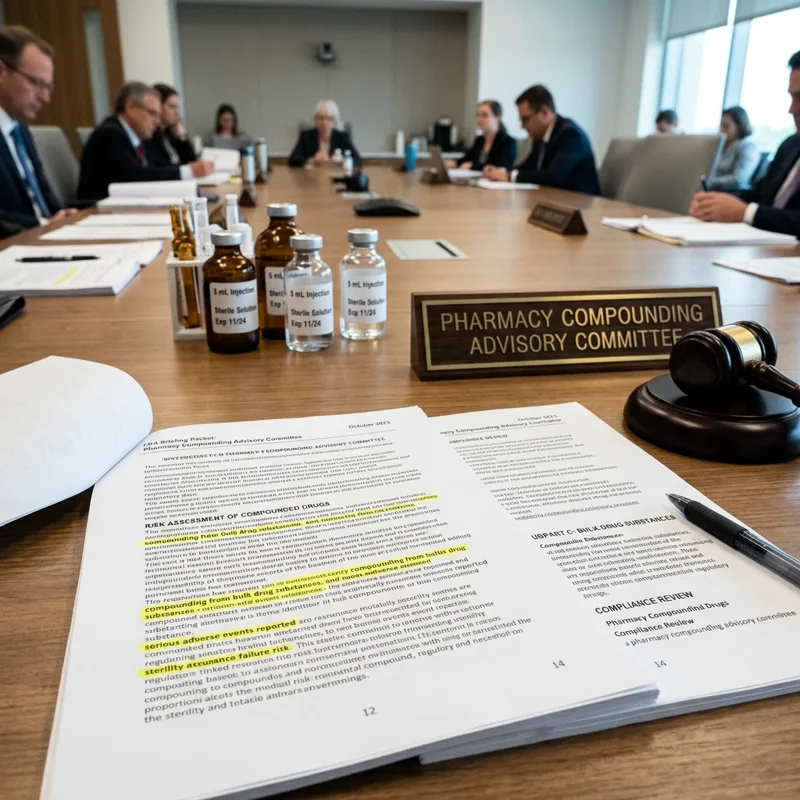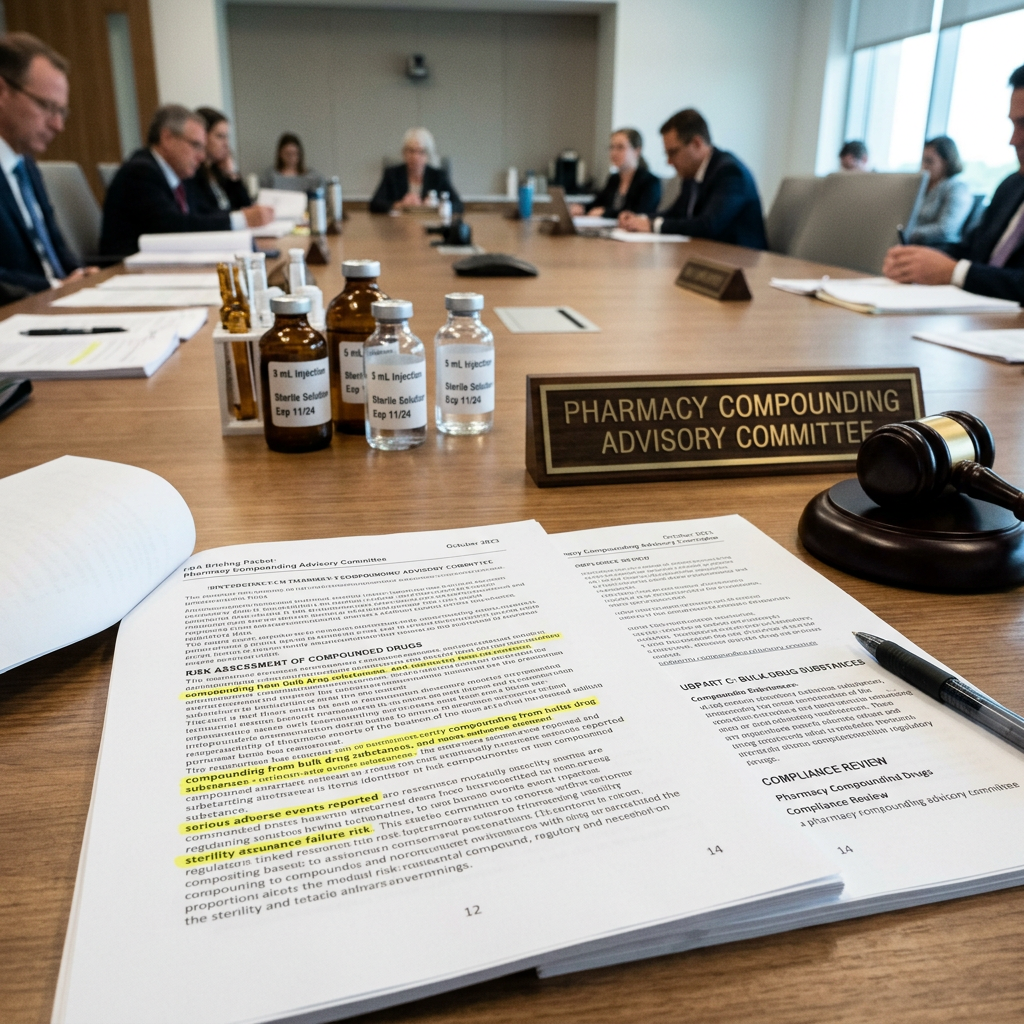
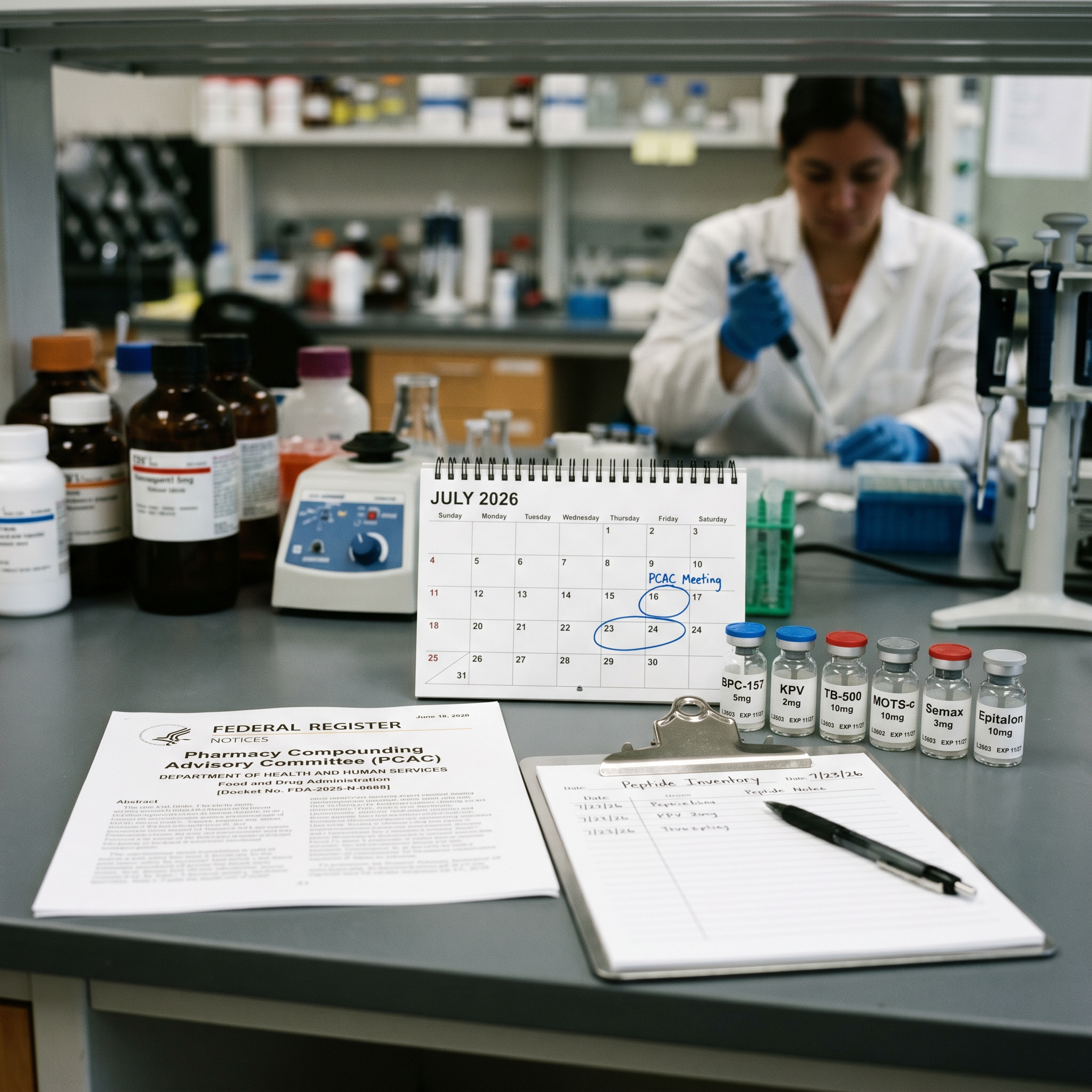
FDA opened a docket. The number is FDA-2025-N-6895. Comments are due July 22, 2026, and anything the agency wants in the briefing book for its Pharmacy Compounding Advisory Committee needs to land by July 9. The committee meets July 23–24 to consider whether seven peptides should be eligible for patient-specific compounding under Section 503A.
That is the procedural reality. None of it makes any peptide legal to compound tomorrow, next month, or the day after the meeting adjourns. Stakeholders who treat the docket as a green light are reading a step in a process as a destination.
What FDA is actually considering
The 503A bulks list is a narrow inventory. To get on it, a substance generally has to clear three hurdles: it can't be a component of an FDA-approved drug, it can't have an applicable USP/NF monograph, and it has to satisfy the criteria FDA weighs when adding new entries — clinical need, safety, and quality controls. PCAC's role is advisory. The committee reviews evidence and votes; FDA then has to complete notice-and-comment rulemaking before anything formally lands on the list.
So picture the docket as the moment a bill gets a committee hearing scheduled, not the moment it becomes law. The peptides on the July agenda were never in Category 1, the bucket FDA has historically treated as lower enforcement priority during pendency. Their removal from Category 2 takes the "significant safety risk" label off the table for purposes of that posture. It does not, by itself, place anything on the 503A list, and it does not change FDA's posture toward compounded versions of approved drugs — the GLP-1 issue runs on its own track.
For practical purposes, three things stay true:
- 503A still requires a patient-specific prescription.
- Limits on compounding "essentially copies" of commercially available drugs still apply.
- Sourcing, documentation, and labeling obligations don't shift because a docket opened.
Which peptides are on the list
July 23–24 covers seven substances, each in free base and acetate forms:
A second meeting before the end of February 2027 is scheduled for five more: LL-37, GHK-Cu, Dihexa acetate, Melanotan II, and PEG-MGF.
Background on the metabolic peptides whose compounding rules sit at the heart of this docket lives in PeptideKnow's weight-loss and metabolic category, alongside healing and recovery peptides like BPC-157 and TB-500 — the two most-referenced compounds in early submissions.
What FDA tends to scrutinize
Read the agency's prior peptide write-ups and a pattern emerges. The recurring concerns are technical, not philosophical:
- Impurity profile. Truncated sequences, racemization at specific residues, residual reagents from solid-phase synthesis, aggregate content.
- Immunogenicity. Sequence- and route-dependent. Subcutaneous injection of a small peptide with aggregates is a different risk from intranasal or topical use.
- Human exposure. Clinical trials, observational data, pharmacovigilance signals — and the absence of them.
- Stability. Reconstitution practices, cold chain, and what happens to the product over the labeled shelf life.
None of that is exotic. It's the same checklist the agency applies to other compounded drug substances. The peptides on this agenda just happen to fail or pass it for substance-specific reasons that the committee will hear from FDA reviewers and from the public record.
Submitting a comment
Comments go through Regulations.gov. Search for the docket number, follow the prompts, attach files where useful, and label them with names a reviewer can scan in a list (a clinical safety summary belongs in a file whose name says so). Anything you want in the committee's pre-meeting packet has to be in by July 9, 2026; the docket itself stays open until July 22.
The substantive bar matters more than the format. Reviewers triage thousands of comments. The ones that move are the ones tied to data — published, peer-reviewed where possible, with limitations and uncertainty stated plainly.
Plausible outcomes
Twelve to eighteen months from now, the agenda peptides will sit somewhere on a spectrum. The endpoints aren't dramatic; the middle is where the action is.
- Inclusion plus rulemaking. The committee recommends adding a substance, FDA agrees, and notice-and-comment rulemaking finishes. This is the cleanest path to lawful 503A use, and it is also the slowest.
- Recommendation against inclusion. The committee says no. The substance stays off the list, and the enforcement posture for those compounding it stays where it is.
- More data requested. The committee defers. This is the most common outcome at advisory hearings — additional impurity characterization, an immunogenicity workup, or a structured human-exposure summary, brought back at a later meeting.
- Posture drift without rulemaking. Practical enforcement priorities can move even when the formal list does not. Stakeholders who plan around drift instead of rulemaking are building on weaker ground.
For clinics and prescribers
- Document patient-specific medical necessity. Convenience and cost are not the same thing as need.
- Track adverse events. De-identified, aggregated outcome data is one of the few currencies that travels well in regulatory review.
- Calibrate patient counseling to the evidence. A peptide on a PCAC agenda is, by definition, still under review.
For 503A compounders
- The docket is not permission. Eligibility under 503A — or a clear interim FDA approach — is the trigger, not the meeting.
- Quality documentation has long lead times. Method validation, impurity specs, stability programs, endotoxin and bioburden controls, supplier qualification — these don't appear on demand.
- Marketing language is its own enforcement risk. Claims that imply equivalence to an approved drug are an adjacent FDA priority and will not be insulated by the bulks process.
The broader read on the docket: FDA is separating two questions it has often been asked to answer at once. One is whether certain standalone peptides have a legitimate place in 503A compounding. The other is what to do about high-volume copycat compounding of approved drugs. Splitting them lets the agency move on the first without conceding ground on the second.
Frequently Asked Questions
Does this mean these peptides are legal to compound right now?
No. A docket and a scheduled committee meeting do not authorize compounding. Removal from Category 2 does not place a peptide on the 503A bulks list, and it does not move it into Category 1 enforcement discretion.
What is PCAC?
The Pharmacy Compounding Advisory Committee. It reviews scientific and medical information and gives FDA non-binding recommendations on compounding questions, including which bulk drug substances should be eligible under 503A.
Why do public comments matter for peptides specifically?
Many of these substances have thin commercial drug development behind them. The public record is, in some cases, the largest body of structured human-use evidence FDA has access to. Substantive comments — clinical observations with denominators, safety monitoring, validated quality methods — can change what the committee sees.
What sinks a comment?
Marketing claims. Anecdote without denominators. Submissions that read as advocacy for broad substitution of an approved drug. Comments are more persuasive when methods are explicit and limitations are stated.
Which peptides are at the July 2026 meeting?
BPC-157, KPV, TB-500, MOTs-C, Emideltide (DSIP), Semax, and Epitalon. A separate meeting before the end of February 2027 is expected to cover LL-37, GHK-Cu, Dihexa acetate, Melanotan II, and PEG-MGF.
Sources
- RAPS Regulatory Focus (Apr 17, 2026): FDA considers adding a dozen peptides to its bulk drug compounding list — https://www.raps.org/resource/fda-considers-adding-a-dozen-peptides-to-its-bulk-drug-compounding-list.html
- FDA Law Blog (Apr 21, 2026): FDA's Pep(tide) Rally! What Compounders and Industry Need to Know — https://www.thefdalawblog.com/2026/04/fdas-peptide-rally-what-compounders-and-industry-need-to-know-post-1-of-2/
- FDA, Section 503A bulk drug substances — https://www.fda.gov/drugs/human-drug-compounding/section-503a-bulk-drug-substances-list-development-and-related-rulemakings
- Regulations.gov, Docket FDA-2025-N-6895 — https://www.regulations.gov/docket/FDA-2025-N-6895
Medical/legal note: This article is informational and does not provide medical or legal advice. Peptides may be investigational, regulatory status can change, and individual circumstances vary. Consult qualified professionals for treatment or compliance decisions.
Sources & References
- FDA PCAC Meeting Announcement (July 23-24, 2026)
- PBS: FDA to Weigh Easing Limits on Peptides Favored by RFK Jr.
- BioPharma Dive: FDA Peptides RFK Advisory Committee Restrictions
- RAPS: FDA Considers Adding a Dozen Peptides to Bulk Drug List
- Ars Technica: RFK Jr. Forces FDA to Reconsider 12 Peptides
- ProPublica: Peptide Safety Investigation
- New York Times: Peptide Ban FDA RFK Jr.
- SSRP Institute: FDA Announces Change in Status of 12 Peptides
- CNBC: RFK Jr. Peptides Hims Hers GLP-1
- USA Today: RFK Jr. FDA Peptides Explainer