

PeptideKnow is a reference site. This article discusses U.S. regulatory policy and published scientific considerations; it is not medical advice. If you’re considering any compounded medication, talk with a licensed clinician and use a state-licensed pharmacy.
In late June, FDA career reviewers published a set of technical writeups that read less like a political fight and more like a safety audit. The documents focus on seven peptides that have become fixtures in the U.S. gray market—often marketed for injury recovery, inflammation, metabolic health, or “longevity.” The reviewers’ bottom line across the set was consistent: the evidence package for each substance is thin, and the risks are hard to bound, especially for products that would be made patient-by-patient in compounding pharmacies.
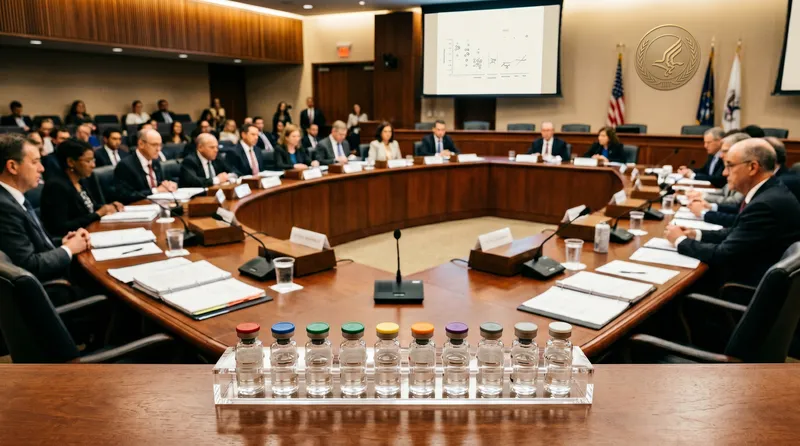
The immediate trigger is the Pharmacy Compounding Advisory Committee (PCAC), which is scheduled to vote July 23–24, 2026 on whether these substances should be considered for the 503A Bulks List. FDA posted briefing materials on June 29, 2026, and those reviews are now circulating widely outside the agency because they directly address several of the peptides most frequently discussed online.
What FDA’s career reviewers said (and why it matters)
PCAC votes are recommendations, not laws. But for compounding, the committee’s work can still change what’s possible in practice. If a bulk substance is placed on the 503A Bulks List, it can become a lawful starting material for traditional compounding under section 503A—subject to the other conditions of the statute. If it stays off, the legal room for routine compounding is far narrower, and enforcement risk goes up.
The June 29 writeups framed the same core problem in different ways: for these peptides, FDA reviewers did not see enough human safety data, enough manufacturing characterization, or enough pharmacology-to-clinic continuity to justify routine compounding. In at least one review, the agency’s scientists raised immunogenicity as a central risk—an especially uncomfortable topic for peptides, where small changes in purity, aggregation, or formulation can change how the immune system “reads” the molecule.
One detail that has received outsized attention is language from the MOTS-c review warning that immune reactions can be unpredictable, with consequences that could extend to “life-threatening and catastrophic” outcomes. That phrasing isn’t common in public-facing summaries, and it signals the reviewers were thinking beyond mild antibody formation and toward the long tail of rare but severe events.
Which peptides are on the agenda
Based on the briefing package described publicly, the seven substances discussed for the July 2026 PCAC meeting include:
- BPC-157
- TB-500 (thymosin beta-4 fragment products marketed under this name)
- KPV
- Semax
- Epithalon (often marketed as “Epitalon”)
- MOTS-c
- DSIP (also referenced as emideltide in some nominations)
These are not fringe compounds in terms of online attention. They’re also not FDA-approved drugs for these uses. That mismatch—high demand, low regulatory clarity—has produced a market where product identity and quality vary dramatically.
The “Category 2” misunderstanding: what changed, and what didn’t
A separate confusion sits underneath the current spike in headlines: when FDA moved certain nominated bulk substances out of a “Category 2” bucket earlier this year, some sellers treated it as an authorization. It isn’t. It’s closer to reopening a file than issuing a permit.
In plain terms: being discussed at PCAC is not the same as being approved for legal compounding. Until a substance is placed on the 503A Bulks List (or fits another lawful pathway), routine patient-by-patient compounding remains a legal gray zone at best—and, in many cases, outside the statute’s conditions entirely.
Why peptides raise immunogenicity questions
Immunogenicity is a fancy word for a simple question: will the immune system learn to treat the molecule as a threat? For peptides, the answer depends on more than the sequence on paper.
A peptide can change immunogenic risk through:
- Aggregation (clumping), which can create multivalent structures that immune cells recognize more readily.
- Impurities and byproducts from synthesis, purification, and storage.
- Route of administration. Parenteral routes can increase the likelihood that the immune system encounters the peptide in a way that drives antibody formation.
- Formulation details like pH, excipients, and container interactions.
That’s why the quality conversation can’t be reduced to “it’s a peptide, therefore it’s safe.” Peptides can be remarkably specific biologically—but specificity is not the same as predictability when the manufacturing chain and clinical evidence base are incomplete.
What this could mean for compounding pharmacies (and for patients)
If you’re a patient, the practical consequence of a “no” recommendation is not just that a favorite product becomes harder to obtain. It’s that the regulatory system is telling you something about evidence thresholds: FDA is being asked to tolerate routine distribution of substances that do not have the kind of human safety package most clinicians assume exists when a drug is ordered.
If you’re a compounding pharmacy, a negative recommendation (or a decision not to list) can translate into:
- Less legal cover for routine dispensing.
- Greater pressure on documentation, sourcing, and quality control.
- More scrutiny of marketing claims—especially claims that sound like disease treatment rather than individualized compounding.
And if you’re one of the many telehealth brands positioned between patients and pharmacies, it raises a harder question: what counts as responsible clinical access when the agency reviewing the evidence is explicitly describing a thin and uncertain safety record?
How to read the upcoming PCAC vote
PCAC votes often get portrayed as a morality play: regulators versus innovators, or the government versus “biohackers.” The committee’s actual job is narrower. It’s to advise on whether a nominated bulk substance has enough evidence to justify compounding under 503A.
Three details worth watching as July 23–24 approaches:
- What evidence is presented publicly. Do proponents show controlled human data, or mostly animal and mechanistic arguments?
- How reviewers treat identity/characterization issues. Peptides are not interchangeable just because two vendors use the same nickname.
- Whether safety concerns hinge on the molecule itself or on manufacturing variability. Those are different problems—and they suggest different policy tools.
What PeptideKnow readers should do right now
If you’re seeing claims that “FDA legalized peptides again,” treat them as marketing until proven otherwise. Regulatory status is documentable. If a product is being compounded under 503A, you should be able to find the relevant statutory rationale and evidence trail—especially for substances that have been openly questioned by FDA reviewers.
If you’re considering a compounded peptide, questions to ask a clinician or pharmacy include:
- What is the exact substance and salt form?
- What is the route of administration and why?
- What evidence in humans supports safety at this dose and duration?
- How is the product tested (identity, purity, endotoxin/sterility where relevant)?
Those questions are not “anti-peptide.” They’re what responsible use looks like when a market runs ahead of evidence.
Frequently Asked Questions
Are BPC-157, TB-500, MOTS-c, Semax, KPV, Epithalon, and DSIP legal to compound today?
Many of these substances are widely offered, but availability is not the same as compliance. A substance being discussed by PCAC does not automatically place it on the 503A Bulks List, and FDA actions like re-categorization do not necessarily create a lawful compounding pathway. For the most current status, use FDA’s 503A bulks list resources and meeting materials.
Why is immunogenicity a bigger worry with peptides than people assume?
Because the immune system responds to patterns, not marketing names. Aggregation, impurities, formulation choices, and route of administration can all change risk. A peptide that looks “clean” on a label can behave differently depending on how it’s made and delivered.
What’s the difference between 503A and 503B compounding?
503A generally covers patient-specific compounding by traditional pharmacies, while 503B covers outsourcing facilities that can compound in larger batches under a different regulatory framework. The legal requirements and FDA expectations differ, and not every substance eligible in one context is eligible in the other.
Why do people keep calling Epithalon “Epitalon”?
“Epitalon” is a common marketing name, but reference sources and many researchers use “Epithalon.” For readers, the important thing is sequence identity and evidence quality—not the nickname used online.
Sources (with dates)
- FDA: Bulk drug substances used in compounding under Section 503A of the FD&C Act (accessed July 3, 2026): https://www.fda.gov/drugs/human-drug-compounding/bulk-drug-substances-used-compounding-under-section-503a-fdc-act
- The Peptide List (Substack): summary and excerpts describing FDA briefing documents posted June 29, 2026 (published July 3, 2026): https://thepeptidelist.substack.com/p/the-fdas-own-scientists-said-no-the
Sources & References
- 503A Bulks List (fda.gov)
- thepeptidelist.substack.com (thepeptidelist.substack.com)