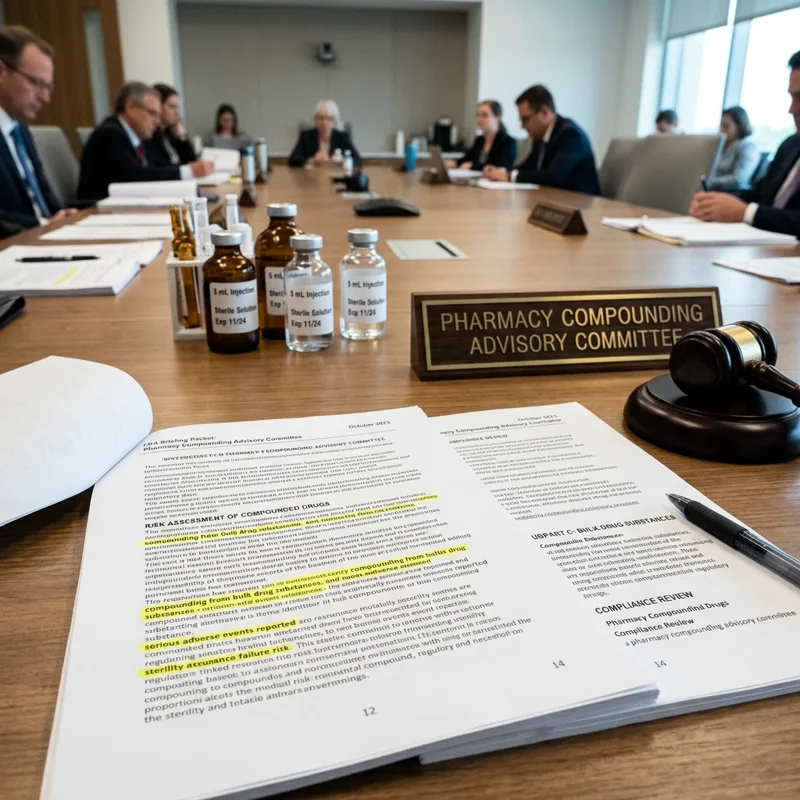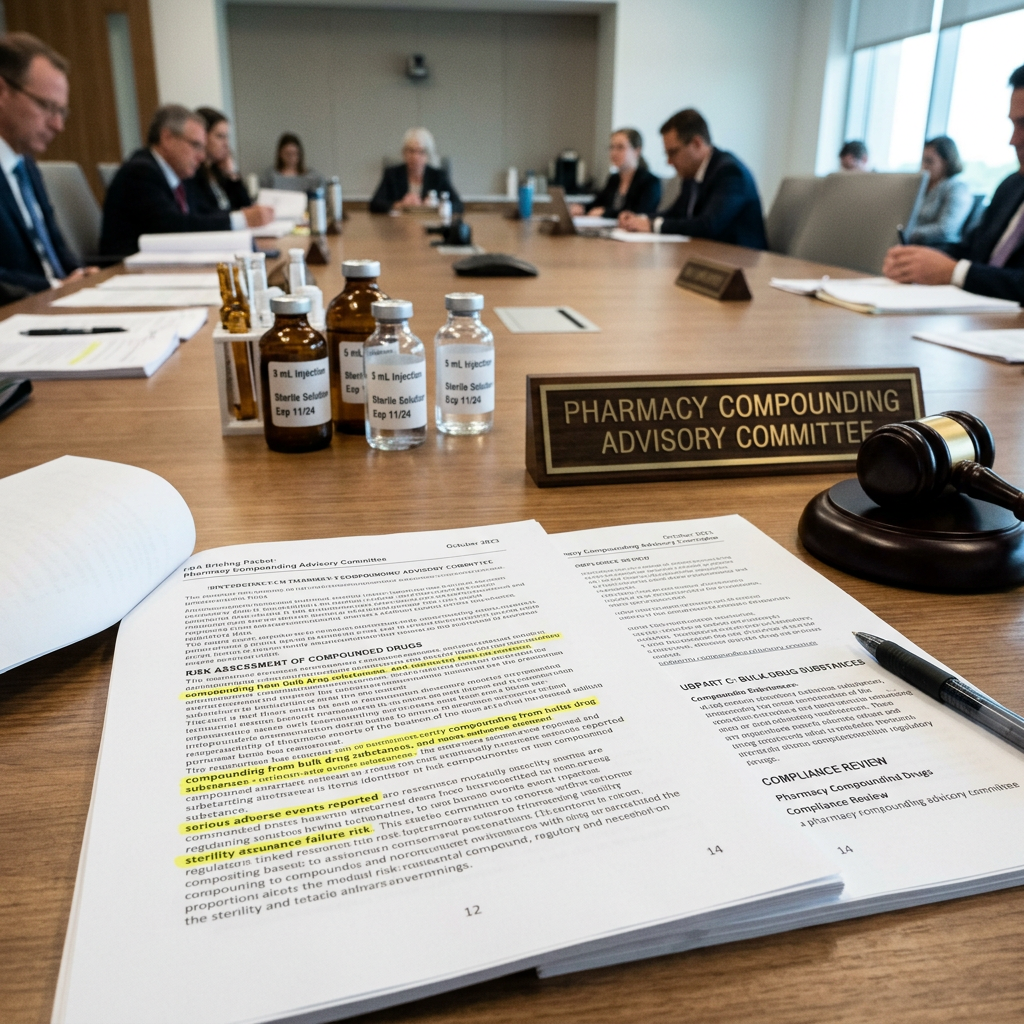

A set of newly posted FDA staff reviews is drawing a sharp line between online peptide enthusiasm and the agency’s evidentiary standard. The documents, released ahead of the Pharmacy Compounding Advisory Committee (PCAC) meeting scheduled for July 23–24, argue that the data package for seven widely discussed peptides is too thin to justify putting them on the FDA’s bulk substances list for compounding. Reuters summarized the staff position plainly: the available evidence doesn’t support allowing compounding pharmacies to manufacture the peptides under review (Reuters).
The stakes are practical. If a peptide lands on the bulk substances list, outsourcing facilities and traditional compounding pharmacies may have a clearer path to make patient-specific preparations. If it doesn’t, demand tends to migrate to a gray market that often looks nothing like pharmacy practice. NPR reported that, since the Biden administration’s 2023 restrictions, many consumers have turned to online sellers and overseas supply chains as a workaround (NPR).
What the FDA posted (and what it’s meant to do)
The PCAC is an advisory body. Its recommendations are non-binding, but they shape how the agency talks about risk, evidence, and enforcement. According to Reuters, the committee will consider whether to add seven peptides to the FDA’s list of bulk drug substances permitted for use in compounded medicines (Reuters).
POLITICO noted that the agency also posted briefing documents for the meeting, and that FDA staff proposed not listing the peptides—consistent with the FDA’s long-running view that the safety and efficacy evidence is inadequate for broad compounding access (POLITICO).
These documents don’t just ask “does it work?” They ask “do we have enough signal in humans to justify a compounding pathway that will expand routine use in clinics and pharmacies?” That’s a different burden than a mechanistic hypothesis or an influencer testimonial.
Which peptides are in scope
The list matters because each peptide lives in a different corner of the online market—sports injury forums, longevity communities, metabolic health clinics, and “nootropic” stacks. Reuters listed the seven peptides expected on the July agenda as: BPC-157, KPV, TB-500, MOTS-c, emideltide, semax, and epitalon (Reuters).
FDA staff reviewers, Reuters reported, flagged not only scant effectiveness evidence but also limited human trial data across the set (Reuters). NPR’s reporting highlighted the same theme—potential safety questions paired with evidence gaps—and emphasized that these products are often promoted for wellness and longevity without the kind of large, rigorous human trials that would typically support broad access (NPR).
Why the agency is nervous: the compounding-specific problem
Compounding is supposed to be narrow: a patient-specific solution when an approved product can’t meet a clinical need. The modern peptide market flips that. It’s consumer demand first, indication second. When compounding becomes the default supply chain for a therapy with sparse human data, the question isn’t just “does the molecule have a plausible mechanism?” It’s “what happens when millions of doses are prepared across many facilities with variable analytical capacity?”
That’s where peptide chemistry stops being an academic detail. Small changes—salt forms, oxidation, deamidation, truncated sequences—can change potency or immunogenicity. Even the best-run compounding shops need a stable reference standard and a validated assay strategy to control impurities. You can see why FDA reviewers, in Reuters’ account, raised impurity and toxicity concerns and pointed to thin human data (Reuters).
For readers trying to orient: this is also why the site’s peptide profiles emphasize what’s known, what’s unknown, and where the evidence comes from. If you’re new to the topic, start with our category pages like Regulation and Inflammation and then drill into the specific compounds.
Politics and process: why July 23–24 could be noisy
The science and the politics are now braided. NPR reported that Health Secretary Robert F. Kennedy Jr. has openly supported easing access to some peptides, while FDA career scientists are recommending the opposite (NPR). POLITICO wrote that the newly posted roster for the PCAC includes members with ties to the peptide industry and clinics offering peptide therapies, raising conflict-of-interest questions ahead of the meeting (POLITICO).
That doesn’t automatically invalidate the committee’s expertise. But it does change how outsiders will interpret the result. If the committee recommends listing despite staff objections, the decision will be read as a policy signal, not just a technical one. If the committee aligns with staff, it becomes a boundary-setting moment: popularity alone won’t pull a peptide into mainstream compounding.
What this could mean for clinics, compounders, and patients
There are three plausible near-term outcomes.
Outcome 1: no peptides listed (status quo holds)
The gray market continues. Clinics that already use peptides keep operating in a patchwork of legal theories and vendor relationships. Patients who self-source keep shouldering quality risk, especially when products are labeled “for research use only.” Regulators and state boards keep playing whack-a-mole.
Outcome 2: a narrow listing with guardrails
The most safety-defensible peptides could be considered for limited compounding pathways paired with stronger reporting and testing expectations. POLITICO reported that the Alliance for Pharmacy Compounding has floated “guardrails” like enhanced disclosure to patients or serious adverse event reporting (POLITICO). If that’s the direction, expect a parallel conversation about what a credible certificate of analysis (COA) must include for peptides.
Outcome 3: a recommendation to list that moves faster than the evidence
This is the scenario that makes career reviewers blanch: broad access before human data tightens. If that happens, the market’s center of gravity shifts to compounding, but the scientific debate doesn’t disappear. It just becomes an argument about what harms are acceptable when the benefits are still speculative.
What to watch between now and the meeting
- Whether the committee focuses on “no evidence” or “insufficient evidence.” Those phrases sound similar, but they lead to different policy instincts.
- Whether the discussion gets specific about dosage forms and salt forms. Ambiguity here can hide manufacturing and stability problems.
- How the panel treats translational evidence. Animal studies can be useful, but they are not a substitute for controlled human outcomes.
- Any hint of new enforcement posture. A “don’t list” decision paired with sharper enforcement could reshape the online market quickly.
Frequently Asked Questions
What is the Pharmacy Compounding Advisory Committee (PCAC)?
It’s an FDA advisory committee that provides non-binding recommendations related to pharmacy compounding policy. Reuters reported that the committee will consider whether to add seven peptides to the FDA’s list of bulk drug substances permitted for compounded medicines at its July 23–24 meeting (Reuters).
If a peptide is “listed,” does that mean it’s FDA-approved?
No. Listing for compounding is not the same as FDA approval for safety and efficacy. It’s a policy decision about whether compounding may use the substance under applicable rules.
Why does the FDA keep coming back to human trials?
Because large-scale use exposes problems that aren’t always visible in petri dishes or rodents. NPR’s reporting emphasized that many of these peptide therapies have not undergone rigorous, large-scale human trials (NPR). When the supply chain expands, the agency wants a clearer picture of benefit-to-risk.
Are BPC-157, TB-500, and MOTS-c legal to buy online?
Legality depends on what’s being sold, how it’s labeled, and how it’s used. Many online products are sold as “research use only,” which is a signal that they are not being distributed as approved medicines. If you’re considering any peptide, discuss it with a licensed clinician and prioritize reputable, regulated sources.
What should patients ask a clinic or pharmacy about a peptide product?
Ask about identity testing (mass spectrometry), purity testing (validated HPLC), sterility, endotoxin testing, and whether results are tied to the specific lot you would receive. Also ask what human evidence supports the exact indication and dose being recommended.
Sources
- June 30, 2026 — FDA staff evidence review summarized by Reuters: US FDA staff highlights peptide risks, says little evidence of benefits
- June 30, 2026 — NPR report on FDA scientists and peptide compounding debate: FDA scientists flag concerns with peptides, the trendy molecules RFK Jr. supports
- June 30, 2026 — POLITICO Prescription Pulse on PCAC roster and briefing docs: FDA unveils peptides position
Sources & References
- FDA PCAC Meeting Announcement (July 23-24, 2026)
- PBS: FDA to Weigh Easing Limits on Peptides Favored by RFK Jr.
- BioPharma Dive: FDA Peptides RFK Advisory Committee Restrictions
- RAPS: FDA Considers Adding a Dozen Peptides to Bulk Drug List
- Ars Technica: RFK Jr. Forces FDA to Reconsider 12 Peptides
- ProPublica: Peptide Safety Investigation
- New York Times: Peptide Ban FDA RFK Jr.
- SSRP Institute: FDA Announces Change in Status of 12 Peptides
- CNBC: RFK Jr. Peptides Hims Hers GLP-1
- USA Today: RFK Jr. FDA Peptides Explainer