
An Associated Press health story carried by KRGV on June 24, 2026 and a Wall Street Journal report the day before describe the same shift in plainer terms than the trade press has been willing to use. Americans are injecting themselves with chemicals the Food and Drug Administration has never approved for human use. They are buying them on TikTok and from biohacker storefronts. They are doing it with the encouragement of Health Secretary Robert F. Kennedy Jr., who has said he will end what he calls the agency’s “war” on peptides. The FDA, under his authority, has begun removing experts from the panel that decides which of these substances pharmacies are allowed to mix.
That is the news. The rest of this piece is what it means.
What changed this week
The June 24 AP wire, written by health reporter Matthew Perrone, is the first major-outlet piece to put four separate facts in the same sentence: that the FDA spent years trying to restrict unapproved peptides through warning letters and a Category 2 list; that compounding pharmacies sued to undo those restrictions; that Kennedy has now removed experts from the FDA’s compounding advisory panel; and that the agency could appoint “more peptide-friendly experts” or simply tell pharmacies it will not enforce existing bans. Each of those facts was already public. Put together they describe a policy reversal in progress.
The WSJ story published a day earlier, by Sara Ashley O’Brien, frames the same moment as a business event — a “peptide gold rush” with telehealth companies, med spas, and venture capital all moving in. The Sacramento Bee, in an explainer dated June 18, named the specific peptides Kennedy said he wanted to see returned to compounding eligibility: BPC-157, Thymosin Alpha-1, TB-500, CJC-1295, Ipamorelin, AOD-9604, GHK-Cu, Selank, Semax, KPV, and MOTS-c. The peptides the Bee identified as remaining restricted were GHRP-2, GHRP-6, Ibutamoren mesylate, and Kisspeptin-10.
None of this has yet appeared in the Federal Register. No statute has been amended. The Pharmacy Compounding Advisory Committee meeting on the calendar for July 23 and 24, 2026 is the next procedural forcing function.
What the gray market actually looks like
Walk through it the way a consumer does. You see a Joe Rogan clip on Instagram. He says BPC-157 cleared up his tendonitis in two weeks. You search the name. You land on a wellness clinic offering a $99 “peptide consult,” or on a biohacker storefront like Gary Brecka’s, where injectable vials run $350 to $600. You can also keep scrolling. TikTok ads link to Chinese suppliers shipping the same molecules for as little as $5 a vial. The vials carry the words “research use only” printed on the label. One Facebook group, according to the AP, instructs members: “instead of ‘taking’ you are ‘researching’ peptides.”
That gap between what the label says and what people are doing is the entire story. The FDA’s authority over compounded drugs is built on a specific premise: that pharmacies registered under section 503A may mix individual prescriptions from a permitted list of bulk substances, and that consumers should not be receiving unapproved injectables outside that framework. The phrase “research use only” was supposed to mark the boundary. In practice it has become the workaround.
Paul Knoepfler, a cellular biologist at UC Davis quoted in the AP story, put it cleanly: “Research-grade peptides are going to have junk in them. They’re going to have chemicals used in the purification process and fragments of peptides that you don’t want.” What he is describing is not a hypothetical contamination risk. It is the difference between a USP-grade compounded prescription and a vial that arrived in a padded envelope from a Shenzhen address.
How the 503A list actually works
Compounding is a real category of pharmacy practice with a specific legal home in section 503A of the Federal Food, Drug, and Cosmetic Act. A 503A pharmacy may mix a drug for an individual patient when a prescriber determines a commercially available product won’t do — a dye-free formulation for an allergic patient, a liquid version of a tablet for someone with a swallowing disorder, a strength the manufacturer doesn’t make. To compound from a bulk active ingredient (rather than from an already-approved drug product), the substance must appear on a list the FDA maintains, the so-called 503A bulks list. Substances under active consideration go on Category 1; substances the agency has flagged for serious safety questions go on Category 2, which effectively pulls them off pharmacy shelves while the review proceeds.
In late 2023, the FDA moved roughly 19 peptides into Category 2. The list named substances that are now familiar in this story: BPC-157, TB-500, CJC-1295, Ipamorelin, AOD-9604, GHK-Cu, MOTS-c, Selank, Semax, KPV, and others. The reasoning, in the agency’s public materials, came down to three concerns: characterization (some of these molecules are short fragments derived from larger natural proteins, and the human exposure data is thin), purity (peptides made offshore are often contaminated with synthesis byproducts that are themselves bioactive), and dose — the doses used in influencer culture are several multiples of any concentration these molecules occur in the body.
Compounding pharmacies sued. The lead litigant, represented by attorney Lee Rosebush, argued the FDA had skipped legally required steps. Rosebush told the AP: “Physicians should have every available arrow in the quiver to treat illness and, because of the FDA’s inaction, they don’t.” A coalition called Save Peptides framed it as a civil-rights argument: “Our basic human rights to access alternative medical care using regenerative peptides is being stripped away by the FDA.”
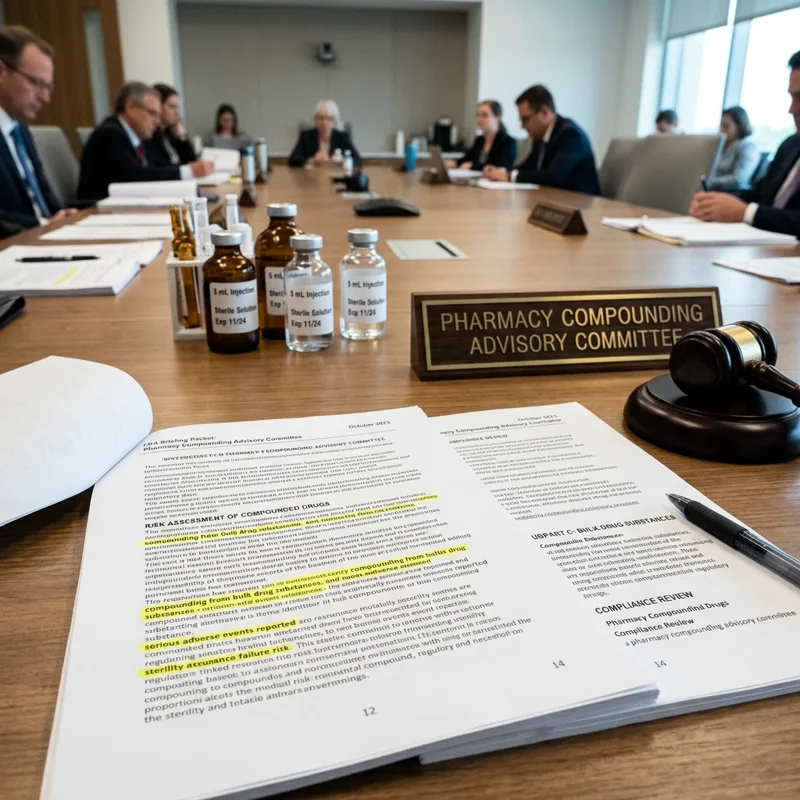
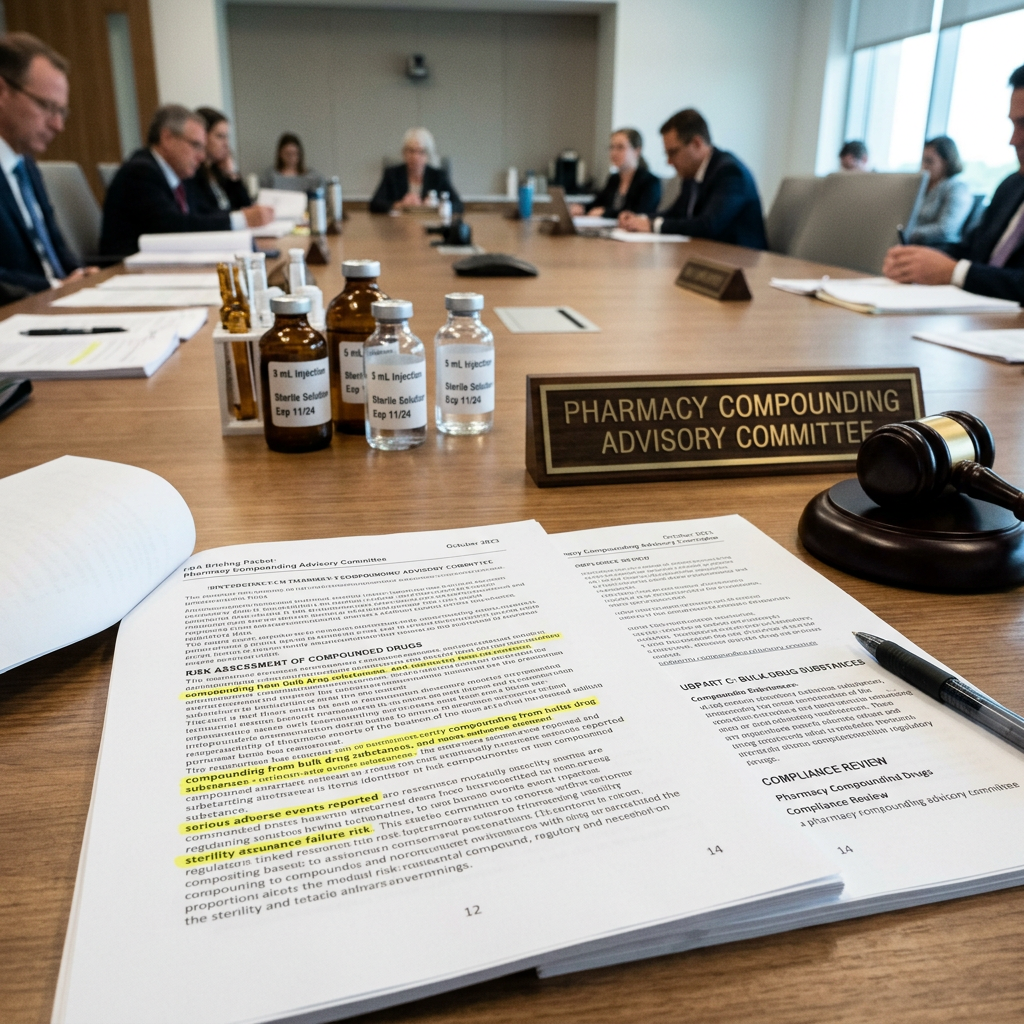
The litigation forced two public meetings of the Pharmacy Compounding Advisory Committee — the body whose members Kennedy is now reshuffling. In each meeting the outside experts voted with the FDA: the substances under review were too risky to be compounded. That is the procedural state of play heading into July 2026. Whether the next meeting reaches the same conclusion depends in part on who is sitting in the chairs.
Who is actually selling, and how
The WSJ’s framing of a “multibillion-dollar wellness boom” isn’t flattery, it’s arithmetic. Three distinct categories of seller are visible:
- Compounding pharmacies operating legally. A 503A pharmacy with a real prescriber relationship can compound peptides that remain on Category 1 or that were never moved to Category 2. Their pricing is closer to standard prescription-fill margins.
- Wellness clinics and telehealth companies. Ways 2 Well, founded by former pharmaceutical sales rep Brigham Buhler and naming Joe Rogan among its celebrity clients, sells a “peptide consult” for $99 and ships vials with dosing instructions and syringes. Buhler did not respond to AP requests for comment. Telehealth-first competitors named in the WSJ piece operate on similar economics — an asynchronous consult, a mail-order vial, a recurring subscription.
- Biohacker storefronts and research-chem sellers. Brecka’s storefront, which the AP put at $350 to $600 per item, sits at the high end of the influencer-direct market. The low end is the “research use only” vial from an offshore supplier, often labeled in a way that purports to absolve the seller of dispensing-without-a-prescription liability. The AP notes that it is “often unclear whether peptides are made in the U.S. by pharmacies and mislabeled for research or purchased from chemical manufacturers, many in China and not subject to FDA drug quality standards.”
The middle category is the one the policy fight is actually about. If Category 2 peptides come back to Category 1, telehealth companies running a 503A-aligned model can sell them openly, with prescriber documentation, in larger volumes, at lower prices. That is the “gold rush” the WSJ describes. The third category — the research-chem sellers — sits outside the compounding framework either way; its existence is what makes the FDA’s enforcement record look thin, and what makes the wellness-industry argument that “people will get these substances anyway” resonate politically.
The advisory panel firings and what they signal
The Pharmacy Compounding Advisory Committee is a small body. Its votes are non-binding but carry weight because the FDA has historically followed them. In 2023, the panel voted with the agency on the peptides at issue. In 2025, Dr. Anita Gupta of Johns Hopkins School of Medicine, who served on the panel until earlier that year, told the AP that her parting question to patients would be: “Are these medications safe long term? That’s the question I would ask if I was a patient.”
Kennedy’s authority over panel membership is real and broad. The AP reports that under his direction the FDA “recently removed a number of experts from the compounding advisory panel.” The story raises two near-term scenarios: the agency appoints replacements likelier to vote for compounding access, or the agency steps around the panel altogether and simply tells pharmacies it will not enforce the existing bans. Both produce the same downstream effect — a larger, more visible legal market for the named peptides — through very different procedural routes.
One non-trivial difference between those routes matters for product safety. Through the panel, restored peptides re-enter Category 1 with a defined set of dosage and labeling expectations attached. Through enforcement discretion, the boundary becomes whatever individual state pharmacy boards and individual prescribers want it to be. Patient-safety researchers care about that distinction because it determines whether a hospital lab can later attribute an adverse event to a specific compounded preparation. Telehealth executives care because it determines what they can put on a label.
What the research actually shows on the named peptides
Three molecules deserve a closer look because they appear in nearly every news segment.
BPC-157 is a synthetic 15-amino-acid fragment derived from a protein found in gastric juice. The bulk of the preclinical literature comes from a single research group in Croatia and describes tendon and ligament healing effects in rodent models. There is no completed human Phase 2 trial for the indication it is most commonly sold for — tendinopathy. The substance is on the World Anti-Doping Agency’s prohibited list and was named by the FDA in 2023 as a Category 2 substance due to characterization and safety questions.
TB-500 is a synthetic fragment of thymosin beta-4. Its athletic reputation rests on veterinary use in horses and on a small body of preclinical work suggesting it accelerates wound healing and may influence cardiac remodeling. WADA prohibits it; the FDA placed it in Category 2 in 2023.
CJC-1295 with DAC is a long-acting growth-hormone-releasing-hormone analog. Paired with Ipamorelin, a selective ghrelin receptor agonist, it is the canonical “biohacker GH stack.” The published human data is thin. Both substances appear on the AP’s list of FDA-flagged peptides.
GHK-Cu is a copper-binding tripeptide with a longer cosmetic-science literature than most of the others. It is used in topical skin formulations; injectable use is the modality that draws regulatory attention.
Dr. Eric Topol, director of the Scripps Research Translational Institute, told the AP plainly: “None of them are proven. None of them have gone through what would be considered adequate clinical trials, but nonetheless many people are taking these. It’s actually quite extraordinary.” That sentence is the editorial center of the whole gray-market story. The substances are not approved. The market is real anyway. The policy fight is over what to do about that gap.
What this could mean for clinicians, patients, and the industry
For prescribers, the immediate question is what to do when a patient walks in already injecting. Refusing to engage doesn’t make the vial disappear from the patient’s refrigerator. Several of the physicians the AP spoke with had landed on a similar pragmatic posture: ask what the patient is taking, ask where it came from, ask about reconstitution and storage, document everything. The harm-reduction conversation that built up around recreational substances over the last two decades is now showing up in cosmetic-injectables practice.
For patients, the practical risks are not abstract. Bacterial contamination is the headline risk in any home-injection scenario. Allergic reactions to synthesis impurities are a separate category. Long-term effects of supraphysiologic dosing — particularly for the growth-hormone-axis peptides — are unknown by definition. Topol’s phrase “the circus of unproven, expensive and possibly dangerous” isn’t rhetorical. It’s a description of a market that exists upstream of safety data.
For the industry, the next eight weeks will determine pricing power for a generation of telehealth peptide brands. If the July panel recommends returning the named peptides to Category 1, the legal cost of selling them collapses and the price floor of the gray market collapses with it. If the agency takes the non-enforcement path instead, the gray market becomes durable but the labeling stays ambiguous, which is good for some sellers and bad for others. The Save Peptides coalition is lobbying for the cleaner Category 1 outcome. The biohacker storefronts are largely indifferent: their margins survive either way.
For the FDA itself, the story is less about peptides than about which expert votes count. The compounding panel is one of several advisory committees whose membership has shifted under the current secretary. The peptide fight is the first one with a calendar date attached.
Frequently Asked Questions
Are peptides like BPC-157 and TB-500 legal to buy right now?
They are not approved drugs, and they are not on the FDA’s permitted bulks list for compounding (Category 2 as of late 2023). Selling them for human use is not legal. Selling them labeled “research use only” is the workaround most online vendors rely on. Whether that label survives any given enforcement action depends on the seller’s representations, where the vial was made, and which state pharmacy board has jurisdiction.
What did Kennedy actually do?
On the AP’s reporting, the Health Secretary has vowed to “end the war at FDA” on peptides and other alternative therapies, and the FDA “under Kennedy’s authority, recently removed a number of experts from the compounding advisory panel.” He has also publicly indicated that 14 of the 19 restricted peptides should return to compounding eligibility — the specific eleven the Sacramento Bee identified.
Is the July 23–24 panel meeting decisive?
No. The Pharmacy Compounding Advisory Committee votes are recommendations. The FDA acts on them, but the agency can also act without them, including by exercising enforcement discretion. The meeting matters because it’s the next public forcing function and because it’s the venue where the new panel composition will be visible.
What’s the difference between a compounded peptide and a “research-grade” vial?
A 503A-compounded prescription is mixed by a licensed pharmacy from a listed bulk substance, for a specific patient, against a specific prescription, under USP-aligned quality standards. A “research-grade” vial is a chemistry product made by a chemical manufacturer, not a pharmacy, with no human-grade quality framework. Paul Knoepfler’s warning about purification residues and peptide fragments is specifically about the second category.
Why does the FDA care about doses?
Several of these molecules occur in the body at picomolar or low-nanomolar concentrations. The dosing protocols circulating on influencer accounts are several orders of magnitude higher and are derived largely from animal studies. Long-term toxicology data at the human exposures actually used in the wellness market does not exist.
What should I ask a clinician?
Dr. Anita Gupta’s phrasing is the cleanest: “Are these medications safe long term?” Beyond that: ask where the vial was synthesized, what testing the compounder runs on incoming bulks, whether the prescriber is treating a specific diagnosis, and what adverse-event monitoring exists. If those questions have no answer, the prescription is closer to the research-chem end of the spectrum than the pharmacy end.
Sources
- Matthew Perrone, “The trend of unproven peptides is spreading through influencers and RFK Jr. allies,” Associated Press / KRGV, June 24, 2026. https://www.krgv.com/news/the-trend-of-unproven-peptides-is-spreading-through-influencers-and-rfk-jr-allies/
- Sara Ashley O’Brien, “Businesses Are Taking Risks to Cash In on the Peptide Gold Rush,” The Wall Street Journal, June 23, 2026. https://www.wsj.com/health/peptide-businesses-telehealth-mino-protocole-next-51b9e2ce
- “What is RFK Jr.’s full 2026 peptides reclassification plan?” Sacramento Bee, June 18, 2026. https://www.sacbee.com/entertainment/living/article316162966.html
- U.S. Food and Drug Administration, “Bulk Drug Substances Nominated for Use in Compounding Under Section 503A.” FDA 503A bulks list
- U.S. Food and Drug Administration, “Pharmacy Compounding Advisory Committee.” PCAC page and meeting materials
- “Experimental injectable peptides craze takes US by storm,” BioXconomy, May 8, 2026 (background context). https://www.bioxconomy.com/modalities/diy-dosing-experimental-injectable-peptides-craze-takes-us-by-storm
Related on PeptideKnow: FDA peptide reclassification announcement (April 2026) · The July 2026 PCAC peptide list · BPC-157, TB-500, MOTS-c, Semax, and the July PCAC agenda · Category: Healing & Recovery · Category: Anti-Aging & Longevity
Sources & References
- FDA PCAC Meeting Announcement (July 23-24, 2026)
- PBS: FDA to Weigh Easing Limits on Peptides Favored by RFK Jr.
- BioPharma Dive: FDA Peptides RFK Advisory Committee Restrictions
- RAPS: FDA Considers Adding a Dozen Peptides to Bulk Drug List
- Ars Technica: RFK Jr. Forces FDA to Reconsider 12 Peptides
- ProPublica: Peptide Safety Investigation
- New York Times: Peptide Ban FDA RFK Jr.
- SSRP Institute: FDA Announces Change in Status of 12 Peptides
- CNBC: RFK Jr. Peptides Hims Hers GLP-1
- USA Today: RFK Jr. FDA Peptides Explainer