
Medical disclaimer: This article is for educational purposes and does not provide medical advice. Peptides discussed here are research-stage or prescription-only in many jurisdictions. Talk with a licensed clinician and follow applicable laws.
On paper, it’s a calendar item: a two-day advisory committee meeting at FDA’s White Oak campus in late July. In practice, it’s the most concrete signal the peptide-compounding world has gotten in years about which molecules the agency is willing to put through a formal, defensible process—and which claims it wants to test in public.
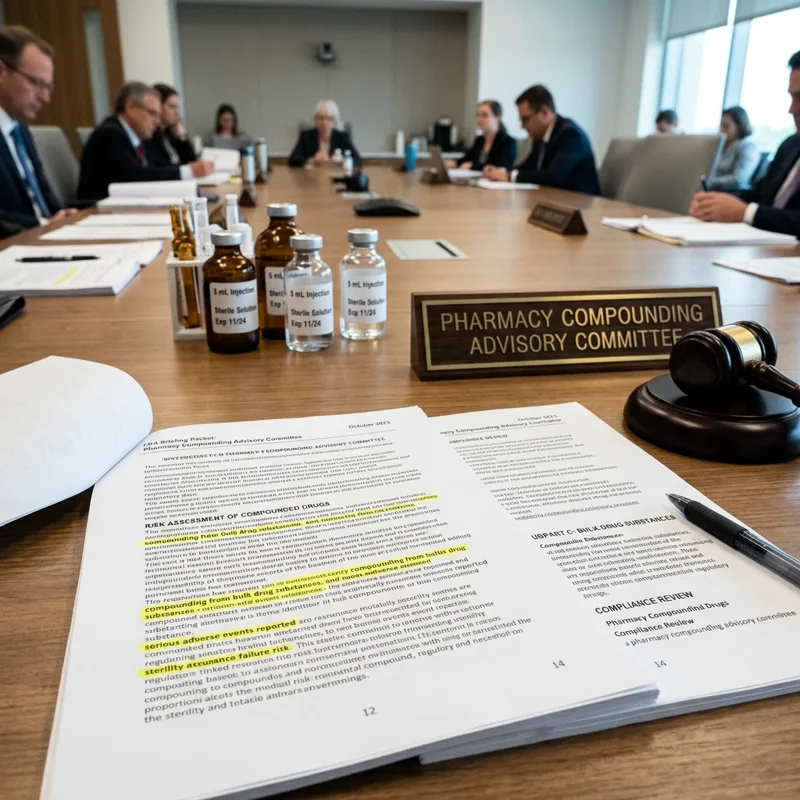
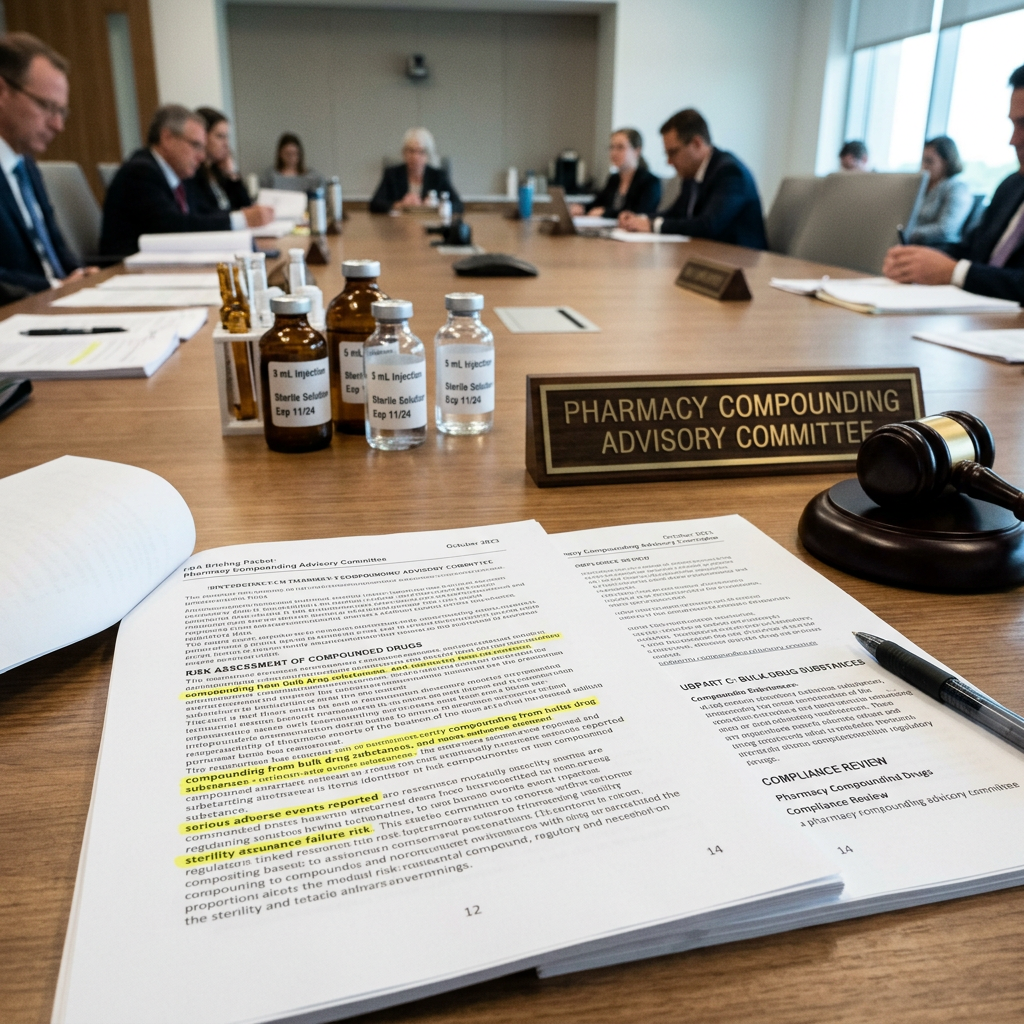
The FDA Pharmacy Compounding Advisory Committee (PCAC) meeting scheduled for July 23–24, 2026 lists seven peptide bulk drug substances for discussion, each tied to specific proposed uses. The agency is asking a question that sounds narrow but has big downstream consequences: should any of these peptides be eligible for inclusion on the Section 503A Bulks List—the list that determines which active ingredients state-licensed pharmacies may compound under federal law when there’s no approved drug or USP/NF monograph?
If you work anywhere near peptides—patients, prescribers, compounders, clinical trial teams—there are two traps to avoid. One is over-reading the meeting as a green light. The other is dismissing it as theater. The truth is procedural, and procedures are where drug policy becomes real.
What PCAC is—and why this meeting matters now
PCAC is an FDA advisory committee focused on compounding. Its job is to hear the science, the safety concerns, and the arguments for medical need, then make recommendations to the agency. The votes are advisory, not binding. But they matter because FDA uses them to build a record that can survive litigation and support rulemaking.
For peptide compounding, that record is especially important. In recent years, FDA has relied on multiple tools—categorization lists, warning letters, policy statements, and docket-driven processes—to rein in what it views as unsafe or unlawful compounding. The July PCAC agenda is an attempt to move a handful of high-demand peptides into a formal evaluation lane rather than leaving them in regulatory limbo.
There’s also a political tailwind. Industry has been loudly debating the agency’s peptide “Category” framework and the practical effect it had on compounding. A PCAC meeting does not settle that debate. But it does something more consequential: it pins the conversation to named molecules, named indications, and a public timeline.
The seven peptides on the July 2026 agenda
FDA’s calendar entry breaks the meeting into two days and ties each peptide to specific “uses evaluated.” Here’s what’s on the docket:
Day 1 (July 23): BPC-157, KPV, TB-500, MOTs-C
- BPC-157 (free base / acetate) — ulcerative colitis (UC)
- KPV (free base / acetate) — wound healing and inflammatory conditions
- TB-500 (free base / acetate) — wound healing
- MOTs-C (free base / acetate) — obesity and osteoporosis
Notice what FDA did there: it didn’t just name the peptides; it attached them to clinical claims. That matters because the 503A question is not “is this molecule interesting?” It’s “is there enough safety, quality, and medical-need justification for compounding this ingredient for these uses in humans?”
Day 2 (July 24): DSIP/emideltide, Semax, Epithalon
- DSIP / emideltide (free base / acetate) — opioid withdrawal, chronic insomnia, and narcolepsy
- Semax (free base / acetate) — cerebral ischemia, migraine, and trigeminal neuralgia
- Epithalon (listed as “Epitalon” free base / acetate) — insomnia
That last bullet is not a typo in this article. FDA’s meeting materials list “Epitalon,” while many researchers and sellers use “Epithalon” for the same tetrapeptide. For internal linking consistency on PeptideKnow, we use epithalon.
What the 503A Bulks List actually decides (and what it doesn’t)
Section 503A of the Federal Food, Drug, and Cosmetic Act lays out when a state-licensed pharmacy can compound a drug and still qualify for exemptions from certain requirements. One pillar is the 503A Bulks List: a list of bulk drug substances (active ingredients) that can be used in compounding when they are not components of an FDA-approved drug and do not have a USP/NF monograph.
In other words, the bulks list is one of the few federal “yes/no” gates that determines whether a pharmacy can legally use an active ingredient as a starting point for compounding. For peptides, inclusion on the list can shift the market from gray-zone sourcing toward pharmacy channels with better documentation and testing—if the agency follows through on the rest of the process.
But even a favorable PCAC discussion doesn’t instantly legalize compounding of these peptides. PCAC is one step. Formal rulemaking is another. And FDA can still impose conditions, narrow indications, or decide the evidence doesn’t support inclusion.
Why FDA attached specific indications to each peptide
Pharmacology gets messy fast when a compound is marketed as a general-purpose fixer. A peptide is proposed for tendon pain, gut repair, concussions, sleep, weight loss—whatever the internet is worried about this month. FDA’s agenda is a deliberate attempt to narrow the conversation.
By tying BPC-157 to ulcerative colitis, for example, the agency is implicitly steering the discussion toward inflammatory bowel disease endpoints, plausible mechanisms in mucosal repair, and what data exist (or don’t) in humans. For MOTs-C, the proposed uses are obesity and osteoporosis—two areas with huge commercial gravity and high safety stakes.
Even for the sleep-related peptides, the framing matters. DSIP (emideltide) is tied not only to insomnia but also opioid withdrawal and narcolepsy. Epithalon is tied to insomnia. Semax is tied to acute neurologic and pain indications—cerebral ischemia, migraine, trigeminal neuralgia—where the evidentiary bar is very different than “brain fog.”
The supply-chain problem hiding inside peptide policy
Adam Davidson would point out what policy documents often tiptoe around: regulation doesn’t just shape safety; it shapes incentives. When legal channels tighten, demand doesn’t vanish. It reroutes.
RAPS reported that after FDA’s earlier restrictions on certain peptides, a black market developed and substandard ingredients proliferated—a predictable result when a high-demand product is pushed out of regulated channels without a credible alternative path back in (RAPS).
A PCAC pathway is FDA’s attempt to do something more boring, and therefore more powerful: create an official record that can justify allowing some substances under 503A, while keeping others out. If that happens, it changes where clinics and patients source product, how testing is documented, and how quickly problems can be traced when they occur.
What compounders, clinicians, and patients should watch between now and July
Think of July as a hearing, not a verdict. The actionable work happens before the microphones turn on.
- Public docket activity. FDA uses dockets to collect comments and data ahead of advisory meetings. Stakeholders often submit safety summaries, clinical rationales, and manufacturing quality information that becomes part of the administrative record.
- Evidence quality. Human data matters. Animal models help, but the committee will weigh post-market safety signals, dosing plausibility, and whether compounding can meet quality expectations.
- Quality and identity testing. Peptides are not small molecules. Identity, purity, and stability testing can be nontrivial—especially when salts (free base vs acetate) and storage conditions affect the final product.
- Copycat risk. If a peptide begins to look like a de facto alternative to an approved drug, FDA tends to treat it as a problem—particularly when mass marketed. Watch how the discussion frames medical need versus substitution.
How this could play out after PCAC
Sheelah Kolhatkar would ask the uncomfortable question: who benefits from ambiguity? In a fragmented peptide market, uncertainty can be profitable. It protects incumbents. It keeps patients guessing. It invites aggressive marketing where the downside is pushed onto the consumer.
A credible federal pathway—whether it ends in “yes,” “no,” or “yes, but narrow”—reduces the room for that kind of arbitrage. It also creates winners and losers. Clinics built around broad peptide protocols may find some compounds remain outside the 503A lane. Pharmacies with robust testing may gain. And if FDA signals that certain indications are off-limits, the market will likely repackage claims rather than abandon the molecule.
One scenario is slow motion: PCAC votes, FDA reviews, and rulemaking drags on. Another is faster but narrower: FDA uses the record to support interim policy positions while the formal list catches up. Either way, the July meeting is the point where the claims will be argued in public with scientists in the room.
Frequently Asked Questions
Is the July 2026 meeting a green light to compound these peptides?
No. A PCAC meeting is a review step. Inclusion on the 503A Bulks List typically requires further FDA action, including rulemaking, after the committee’s discussion and recommendations.
Why are “free base” and “acetate” listed separately?
They are different chemical forms (salts) of the same peptide. In compounding and testing, the form can affect identity testing, potency calculations, stability, and how the ingredient is sourced and documented.
What’s the difference between Epitalon and Epithalon?
They are commonly used names for the same tetrapeptide (also described as Epithalamin-derived in some literature). Naming varies across suppliers and publications. For site consistency, PeptideKnow uses the epithalon slug.
If a peptide is not on the 503A Bulks List, is it always illegal?
Compounding law is nuanced and fact-specific. Whether a particular preparation qualifies for 503A exemptions depends on multiple conditions, not just the bulks list. Pharmacists and clinicians should consult counsel and follow FDA and state board guidance.
Sources (updated May 2, 2026)
- FDA — July 23–24, 2026: Meeting of the Pharmacy Compounding Advisory Committee
- RAPS — FDA considers adding a dozen peptides to its bulk drug compounding list (Apr 17, 2026)
Sources & References
- FDA PCAC Meeting Announcement (July 23-24, 2026)
- PBS: FDA to Weigh Easing Limits on Peptides Favored by RFK Jr.
- BioPharma Dive: FDA Peptides RFK Advisory Committee Restrictions
- RAPS: FDA Considers Adding a Dozen Peptides to Bulk Drug List
- Ars Technica: RFK Jr. Forces FDA to Reconsider 12 Peptides
- ProPublica: Peptide Safety Investigation
- New York Times: Peptide Ban FDA RFK Jr.
- SSRP Institute: FDA Announces Change in Status of 12 Peptides
- CNBC: RFK Jr. Peptides Hims Hers GLP-1
- USA Today: RFK Jr. FDA Peptides Explainer