
What Happened
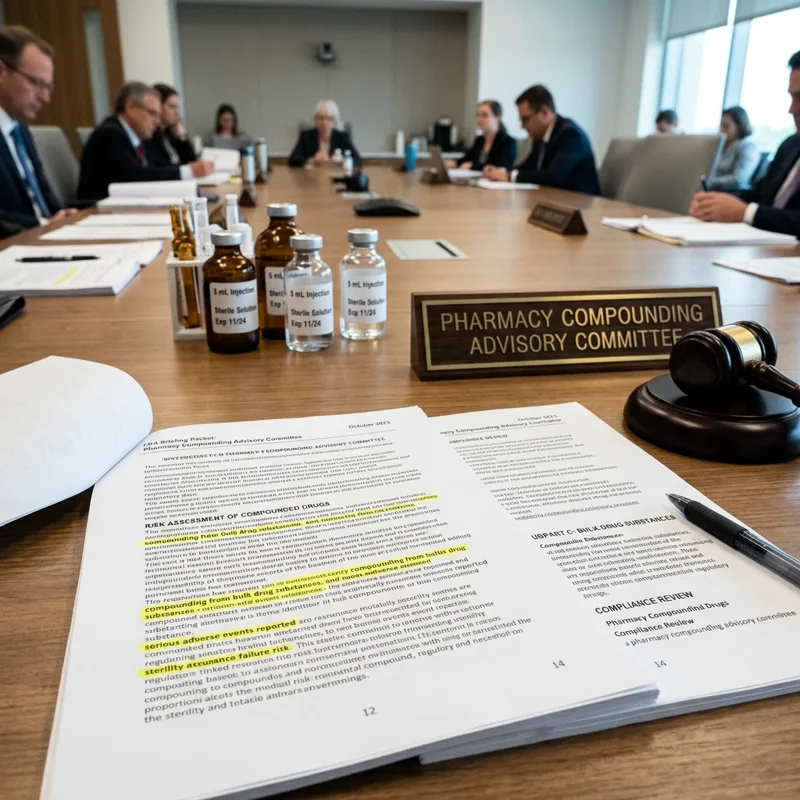
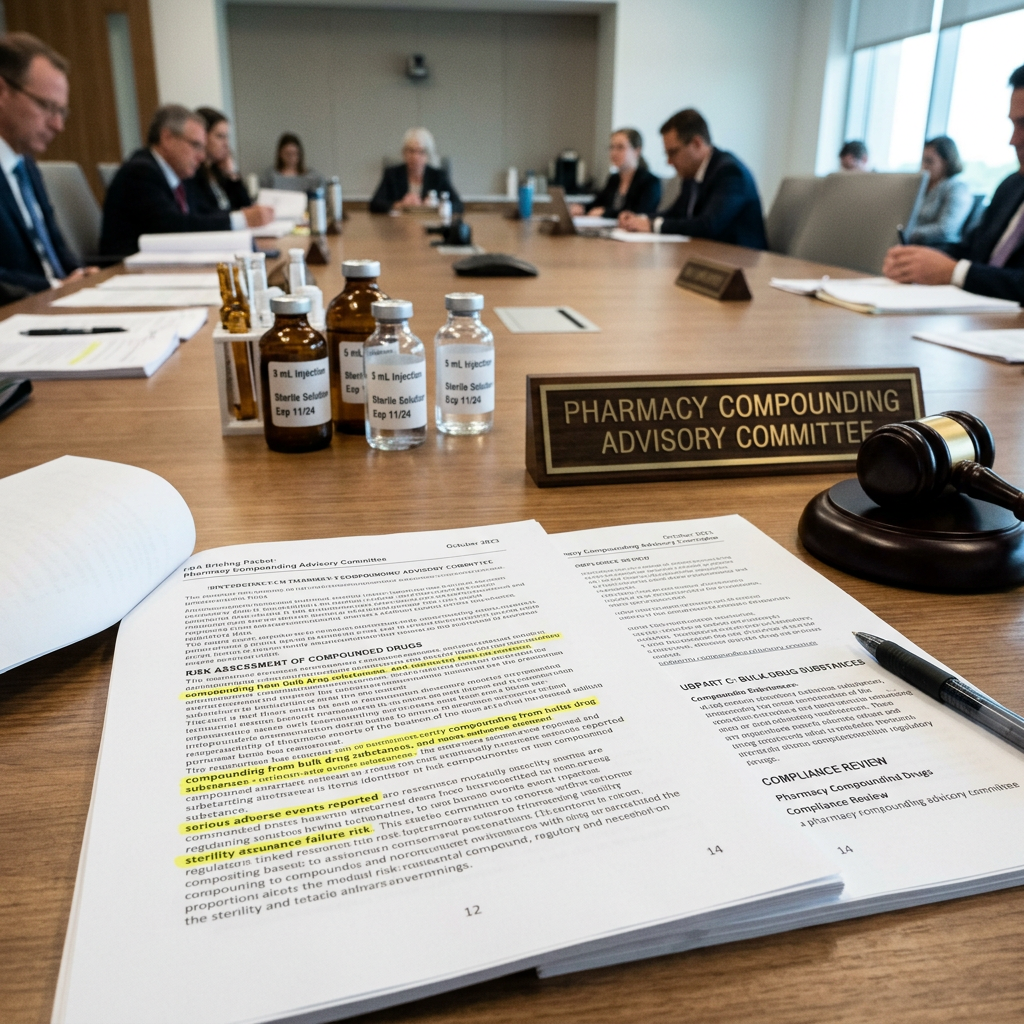
The U.S. Food and Drug Administration's Pharmacy Compounding Advisory Committee will meet for two full days, July 23 and 24, 2026, at the FDA's White Oak campus in Silver Spring, to vote on whether seven peptides should be added to the Section 503A Bulks List — the federal whitelist that determines which active ingredients licensed compounding pharmacies are allowed to source as bulk drug substances. The peptides on the agenda: BPC-157, KPV, TB-500, MOTs-C, Emideltide (the FDA's name for delta sleep-inducing peptide, DSIP), Semax, and Epitalon. None of the seven are currently on the list. None are FDA-approved drug products. The July meeting is the formal advisory step before an FDA decision.
FDA published the agenda on April 15. A separate public docket, FDA-2026-N-2979, is now open for public comments specifically on the meeting itself; the broader peptide-bulks docket, FDA-2025-N-6895, remains open through July 22. Comments received by July 9 will be provided to the committee in advance; comments received between July 9 and July 22 will be reviewed by FDA but not the committee. The two-tier deadline matters for anyone planning to submit substantive comments and expecting them to influence the vote.
The Numbers That Matter
- Meeting: July 23-24, 2026, 8:00 a.m. - 3:50 p.m. ET each day, FDA White Oak Campus, Bldg. 31, Great Room (Rm. 1503), with public webcast.
- Day 1 agenda (July 23): BPC-157 (ulcerative colitis), KPV (wound healing and inflammatory conditions), TB-500 (wound healing), MOTs-C (obesity and osteoporosis).
- Day 2 agenda (July 24): Emideltide / DSIP (opioid withdrawal, chronic insomnia, narcolepsy), Semax (cerebral ischemia, migraine, trigeminal neuralgia), Epitalon (insomnia).
- Two dockets: FDA-2025-N-6895 (peptide bulks list, closes July 22) and FDA-2026-N-2979 (meeting-specific docket).
- Two-tier comment deadline: July 9 (provided to committee), July 22 (final accepted by FDA).
- Vote effect: A "place on list" vote does not by itself add the substance; a "do not place" vote effectively forecloses 503A compounding for that ingredient.
What Is Actually Being Decided
Section 503A of the Federal Food, Drug, and Cosmetic Act sets the rules for traditional compounding pharmacies. A pharmacy operating under 503A can compound a drug product for an individual patient under a valid prescription, but the active ingredients used to make that product have to come from one of three places: a component of an FDA-approved drug, a USP/NF monograph, or a substance on the FDA's "503A Bulks List." For research peptides like BPC-157 or Epitalon, none of which are FDA-approved drugs and none of which have USP monographs, the bulks list is the only legal path into a compounded prescription.
That is what the PCAC is voting on. The committee does not approve the drug for sale. It does not regulate dosage. It makes a recommendation to FDA on whether each substance has, in its words, "a clinical need" that is not addressed by an approved drug, and whether the available evidence on safety, efficacy, and historical use supports listing.
FDA is not bound by the committee's vote. In practice, the agency follows PCAC recommendations the large majority of the time. A "do not place on the list" recommendation is, for compounding purposes, very close to dispositive: pharmacies cannot lawfully source the ingredient as a bulk after FDA finalizes its decision.
Indication-by-Indication: What FDA Said It Would Evaluate
The agenda is unusually specific about which indication each peptide is being considered for. That is the language FDA's reviewers and the committee will be testing the evidence against. Indications and uses outside what is listed will not be considered; "BPC-157 for tendon repair" is not on the docket because the nominators wrote ulcerative colitis.
Day One — July 23
- BPC-157, ulcerative colitis. The peptide entered the popular peptide-therapy conversation through animal models of musculoskeletal repair. The nomination on the table at PCAC is for inflammatory bowel disease — specifically ulcerative colitis — which is supported by rodent models but not by published controlled human trials.
- KPV, wound healing and inflammatory conditions. A tripeptide fragment of alpha-MSH, evaluated in topical formulations for atopic dermatitis and inflammatory bowel disease in animal and small human studies.
- TB-500, wound healing. A synthetic fragment of thymosin beta-4. Most published human research on the related full-length compound is in dry eye disease (under FDA-approved RGN-259 development), not on the TB-500 fragment per se.
- MOTs-C, obesity and osteoporosis. A 16-amino-acid mitochondrial-derived peptide. Mechanistic literature is broad; controlled human therapeutic trials in either listed indication are limited.
Day Two — July 24
- Emideltide / DSIP, opioid withdrawal, chronic insomnia, narcolepsy. Delta sleep-inducing peptide has been studied since the 1970s. The FDA has assigned the name "Emideltide" in agency documents; the underlying substance is the same nine-amino-acid peptide.
- Semax, cerebral ischemia, migraine, trigeminal neuralgia. A heptapeptide fragment of ACTH(4-10), used clinically in Russia for stroke and cognitive indications. U.S. research is limited.
- Epitalon, insomnia. The four-amino-acid pineal peptide is most associated in the popular literature with longevity claims; the indication PCAC is being asked to consider is narrower — insomnia.
The mismatch between the indications popularly associated with these peptides and the indications on the FDA agenda is one of the most consequential features of this meeting. Nominators select the indication; the committee evaluates the evidence for the indication selected. A peptide can fail PCAC review on its agenda indication and still be a different conversation in research labs.
Why It Matters
For 503A compounding pharmacies, the July meeting is a binary event. If a peptide goes on the list, sourcing it as a bulk and dispensing compounded prescriptions is, at minimum, federally tolerated; payers, insurers, and state boards can still apply additional restrictions. If a peptide is voted off, every legitimate compounding pharmacy in the United States loses a legal sourcing path within months of FDA's decision.
For patients on prescriptions of the seven peptides, the practical effect of a "no" vote is that their compounding pharmacy will, in most cases, stop making the product. Some prescribers will switch to FDA-approved alternatives where alternatives exist. For most of these compounds, including BPC-157 and Epitalon, no FDA-approved alternative exists.
For the broader peptide therapeutics field, the July agenda is the most consequential PCAC meeting in years. Seven peptides in two days, all evaluated against discrete indications, all with the FDA's clinical-need analysis already in the briefing materials. The agency has been signaling for a decade that it intends to formalize its position on bulk peptides; the July vote is the formalization.
How The Comment Process Works (And The Two Dockets)
Two dockets are open and they do different things.
FDA-2025-N-6895 is the broader bulks-list docket, opened in 2025, on which the FDA solicited input on the seven peptides as candidates. That docket closes July 22, 2026. Comments here go into the FDA's general administrative record on the substance.
FDA-2026-N-2979 is the meeting-specific docket, opened on April 15 alongside the agenda. Its purpose is the committee meeting itself: comments here are routed to the panelists. July 9, 2026 is the cutoff for the committee to receive a comment in its briefing book.
The substantive distinction matters. A patient testimony, a clinician's case-series summary, or a researcher's data note submitted to FDA-2026-N-2979 by July 9 lands in front of the committee before the vote. The same comment submitted on July 21, even though it makes the bulks-list docket on time, will be read by FDA staff but not by the panelists who actually vote. PeptideKnow's earlier coverage of the FDA-2025-N-6895 docket goes deeper on what kinds of submissions historically influence PCAC outcomes.
Caveats Worth Naming
Three points are worth flagging about how this meeting will likely play out and how to read the result.
First, PCAC votes are recommendations, not rulings. FDA's final decision usually follows by months, sometimes by years. A vote on July 23 or 24 will not change anyone's prescription on July 25.
Second, FDA evaluates each peptide against the specific indication the nominator submitted. The published briefing memos for prior PCAC peptide reviews have read as conservative on clinical-need findings: if there is a plausible FDA-approved alternative for the named indication — mesalamine for ulcerative colitis, for instance — the agency tends to find that the bulks-list path is unnecessary, regardless of whether the alternative is what compounding patients actually want.
Third, an unfavorable PCAC recommendation does not prohibit research. Investigators with valid Investigational New Drug applications or who source peptides under research-use-only labels through licensed suppliers are not affected by the bulks-list decision. The decision is specifically about 503A compounded prescriptions for patients.
How It Fits This Quarter
The July meeting closes the loop on a year of regulatory activity around peptide compounding. The Apr 22 effective date for FDA's removal of 12 peptides from 503A Category 2 was the preceding step. The PCAC vote on the seven nominated peptides is the next. The full sequence will likely be: April removal of unsupported substances, July advisory committee vote on the seven, FDA final decision later this year or in early 2027, federal register publication of the updated 503A Bulks List, and state board guidance to follow. The window for substantive evidence to enter the record closes on July 9.
Tirzepatide and the other GLP-1-class agents are not on this agenda. They are FDA-approved drug products and therefore outside the bulks-list framework. PeptideKnow's recent coverage of the post-PCI and post-TAVR cardiovascular data and the SURMOUNT-5 cost-effectiveness model sits on the regulated end of the peptide map; the PCAC meeting sits on the unregulated end.
Frequently Asked Questions
Will the seven peptides be banned if the committee votes "no"?
Not banned in a research sense. A "do not place on the list" recommendation, if FDA accepts it, removes the legal sourcing path for licensed 503A compounding pharmacies. Possession, research use, and use under a valid Investigational New Drug application are governed by other parts of the FD&C Act and are not changed by a bulks-list decision.
Why is FDA evaluating BPC-157 against ulcerative colitis when most BPC-157 use is for tendon and tissue repair?
Because that is the indication the nominator submitted. PCAC reviews the evidence for the indication on the docket. The choice of indication shapes what evidence the committee is allowed to weigh.
What is the difference between the two dockets?
FDA-2025-N-6895 is the bulks-list docket, broader and longer-running. It closes July 22. FDA-2026-N-2979 is the meeting-specific docket, opened April 15. Comments to FDA-2026-N-2979 received by July 9 are placed in the committee's briefing book.
Can I attend the meeting?
Yes. The meeting is held at FDA's White Oak campus and is open to the public both in person and via webcast. Public comments during the meeting require advance registration; the FDA event page lists the procedure.
Where can I read FDA's briefing materials?
FDA publishes briefing materials in the "Event Materials" section of its meeting page no later than two business days before the meeting. The materials typically include the agency's clinical-need analysis, summaries of nominated indications, and reference lists of the literature reviewed.
How does this affect my prescription if I am taking a compounded peptide?
It does not affect any current prescription directly. If a peptide is voted off the list and FDA finalizes that decision, the compounding pharmacy filling that prescription will, after FDA's effective date, no longer be able to source it as a bulk. Your prescriber will need to work with you on alternatives at that point.
Sources
- FDA. July 23-24, 2026: Meeting of the Pharmacy Compounding Advisory Committee. FDA Advisory Committee Calendar (announced April 15, 2026).
- FDA. Bulk Drug Substances Nominated for Use in Compounding Under Section 503A of the Federal Food, Drug, and Cosmetic Act (PDF).
- FDA. About the Pharmacy Compounding Advisory Committee.
- FDA Docket FDA-2025-N-6895 (Peptides nominated for the 503A Bulks List). Closes July 22, 2026.
- FDA. Section 503A and 503B Overview.
- 21 U.S.C. § 353a (Section 503A of the Federal Food, Drug, and Cosmetic Act).
Sources & References
- FDA PCAC Meeting Announcement (July 23-24, 2026)
- PBS: FDA to Weigh Easing Limits on Peptides Favored by RFK Jr.
- BioPharma Dive: FDA Peptides RFK Advisory Committee Restrictions
- RAPS: FDA Considers Adding a Dozen Peptides to Bulk Drug List
- Ars Technica: RFK Jr. Forces FDA to Reconsider 12 Peptides
- ProPublica: Peptide Safety Investigation
- New York Times: Peptide Ban FDA RFK Jr.
- SSRP Institute: FDA Announces Change in Status of 12 Peptides
- CNBC: RFK Jr. Peptides Hims Hers GLP-1
- USA Today: RFK Jr. FDA Peptides Explainer