
What Happened
A peer-reviewed economic evaluation published online April 21, 2026 in the Journal of Medical Economics built a lifetime simulation of every dollar and every quality-adjusted life year spent on adults with obesity in the United States who start either tirzepatide or semaglutide for weight management. The model was anchored on the head-to-head SURMOUNT-5 phase-3 trial. It found that tirzepatide was projected to save $41,688 per patient over a lifetime, deliver 0.506 additional QALYs, and reduce projected diabetes and cardiovascular events — results that arrived in the same week the FDA's procedural Category 2 removal of 12 compounded peptides took formal effect (Johansson et al., J Med Econ 2026).
The conclusion is narrow and worth stating plainly. The paper does not say tirzepatide is cheaper at the pharmacy counter. It says that, run forward across a modeled lifetime under U.S. list prices, the higher up-front spend on tirzepatide is more than offset by the chronic disease it appears to prevent.
The Numbers That Matter
- $41,688 lower lifetime cost per patient with tirzepatide versus semaglutide, from a U.S. societal perspective including both healthcare and lost-productivity costs.
- 0.506 QALYs gained, with a positive incremental net health benefit of 0.784.
- 70 fewer cases of type 2 diabetes and 10 fewer cases of cardiovascular disease per 1,000 patients treated.
- 87.5% vs 76.88% normoglycemia at 72 weeks, modeled from SURMOUNT-5.
- 3.07 fewer years spent living with moderate or severe obstructive sleep apnea.
- Five fewer days of reduced productivity per year (absenteeism plus presenteeism).
- SURMOUNT-5 anchor: a 751-patient open-label phase-3b trial in adults with obesity but without type 2 diabetes; 72-week weight loss was -20.2% with tirzepatide, -13.7% with semaglutide (Aronne et al., NEJM 2025).
What Was Actually Modeled
The investigators built a patient-level simulation. Real participants from SURMOUNT-5 were used to seed the starting cardiometabolic profile — age, sex, BMI, HbA1c, systolic blood pressure, lipids — and the model then projected each patient forward over a lifetime, tracking the probability of developing type 2 diabetes, cardiovascular disease, MASLD, and obstructive sleep apnea as their weight, blood pressure, cholesterol, and glycemia evolved on each drug.
Costs were tallied from a U.S. societal perspective. That means more than just the prescription. It includes inpatient and outpatient care, complications of obesity, and indirect costs from lost work productivity. The base case used publicly available U.S. list prices; a sensitivity scenario tested net prices. Tirzepatide remained either cost-saving or highly cost-effective across every sensitivity arm.
One detail worth pausing on: list prices for both drugs in the United States run roughly $1,000 to $1,300 per month before rebates, insurance, or manufacturer coupons. Tirzepatide's list price is similar to or slightly higher than semaglutide's. The model is not finding savings because tirzepatide costs less. It is finding savings because, in the model, more weight comes off, more diabetes does not happen, fewer hearts fail, and fewer years are spent in apnea masks — and those are all expensive things to treat.
Why the Trial Numbers Translate
The paper does not stand on its own. Its credibility is borrowed from the trial it is built on. SURMOUNT-5 was the first head-to-head phase-3 trial of tirzepatide versus semaglutide for obesity, published in the New England Journal of Medicine in May 2025 after Lilly released topline numbers in late 2024.
The trial randomized 751 adults with obesity but without type 2 diabetes, 1:1, to maximum-tolerated weekly doses of tirzepatide (10 mg or 15 mg) or semaglutide (1.7 mg or 2.4 mg) for 72 weeks. The least-squares mean weight change was -20.2% with tirzepatide and -13.7% with semaglutide, P<0.001 for the primary endpoint and every key secondary endpoint. About 31.6% of tirzepatide patients lost at least 25% of their body weight; only 16.1% of semaglutide patients did. Adverse events were predominantly gastrointestinal in both arms, mostly mild to moderate, mostly during dose escalation. That is the trial population the new economic model rebuilt and pushed forward in time.
That trial was, in the language regulators use, methodologically clean. Open-label, yes — you cannot blind a self-injection of one drug versus another at different doses — but randomized, large enough to detect a real difference, and the difference was large. A 6.5-percentage-point gap in weight loss, sustained at 72 weeks, is not a noise-level signal. It is a different drug.
What This Changes for Payers and Prescribers
For a U.S. payer reading this paper this week, three questions matter: which drug to prefer on formulary, how aggressively to encourage tirzepatide as first-line, and whether the QALY case clears the threshold most plans use to call something cost-effective.
Most U.S. payer evaluations consider an intervention cost-effective at incremental cost-effectiveness ratios under $100,000 to $150,000 per QALY. The Johansson model does not produce a positive ICER at all. Tirzepatide is dominant: more QALYs and lower costs. That is the rare quadrant where standard willingness-to-pay analysis loses its grip, because there is no ratio to compute when both axes favor one option. From a strict modeling standpoint, the case to prefer tirzepatide for the population SURMOUNT-5 enrolled — obese or overweight adults without diabetes — just got harder to argue against.
Whether U.S. payers act on it is a separate question. Formulary decisions involve rebates, contracts with manufacturers, prior authorization workflows, and political pressure from employers absorbing premium increases. Models do not negotiate. Models also do not account for the fact that tirzepatide demand still occasionally outstrips supply, even after the FDA declared the U.S. shortage resolved in early 2025.
Caveats Worth Naming
A patient-level simulation is only as good as its inputs. SURMOUNT-5 was 72 weeks. The model projects across decades. Patients who stop the drug were modeled; adherence to GLP-1-class therapy outside trials remains poor, with many patients off therapy within a year of starting. The paper handled this with sensitivity analyses, and tirzepatide stayed favorable, but the further out a model runs the more its assumptions matter.
Several other cautions belong on the page. The trial population was U.S. and predominantly female; the economic model used U.S. cost inputs and societal-perspective indirect costs; the comparator dose was the maximum-tolerated dose of each drug, which not every patient reaches. Lilly funded SURMOUNT-5. The economic paper's authorship list includes researchers affiliated with both academic groups and pharmaceutical-industry consulting, and the journal's disclosures should be read alongside the abstract.
None of that invalidates the result. It locates it. Run the same comparison in a country with single-payer pricing and rebate structures already baked into the list cost, or in a population that includes type 2 diabetes patients (where semaglutide has its own large CVOT data set), and the numbers move. That is how health economics works. The contribution of this paper is to set the U.S. obesity-without-T2D anchor.
How It Fits with the Rest of This Week
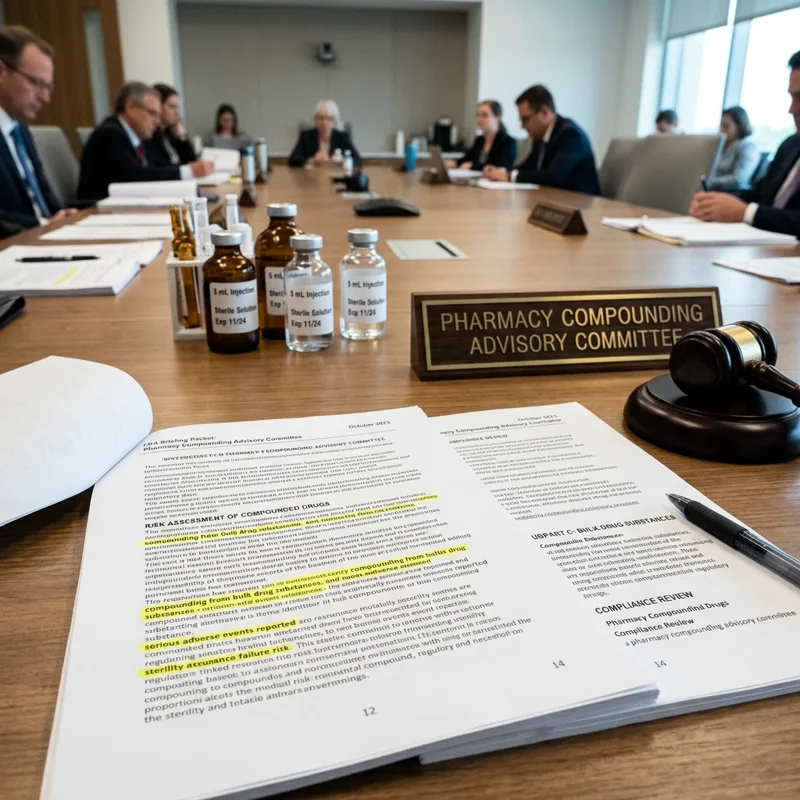
The economics paper landed in a week with two other peptide stories already in motion. The FDA's procedural removal of 12 peptides from Category 2 took effect April 22, the same day this paper hit the Journal of Medical Economics website. The agency's Pharmacy Compounding Advisory Committee docket remains open through July 22. None of the 12 peptides on that compounding docket are GLP-1-class drugs, and SURMOUNT-5 is irrelevant to whether BPC-157 or KPV ever clear PCAC.
But the broader policy current is the same: the regulatory and reimbursement landscape for peptide therapeutics is consolidating. On the high end, FDA-approved branded GLP-1s with phase-3 head-to-head data and lifetime cost-effectiveness modeling. On the regulated-but-unsettled middle, compounded peptides whose status is being relitigated. On the bottom, gray-market research-only product with no oversight. The Johansson paper is a data point in the first tier and only the first tier — but it sets the standard of evidence the rest of the field will increasingly be measured against.
Frequently Asked Questions
Does this paper say tirzepatide is cheaper at the pharmacy?
No. List prices for tirzepatide and semaglutide in the United States are similar, with tirzepatide often slightly higher per month before rebates. The model finds that tirzepatide saves $41,688 per patient over a lifetime by preventing downstream conditions — type 2 diabetes, cardiovascular disease, complications of obstructive sleep apnea — that are themselves expensive to treat. The savings are modeled, lifetime, and societal-perspective, not pharmacy-counter savings.
Was this an industry-funded study?
The economic model was conducted by authors affiliated with academic and consulting groups, with disclosures available in the published paper. SURMOUNT-5, the underlying clinical trial, was funded by Eli Lilly, the manufacturer of tirzepatide. Industry funding does not invalidate trial results, which were peer-reviewed in the New England Journal of Medicine and showed standard, pre-specified endpoints. Readers should still read the disclosures.
Does this apply to people with type 2 diabetes?
Not directly. SURMOUNT-5 specifically excluded patients with type 2 diabetes. The economic model is specific to obesity-without-T2D in the U.S. setting. Semaglutide has its own large cardiovascular outcomes trial, SELECT, and is approved for cardiovascular risk reduction in adults with obesity. Comparing the two drugs in patients with established T2D would require different trial data — and tirzepatide has separate phase-3 evidence in that population through the SURPASS program.
What about retatrutide?
Retatrutide is the next compound in line. Lilly's triple-agonist retatrutide reported a 28.7% mean weight reduction at 68 weeks in TRIUMPH-4, the first phase-3 readout in the program, in late 2025. Additional phase-3 readouts are expected through 2026. Retatrutide is investigational; it is not yet approved or available outside trials, so cost-effectiveness modeling is premature.
Does this affect compounded versions of semaglutide or tirzepatide?
The FDA declared the U.S. shortage of both compounds resolved in 2025, which formally ended the legal pathway for 503A pharmacies to compound them under shortage-based exemptions. Compounded GLP-1s remain available in some narrow individual-prescription contexts, but the broader compounded-shortage market for these specific drugs has closed. The Johansson paper analyzes branded products at U.S. list prices.
Where can I read the original paper?
The full citation is Johansson E, Wilding JPH, Upadhyay N, et al. Cost-effectiveness of tirzepatide versus semaglutide for patients with obesity or overweight in the US: evidence from the SURMOUNT-5 head-to-head phase-3 trial. J Med Econ. 2026;29(1):1258-1278. doi:10.1080/13696998.2026.2646078. PubMed indexing under PMID 42012820.
Sources
- Johansson E, Wilding JPH, Upadhyay N, van Hest N, Kirk M, Spaepen E, Zimner-Rapuch S, Annemans L, Bays H. Cost-effectiveness of tirzepatide versus semaglutide for patients with obesity or overweight in the US: evidence from the SURMOUNT-5 head-to-head phase-3 trial. Journal of Medical Economics. 2026;29(1):1258-1278. doi:10.1080/13696998.2026.2646078. Epub April 21, 2026. PubMed.
- Aronne LJ, Horn DB, le Roux CW, et al. Tirzepatide as Compared with Semaglutide for the Treatment of Obesity. New England Journal of Medicine. 2025 Jul 3;393(1):26-36. doi:10.1056/NEJMoa2416394. SURMOUNT-5 ClinicalTrials.gov NCT05822830. PubMed.
- News-Medical coverage of Johansson et al. (April 22, 2026). Tirzepatide vs. semaglutide: Study compares cost and health outcomes in obesity.
- Eli Lilly press release on SURMOUNT-5 topline results, December 4, 2024. TCTMD coverage.
- U.S. Food and Drug Administration. Bulk Drug Substances Nominated for Use in Compounding Under Section 503A; Category Update Effective April 22, 2026. FDA.
Sources & References
- FDA PCAC Meeting Announcement (July 23-24, 2026)
- PBS: FDA to Weigh Easing Limits on Peptides Favored by RFK Jr.
- BioPharma Dive: FDA Peptides RFK Advisory Committee Restrictions
- RAPS: FDA Considers Adding a Dozen Peptides to Bulk Drug List
- Ars Technica: RFK Jr. Forces FDA to Reconsider 12 Peptides
- ProPublica: Peptide Safety Investigation
- New York Times: Peptide Ban FDA RFK Jr.
- SSRP Institute: FDA Announces Change in Status of 12 Peptides
- CNBC: RFK Jr. Peptides Hims Hers GLP-1
- USA Today: RFK Jr. FDA Peptides Explainer