
May 29 brought a familiar kind of peptide headline: a company press release promising a needle-free delivery breakthrough for molecules that, in practice, are still mostly injected. Mountain Valley MD says its Quicksome™ platform can be used to formulate multiple high-interest peptides into a rapid-dissolve sublingual tablet, naming BPC-157, GHK-Cu, KPV, SNAP-8, and retatrutide. (Business Wire)
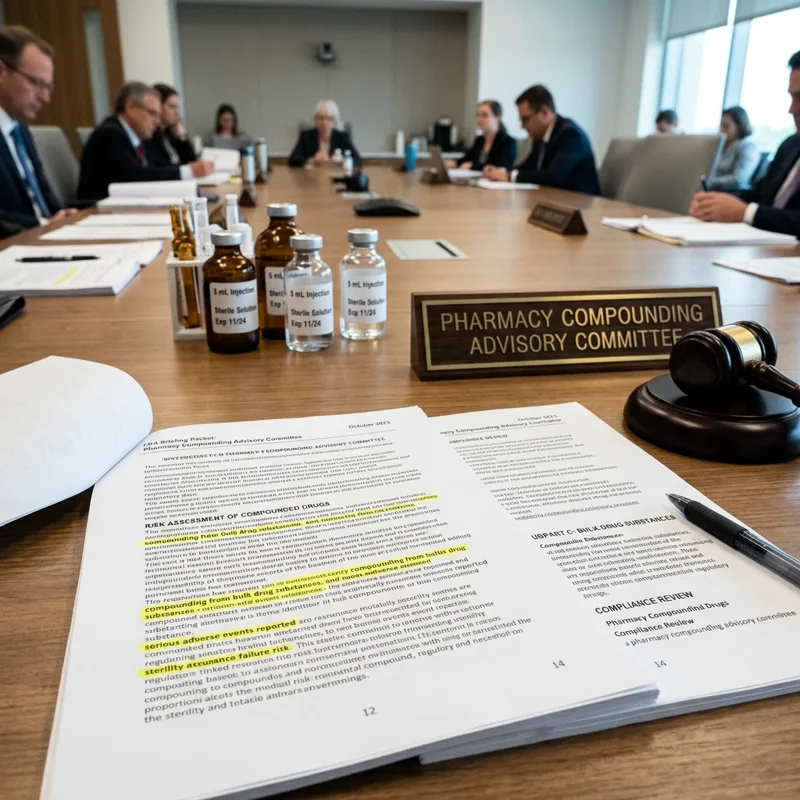
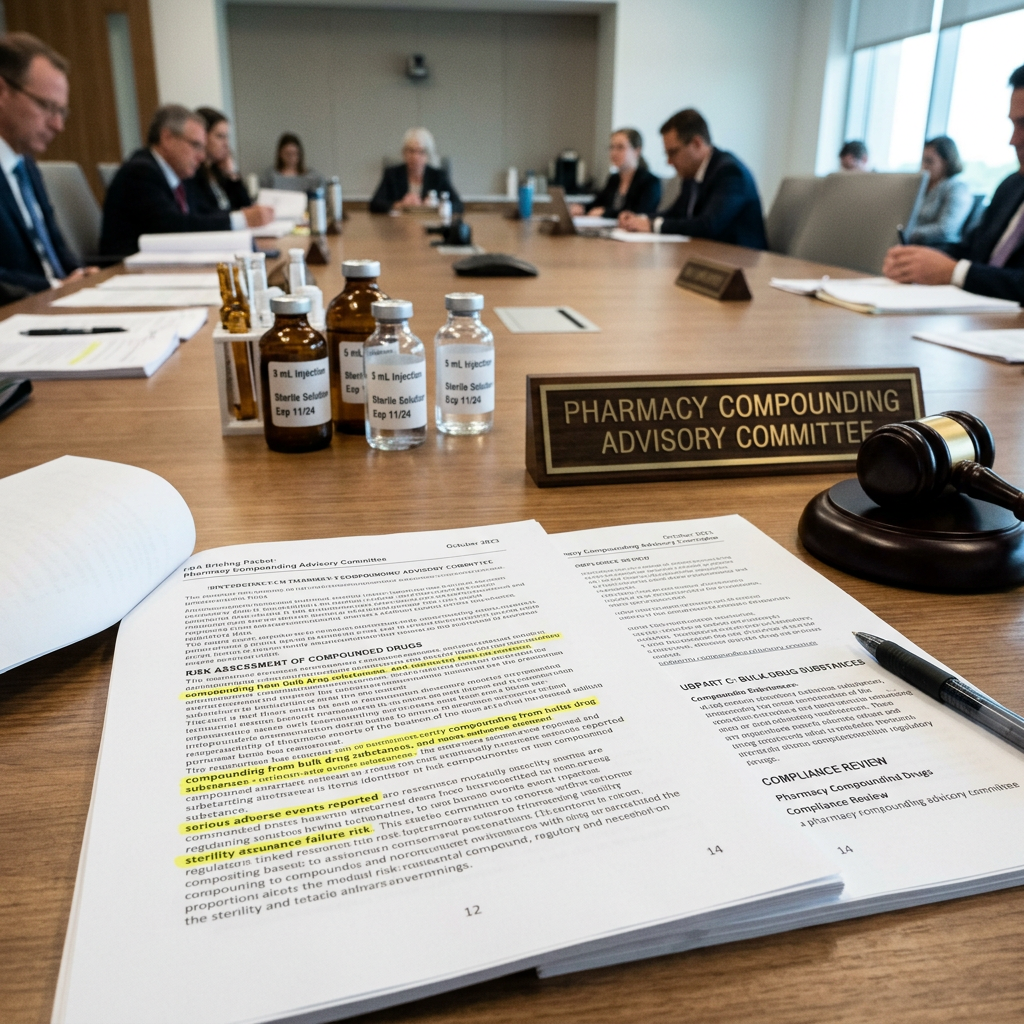
On its own, that’s marketing. But the timing matters: the same release points to the FDA’s upcoming Pharmacy Compounding Advisory Committee (PCAC) meeting, scheduled for July 23–24, 2026, where seven peptides are slated for review for possible inclusion on the 503A Bulk Drug Substances List. Those include BPC-157, TB-500, KPV, MOTS-c, Emideltide, Semax, and Epitalon. (Business Wire)
That convergence—delivery hype meeting a regulatory chokepoint—is the actual story. If the PCAC process eventually expands what can be compounded under 503A, demand will rise for formulations that look and feel like conventional meds. If the list stays narrow, the market keeps routing around injection aversion with gray-area products. Either way, “sublingual peptide” claims are about to collide with scrutiny.
What Quicksome says it can do (and what it doesn’t show)
Mountain Valley MD describes Quicksome as a rapid-dissolve tablet that sits under the tongue, aiming to avoid stomach acid and digestive enzymes that break down peptide chains. Sublingual absorption can, in principle, route some molecules into systemic circulation without going through the gastrointestinal tract first. (Business Wire)
The company says it has completed “initial” formulation work across several peptides in the compounding channel and is finalizing dosing for some programs. It also cites older vaccine stability work (a trivalent inactivated poliovirus vaccine exposed to high heat) as evidence the platform can help stabilize sensitive biologics outside cold-chain conditions. (Business Wire)
None of that is the same as showing human pharmacokinetics.
The missing piece: bioavailability data in people
For sublingual delivery, the core questions are blunt:
- Does the intact peptide reach measurable blood levels? (Not just metabolites.)
- How consistent is absorption? Sublingual uptake varies with saliva flow, oral pH, and how long a tablet stays in place.
- Does the delivered exposure match an injectable comparator? Without an AUC/Cmax bridge, dosing talk is mostly theater.
Quicksome’s release doesn’t provide PK curves, assay methods, or independent replication. It positions the platform as a licensing-and-partnership play, not a traditional drug-development program. That’s a legitimate business strategy, but it also means readers should treat efficacy claims as unproven until human data exist. (Business Wire)
Why compounded peptides are the battleground
The press release is explicit about its target: compounded peptides. It name-checks the molecules that dominate online demand—repair and “wellness” peptides like BPC-157 and cosmetic peptides like GHK-Cu—and it also reaches for the crown jewel of the moment: next-generation GLP-class obesity drugs, including retatrutide, which remains an investigational product in Phase 3. (Business Wire)
That choice is telling. Compounding is where patient preference (no needles) meets regulatory friction (what can legally be compounded, and under what conditions). It’s also where dosage forms become a compliance tool: a product that looks like a conventional tablet can feel, to consumers, like an approved medicine even when it isn’t.
Category 1 vs. Category 2: the distinction people talk past
The release describes a re-evaluation path: it says HHS Secretary Robert F. Kennedy Jr. publicly suggested that roughly 14 peptides on the FDA’s Category 2 Bulk Drug Substances List could be considered for a return to Category 1, and it cites the FDA’s confirmation of a PCAC meeting in late July 2026 to review specific peptides. (Business Wire)
Translated into plain language: it’s about whether certain bulk substances can be used by 503A pharmacies to compound prescriptions. A positive PCAC recommendation, the company notes, triggers formal rulemaking—slow, public, and not guaranteed. (Business Wire)
What the July 2026 PCAC review covers (per the company’s cited list)
According to Mountain Valley MD’s summary of the FDA’s scheduled agenda, the July 23–24, 2026 PCAC meeting will review seven peptides for possible inclusion on the 503A Bulk Drug Substances List:
The release also mentions a second meeting anticipated before February 2027 to review additional peptides, including GHK-Cu, Melanotan II, cathelicidin, dihexa acetate, and PEG-MGF. (Business Wire)
Important: this is a company’s characterization of what’s on deck. For the actual docket materials, readers should check the FDA’s public meeting announcements and supporting documents when posted. The FDA maintains a public registry of bulk drug substances that have been nominated for use in 503A compounding, broken into Category 1 (under evaluation, may continue to be used pending a final determination), Category 2 (raised significant safety risks), and Category 3 (already evaluated, will not be included). The current 503A bulks list and PCAC meeting materials are published by the agency on its compounding pages. (FDA)
For most of the substances on the July 23–24 agenda, the binding question is the same one PCAC has wrestled with since 2015: is there a clinical need for the compounded form, and does the available physical and chemical characterization support quality manufacturing? A vote in favor of inclusion is a recommendation, not a rule. The agency has historically declined to add substances PCAC voted to add (and vice versa) when its own review of safety data pointed elsewhere. (FDA — PCAC)
Where sublingual delivery intersects with FDA scrutiny
Even if a peptide ends up eligible for compounding, dosage form and quality still matter. Sublingual products add their own failure modes: content uniformity, dissolution time, saliva-driven variability, and stability under ambient storage. And for peptides that are typically refrigerated, “stable at room temperature” is a claim that lives or dies on degradation data, not on a press release.
Quicksome tries to bridge that gap by pointing to its prior temperature-stability work in a vaccine context, suggesting the platform could help stabilize heat-sensitive molecules outside a cold chain. (Business Wire)
But peptides are not all the same, and the stabilizers that work for one biological product don’t automatically transfer to another. The “end of the needle” story depends on measurements: stability assays, impurity profiles, and human PK.
The gray-zone risk: consumer interpretation outpacing evidence
Compounded products sit in a weird space in the public imagination. Many people assume “pharmacy-made” means “FDA-approved.” It doesn’t. A July PCAC meeting can tighten or loosen the legal pathway for specific substances, but it doesn’t turn them into approved drugs.
If sublingual compounded peptides expand, clinics and pharmacies will face pressure to explain the difference between:
- an FDA-approved peptide drug (with trials, labeling, and post-market monitoring),
- a compounded preparation (patient-specific, legal under certain conditions, but not approved in the same way), and
- a “research use only” product sold to consumers (a different risk category entirely).
What to watch next (practical signals, not vibes)
Between now and late July, three things will matter more than any headline:
- PCAC briefing materials: Which peptides are actually on the agenda, and what safety/efficacy arguments are presented for and against compounding eligibility?
- Human PK disclosure: Any sublingual platform that wants to be taken seriously will eventually show plasma exposure data vs. injections for at least one peptide.
- Quality language: Look for specifics—assay methods, degradation products, storage conditions—not vague “stability” claims.
In the press release, Mountain Valley MD frames its role as a delivery platform rather than a drug developer and emphasizes that it does not own the peptides it mentions. (Business Wire)
That’s a clean disclosure. It’s also a reminder: if you see a sublingual compounded peptide product tomorrow, the burden is on the seller to show what’s in it, how it behaves, and what it does in humans.
Why this matters now
The compounded peptide market in the United States grew faster than almost anyone forecasted between 2023 and 2025, mostly on the back of GLP-1 weight-loss demand and a parallel boom in repair and longevity peptides ordered through telehealth clinics. State medical boards have responded unevenly. Alabama’s Board of Medical Examiners issued an explicit warning earlier this month against prescribing or administering research-grade peptides outside FDA-cleared channels. Other states have not. The PCAC review is the first national-level checkpoint where the question of which peptides can legitimately enter a compounded prescription will be argued in public on the record.
For sublingual platforms, that creates two distinct paths. If a peptide ends up on the 503A bulk list, a compelling sublingual formulation with PK data could become the preferred dosage form for that molecule and capture meaningful share. If a peptide stays on Category 2 or moves there, no amount of formulation work makes it legal for human compounding in the United States; it can only be sold abroad or as a research chemical, which is a much smaller and more legally fraught market.
Safety note
PeptideKnow is a reference site. Nothing here is medical advice. Many peptides discussed in the compounding and “wellness” space are not FDA-approved for the uses people promote online. If you’re considering any peptide product, talk with a licensed clinician and use a pharmacy operating within applicable compounding rules.
Frequently Asked Questions
Do sublingual peptides work?
Some molecules can be absorbed through oral mucosa, but peptides tend to be large and fragile. For any specific peptide, the right question is whether human pharmacokinetic data show meaningful blood levels after sublingual dosing—and how that compares to injections. A delivery claim without PK data is incomplete.
What is the FDA’s PCAC meeting and why does it matter for peptides?
The Pharmacy Compounding Advisory Committee advises the FDA on issues related to compounding, including whether specific bulk substances should be eligible for use by 503A compounding pharmacies. The company press release says the FDA confirmed a July 23–24, 2026 PCAC meeting where seven peptides will be reviewed for potential inclusion on the 503A Bulk Drug Substances List. (Business Wire)
If a peptide is reviewed, does that mean it becomes legal and FDA-approved?
No. Review is not approval. Even a positive recommendation can trigger a rulemaking process, and a compounded preparation is not the same as an FDA-approved drug with a full label and clinical-trial package.
Why is retatrutide showing up in compounding discussions?
Retatrutide is a next-generation GLP-class obesity drug in Phase 3 trials. It is watched closely and is often mentioned in market commentary because of the demand for weight-loss peptides. In the Quicksome release, it’s cited as an example peptide the company tested for formulation applicability, while noting the company does not own GLP-class molecules. (Business Wire)
Sources (accessed May 30, 2026)
Sources & References
- FDA PCAC Meeting Announcement (July 23-24, 2026)
- PBS: FDA to Weigh Easing Limits on Peptides Favored by RFK Jr.
- BioPharma Dive: FDA Peptides RFK Advisory Committee Restrictions
- RAPS: FDA Considers Adding a Dozen Peptides to Bulk Drug List
- Ars Technica: RFK Jr. Forces FDA to Reconsider 12 Peptides
- ProPublica: Peptide Safety Investigation
- New York Times: Peptide Ban FDA RFK Jr.
- SSRP Institute: FDA Announces Change in Status of 12 Peptides
- CNBC: RFK Jr. Peptides Hims Hers GLP-1
- USA Today: RFK Jr. FDA Peptides Explainer