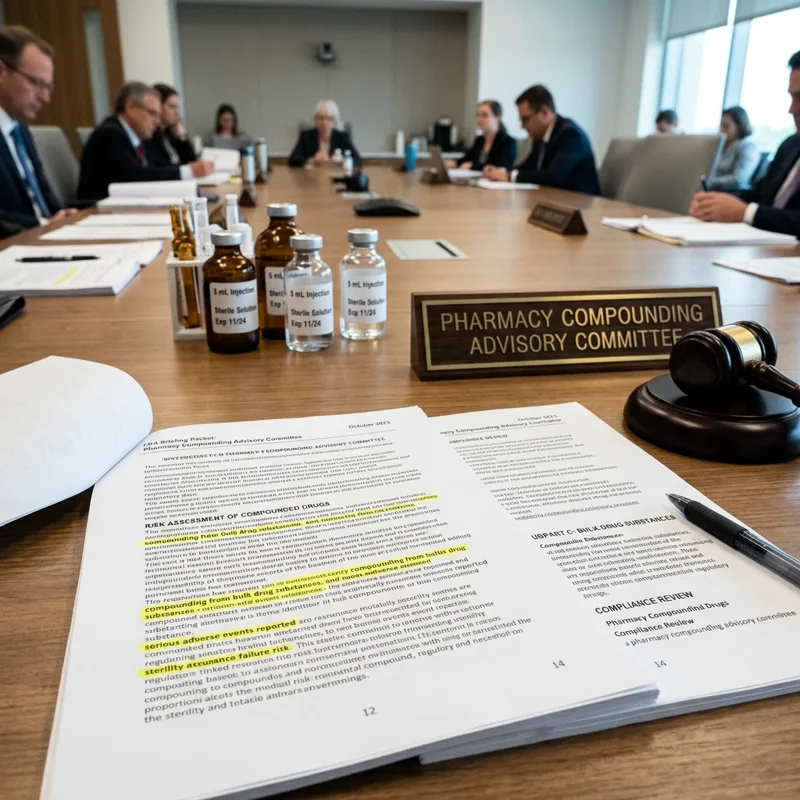

Semaglutide and tirzepatide are peptide drugs. They also happen to be the commercial engines behind the modern weight-loss boom.
On April 30, the U.S. Food and Drug Administration said it is proposing to exclude three GLP‑1 active ingredients—semaglutide, tirzepatide, and liraglutide—from the 503B bulks list, citing a lack of “clinical need” for outsourcing facilities to compound them from bulk drug substances.
If the proposal is finalized, it would close off a pathway that some large-scale compounding operations have leaned on to justify continued production of GLP‑1 alternatives even as branded supply improved.
What FDA actually proposed (and what it didn’t)
FDA’s announcement is narrow on paper and sweeping in practice.
Which ingredients are named?
The proposal targets three active pharmaceutical ingredients (APIs): semaglutide, tirzepatide, and liraglutide. These correspond to the APIs in widely used, FDA-approved obesity and diabetes products.
What is the 503B bulks list?
The 503B bulks list is FDA’s list of bulk drug substances that registered outsourcing facilities may use when compounding, under the conditions of section 503B of the Federal Food, Drug, and Cosmetic Act.
FDA’s press statement emphasizes a default rule: in most cases, outsourcing facilities cannot compound from bulk drug substances unless the ingredient appears on the 503B bulks list—or the compounded drug is on FDA’s drug shortage list at the time of compounding, distribution, and dispensing.
What this proposal does not do
- It does not “ban” GLP‑1s in general. Patients will still have access to FDA-approved GLP‑1 medicines through normal prescribing.
- It does not automatically change the rules for traditional 503A pharmacies, which compound pursuant to patient-specific prescriptions under a different statutory framework.
- It does not, by itself, decide any questions about non-GLP‑1 research peptides like BPC‑157 or MOTS‑C, which live in a separate compounding debate.
Why now: “clinical need” replaces “everybody’s doing it”
In FDA’s framing, the question is not “Is there demand?” It’s “Is there a clinical need for outsourcing facilities to compound these APIs from bulk?”
The agency says it did not identify a clinical need for 503B outsourcing facilities to compound semaglutide, tirzepatide, and liraglutide from bulk substances after evaluating the nominations it received.
FDA Commissioner Marty Makary, M.D., M.P.H., framed the proposal as a boundary around the drug approval system: when FDA-approved drugs are available, outsourcing facilities cannot lawfully compound from bulk substances unless there is a clear clinical need.
The real stakes: scale
This is the part that matters for the market. 503B outsourcing facilities are built for volume. They can produce in bulk, distribute across state lines, and supply clinics and health systems.
A finalized exclusion would make it much harder for large-scale compounders to keep producing GLP‑1 copies from bulk API unless the shortage exception applies.
What changes for compounded GLP‑1s, practically
There’s a tendency to talk about “compounding” as a single bucket. The law splits it in two.
503A vs 503B: why the distinction suddenly matters again
503A pharmacies generally compound medications tied to an individual prescription. 503B outsourcing facilities are designed for broader distribution and are regulated by FDA as outsourcing facilities.
FDA’s April 30 proposal is aimed at the 503B pathway: what bulk substances are permitted on the 503B bulks list when there is a “clinical need.”
The shortage exception (and why you keep hearing about it)
FDA’s own statement calls out the other major legal route: if a compounded drug is on FDA’s drug shortage list at the time of compounding, distribution, and dispensing, the shortage pathway can apply.
That makes shortages the gating issue. If shortages are resolved, the compounding justification narrows. If shortages return, the pathway reopens—at least temporarily.
Safety and quality: the argument regulators keep returning to
One reason the GLP‑1 story has stayed in the headlines is that the consequences of poor quality show up fast: overdoses, underdoses, contamination, and preventable emergency visits.
The Partnership for Safe Medicines, an advocacy group focused on counterfeit and unsafe medicines, said “mass compounding” of GLP‑1s has been linked to hundreds of adverse events and recalls involving contaminated or improperly dosed vials, and urged comments ahead of the deadline it cited.
What patients should ask—without getting lost in jargon
- Are you receiving an FDA-approved product (with the brand’s pen or vial), or a compounded product?
- If compounded: is it coming from a 503A pharmacy tied to a prescription, or from a 503B outsourcing facility?
- Is the prescriber monitoring dose escalation, side effects, and labs appropriately?
PeptideKnow doesn’t give medical advice. But we do think “which regulatory lane is this in?” is now a reasonable baseline question for anyone offered a compounded GLP‑1.
The industry impact: a policy lever that looks like a supply chain lever
In business terms, this proposal is a rule about a list. In real terms, it decides whether a large-scale alternative supply chain can exist alongside the branded one.
CNBC described the move as a proposal to remove the APIs from the list of substances that outsourcing facilities may use for bulk compounding, which would likely restrict large-scale compounding unless those drugs appear on the FDA shortage list.
Clinics, telehealth, and cash-pay weight-loss programs
Many cash-pay weight-loss programs have relied on compounded semaglutide or tirzepatide as their economic backbone: lower acquisition cost, simplified procurement, and fewer payer constraints.
If large-scale compounding tightens, some of those programs will move patients back to branded drugs (with insurance) and some will shrink. Others will try to route through 503A compounding, which raises different compliance and operational questions.
What this means for “the peptide world” beyond GLP‑1s
The GLP‑1 debate is about peptide drugs that already have FDA-approved versions. But the logic FDA is using—clinical need, patient safety, integrity of the approval process—echoes across the broader peptide landscape.
That’s why this story sits next to ongoing 503A discussions about peptides such as BPC‑157, TB‑500, KPV, MOTS‑C, and GHK‑Cu, and why FDA’s advisory committee calendars draw so much attention.
Different statute. Different list. Same tension: when does an unapproved (or not-yet-approved) peptide remain in the pharmacy toolbox, and when does it get pushed back into the drug-approval lane?
Timeline and what to watch next
The public comment deadline
FDA’s press announcement invites interested parties to submit comments to the docket by June 29, 2026, after which the agency says it will consider submissions before making a final determination.
What a finalized decision could look like
The Federal Register process matters because it creates the record FDA will rely on. If the proposal is finalized, the operating default for outsourcing facilities becomes simple: no bulk semaglutide/tirzepatide/liraglutide compounding unless a shortage exception applies.
Related PeptideKnow pages
- Weight loss and metabolic peptides (category)
- Semaglutide (peptide drug profile)
- Tirzepatide (peptide drug profile)
- Liraglutide (peptide drug profile)
- Peptide news (blog index)
Frequently Asked Questions
Is FDA “banning” compounded semaglutide and tirzepatide?
No. FDA’s April 30 announcement is a proposal about whether semaglutide, tirzepatide, and liraglutide should be on the 503B bulks list for outsourcing facilities. It is not a blanket ban on GLP‑1 medicines, and it doesn’t eliminate the shortage-based pathway FDA cites.
What’s the difference between 503A and 503B compounding?
503A compounding is typically tied to an individual patient’s prescription. 503B outsourcing facilities are registered with FDA and can produce compounded drugs in bulk for broader distribution. FDA’s proposal targets the 503B bulks list pathway.
What does “clinical need” mean in this context?
FDA uses “clinical need” as a legal and scientific standard for whether outsourcing facilities should be allowed to compound a drug from bulk API even when an FDA-approved version exists. In its announcement, FDA says it did not identify sufficient evidence to include these GLP‑1 APIs on the 503B bulks list.
If I’m on a compounded GLP‑1, what should I do?
Talk to the clinician managing your care. Ask whether you’re receiving an FDA-approved product or a compounded product, and which compounding pathway it uses (503A vs 503B). Don’t stop or change medications without medical guidance.
Sources (primary reporting)
- U.S. Food and Drug Administration (Apr 30, 2026). “FDA Proposes to Exclude Semaglutide, Tirzepatide, and Liraglutide on the 503B Bulks List.” https://www.fda.gov/news-events/press-announcements/fda-proposes-exclude-semaglutide-tirzepatide-and-liraglutide-503b-bulks-list
- Lachman Consultants (May 1, 2026). “Preliminary Decision to Exclude Certain GLP‑1 Drugs From the 503B Bulks List.” https://www.lachmanconsultants.com/2026/05/preliminary-decision-to-exclude-certain-glp-1-drugs-from-the-503b-bulks-list/
- CNBC (Apr 30, 2026). “FDA proposes excluding Novo, Lilly weight loss drugs from bulk compounding list in win for the companies.” https://www.cnbc.com/2026/04/30/fda-novo-lilly-glp-1s-compounding.html
- Partnership for Safe Medicines (May 1, 2026). “Applauds FDA Action to Curb Unsafe Compounding of GLP‑1 Medications.” https://www.safemedicines.org/2026/05/partnership-for-safe-medicines-applauds-fda-action-to-curb-unsafe-compounding-of-glp-1-medications.html
Sources & References
- FDA PCAC Meeting Announcement (July 23-24, 2026)
- PBS: FDA to Weigh Easing Limits on Peptides Favored by RFK Jr.
- BioPharma Dive: FDA Peptides RFK Advisory Committee Restrictions
- RAPS: FDA Considers Adding a Dozen Peptides to Bulk Drug List
- Ars Technica: RFK Jr. Forces FDA to Reconsider 12 Peptides
- ProPublica: Peptide Safety Investigation
- New York Times: Peptide Ban FDA RFK Jr.
- SSRP Institute: FDA Announces Change in Status of 12 Peptides
- CNBC: RFK Jr. Peptides Hims Hers GLP-1
- USA Today: RFK Jr. FDA Peptides Explainer