
Medical disclaimer: This article is for education and reference. It does not provide medical advice. Compounding regulation is fact-specific and evolving. Patients should discuss options with a licensed clinician and use state-licensed pharmacies. Clinicians should consult primary FDA materials and counsel before changing practice.
The news, in one paragraph
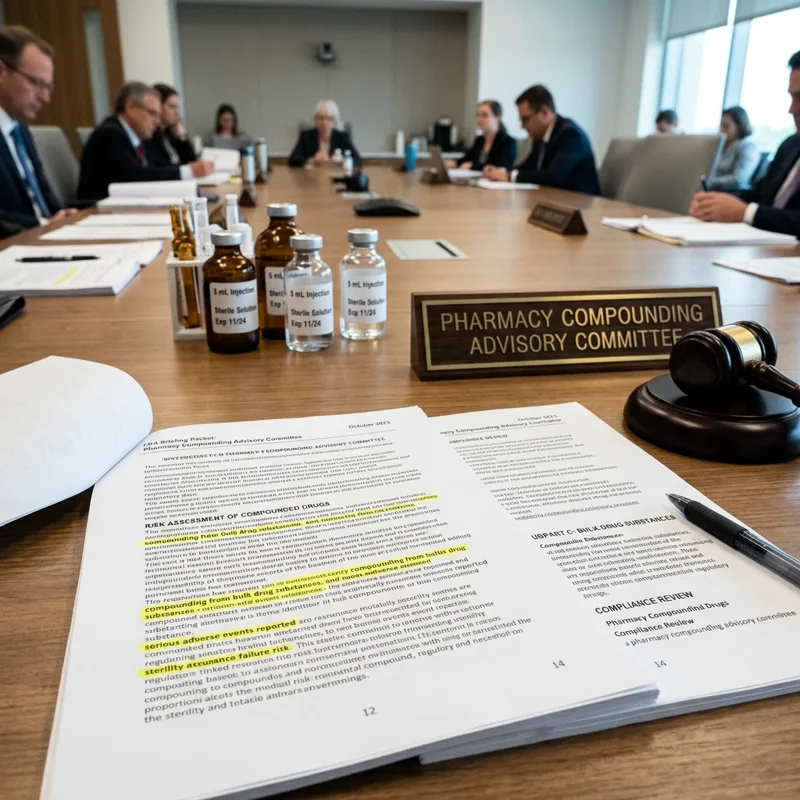
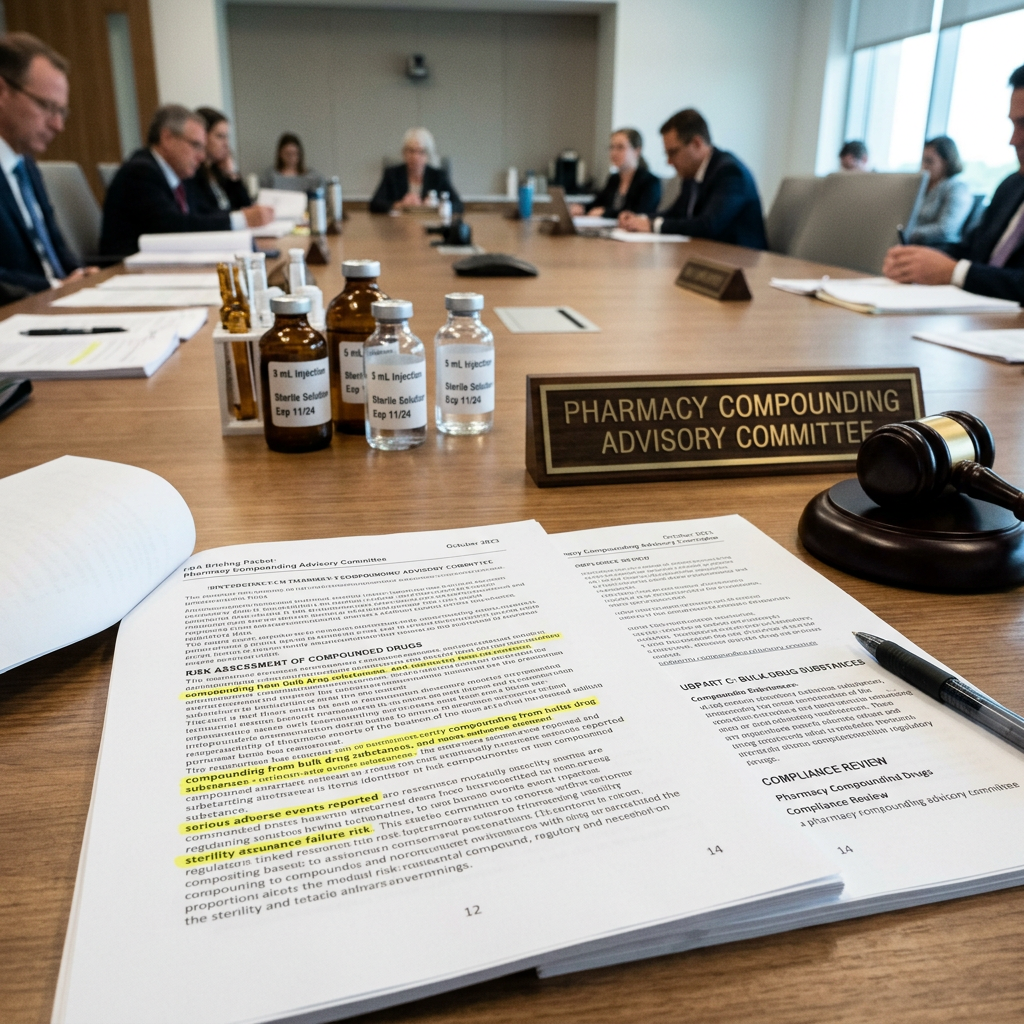
The FDA confirmed in a letter that nominations for several therapeutic peptides — including BPC-157, KPV, and Semax — had been withdrawn, and that these substances would be removed from the agency’s Category 2 list as of April 22, 2026. (Aesthetics Journal, May 29, 2026) That sounds like a green light. It isn’t. The same letter makes clear the peptides do not automatically move into Category 1 — the bucket where the FDA has said it generally would not take action against compounders — and that the Pharmacy Compounding Advisory Committee (PCAC) will review them at the July 23–24, 2026 meeting, with February 2027 as the alternate date.
Until PCAC issues recommendations and the FDA updates its bulk drug substances list, U.S. compounding pharmacies still cannot routinely use these peptides in compounded preparations.
What Category 2 was, and why removal matters
The FDA’s 503A bulk drug substances framework is a three-bucket system. Category 1 is “the agency does not generally intend to take action.” Category 2 is “significant safety risks; compounding is restricted.” A third bucket holds nominations the agency hasn’t yet finished evaluating.
In 2023, several popular peptides — BPC-157 prominent among them — were placed in Category 2 after the FDA flagged safety concerns including immunogenicity risk, lack of GMP-grade API supply, and minimal human clinical data. That placement effectively shut down lawful 503A compounding of those peptides nationwide.
What happened in April was procedurally narrow: the parties who originally nominated several of these peptides for the bulks list withdrew those nominations. A withdrawn nomination cannot sit in Category 2. So the FDA moved them off Category 2 effective April 22. That is not the agency saying the safety concerns went away. It is the agency saying the formal vehicle that put them on Category 2 is gone, and the substances now have to be evaluated again through a fresh process.
That fresh process is PCAC.
The gray zone that exists right now
This is where it gets confusing for clinicians and patients. As of today, the affected peptides are:
- Not on Category 2.
- Not on Category 1.
- Not on the 503A bulks list.
- Awaiting PCAC review.
Under U.S. compounding law, 503A pharmacies may compound from an FDA-approved drug product, from a substance with a USP or NF monograph, or from a substance on the 503A bulks list. Peptides like BPC-157, KPV, and Semax fit none of those three. So even though they are no longer formally restricted by Category 2, the affirmative basis to compound them at scale still doesn’t exist.
The practical answer for a pharmacy is the same it was last month: don’t routinely compound these peptides for office-stock or mass distribution. Patient-specific prescriptions in narrow circumstances remain a fact-specific legal question that depends on state board interpretation, the pharmacist’s judgment, and the prescriber’s clinical rationale — not a green light from the FDA.
Why this isn’t the end of the story
PCAC’s July 23–24, 2026 meeting is now the actual decision point. The committee will review each peptide’s data and recommend whether the FDA should consider it appropriate for 503A bulk compounding. The FDA does not have to follow PCAC recommendations, but it almost always does — and when it doesn’t, the divergence becomes its own news.
Three scenarios are plausible for any given peptide on the docket.
Scenario one: PCAC recommends inclusion on the bulks list. The FDA opens rulemaking, eventually publishes a final rule adding the substance to the 503A bulks list. Lawful compounding by 503A pharmacies becomes possible nationwide, subject to USP <797> sterile-prep standards, beyond-use dating, and state requirements. Time from PCAC recommendation to final rule is typically measured in many months, not weeks.
Scenario two: PCAC recommends against inclusion. The FDA can decline to add the substance, and the de facto restriction continues even though nothing is sitting in Category 2. This is the outcome least understood by patients. “Removed from Category 2” gets read as “legal again,” when in fact the absence of Category 1 inclusion is the operative restriction.
If you’re browsing by topic, start with our related compounds overview for context on how these substances fit the regulatory map.
Scenario three: PCAC defers. Some substances get punted to February 2027 or later if the committee feels the data are insufficient. From a compounding-access standpoint, deferral is functionally indistinguishable from a no — the bulks list doesn’t change.
What changes for clinicians this month
Not much, and that’s the message. The legal posture for a pharmacist filling a peptide prescription has not materially improved. Documentation discipline still matters: source of API, evidence of GMP, vendor qualification, patient consent that explicitly explains the FDA approval status, and a clinical rationale tied to the individual patient’s condition.
What does change is the marketing environment. Telehealth platforms and wellness marketing teams will likely seize on the words “removed from Category 2” to imply approval. They are the same words; the meaning is not the same. Clinics that want to stay clear of warning letters should audit their websites, intake forms, and social channels now for any language that implies these peptides are FDA-approved or that PCAC review has happened.
The FDA’s 2025 advertising-claim enforcement push against telehealth marketing of compounded GLP-1 drugs is a useful precedent. The agency has shown it will move on misbranding even when the underlying compounding fact pattern is debatable.
What changes for patients this month
If you are a patient who has been waiting for these peptides to “come back,” the honest answer is: the door isn’t open yet, and the next real decision is six to eight weeks away. PCAC will meet July 23–24. Recommendations typically follow within weeks of the meeting. The FDA’s response timeline after that is longer — months, sometimes longer than a year for final rules.
If you have an active prescription for a compounded peptide from a state-licensed pharmacy, the immediate change is zero. If you are buying these peptides from gray-market vendors marketed as “research only,” the regulatory news doesn’t change anything about those products either — they are unapproved and unregulated whether or not the FDA category has shifted.
The quieter story underneath the headline
The peptides community has been focused on PCAC and the bulks list because those are the visible levers. There is a quieter story underneath: API quality and characterization.
Even in a world where BPC-157 ends up on the 503A bulks list, a 503A pharmacy still has to source API that meets identity, purity, and potency standards under USP <1163>. The current commercial supply of BPC-157 is dominated by research-grade vendors whose certificates of analysis frequently fail independent retesting. A 2024 third-party survey of vendor samples found significant variance in purity assays and frequent endotoxin levels incompatible with injectable use.
If PCAC recommends inclusion and the FDA agrees, the supply side becomes the next bottleneck. Compounding pharmacies will need GMP-grade material from facilities that can pass FDA inspection. That market doesn’t robustly exist in the U.S. yet for most of the peptides in question. Building it will take time, capital, and a willingness on the part of pharmaceutical-grade peptide manufacturers to enter a market that is still legally and reputationally messy.
Related: TB-500 is on a separate but parallel track and faces the same supply-quality question. MOTS-c and epithalon sit further out on the timeline.
What to watch between now and July 24
- The PCAC meeting agenda when it’s published — usually 30 days before. It will name the specific peptides on the docket and indicate whether the discussion is full review or limited.
- Federal Register notices about the 503A bulks list. Any movement here is the operative legal step.
- State pharmacy board guidance. Several state boards have issued their own positions on peptide compounding that are stricter than federal posture. Those won’t change because of Category 2 removal.
- Warning letters to telehealth and wellness brands. The marketing environment after April 22 is the most likely near-term enforcement zone.
- Independent assay data on commercial peptide supply. A clean supply chain is the silent prerequisite to any of this becoming meaningful.
Frequently Asked Questions
Does April 22 mean BPC-157 is legal for compounding now?
No. Removal from Category 2 is a procedural step that reflects a withdrawn nomination, not a determination of safety or appropriateness. To be compounded under 503A on a routine basis, a substance still needs to fit one of three lawful sources: FDA-approved drug, USP/NF monograph, or 503A bulks list. BPC-157 fits none of those today. (Aesthetics Journal, May 29, 2026)
When will the FDA decide for real?
The next decision point is PCAC’s recommendation after the July 23–24, 2026 meeting. The FDA usually publishes a response within several months. Inclusion on the 503A bulks list, if it happens, comes through formal rulemaking and is typically a longer process. Some peptides may be punted to the February 2027 PCAC meeting if the committee determines data are insufficient.
Can a doctor still write me a prescription for compounded BPC-157?
This is a fact-specific question that depends on the state, the pharmacy, the clinical context, and the prescriber’s rationale. The FDA’s April 22 change does not materially expand what a pharmacist can lawfully compound. Patient-specific prescriptions in narrow circumstances remain legally gray and require careful documentation by both the prescriber and the pharmacy.
What about KPV and Semax specifically?
KPV (the C-terminal tripeptide of α-MSH) and Semax (a heptapeptide ACTH analog) are both on the PCAC docket alongside BPC-157. Each has a different evidence base — KPV with limited human data on inflammatory bowel conditions, Semax with a longer history of use in Russia for cognitive and stroke-recovery indications. PCAC will weigh each separately.
Should clinics update marketing now?
Yes. Any language on a clinic website, intake form, or social channel that implies these peptides are FDA-approved or now legal to compound is a misbranding risk. The 2025 GLP-1 advertising enforcement push showed the FDA will move on this class of claims independently of compounding-law questions.
Sources
- Aesthetics Journal (May 29, 2026). “FDA reviews regulatory status of peptides.” https://aestheticsjournal.com/news/fda-reviews-regulatory-status-of-peptides/
- U.S. Food and Drug Administration. “Bulk Drug Substances Used in Compounding Under Section 503A of the FD&C Act.” https://www.fda.gov/drugs/human-drug-compounding/bulk-drug-substances-used-compounding-under-section-503a-fdc-act
- U.S. Food and Drug Administration. “Pharmacy Compounding Advisory Committee.” https://www.fda.gov/advisory-committees/human-drug-advisory-committees/pharmacy-compounding-advisory-committee
Sources & References
- FDA PCAC Meeting Announcement (July 23-24, 2026)
- PBS: FDA to Weigh Easing Limits on Peptides Favored by RFK Jr.
- BioPharma Dive: FDA Peptides RFK Advisory Committee Restrictions
- RAPS: FDA Considers Adding a Dozen Peptides to Bulk Drug List
- Ars Technica: RFK Jr. Forces FDA to Reconsider 12 Peptides
- ProPublica: Peptide Safety Investigation
- New York Times: Peptide Ban FDA RFK Jr.
- SSRP Institute: FDA Announces Change in Status of 12 Peptides
- CNBC: RFK Jr. Peptides Hims Hers GLP-1
- USA Today: RFK Jr. FDA Peptides Explainer