
What Happened
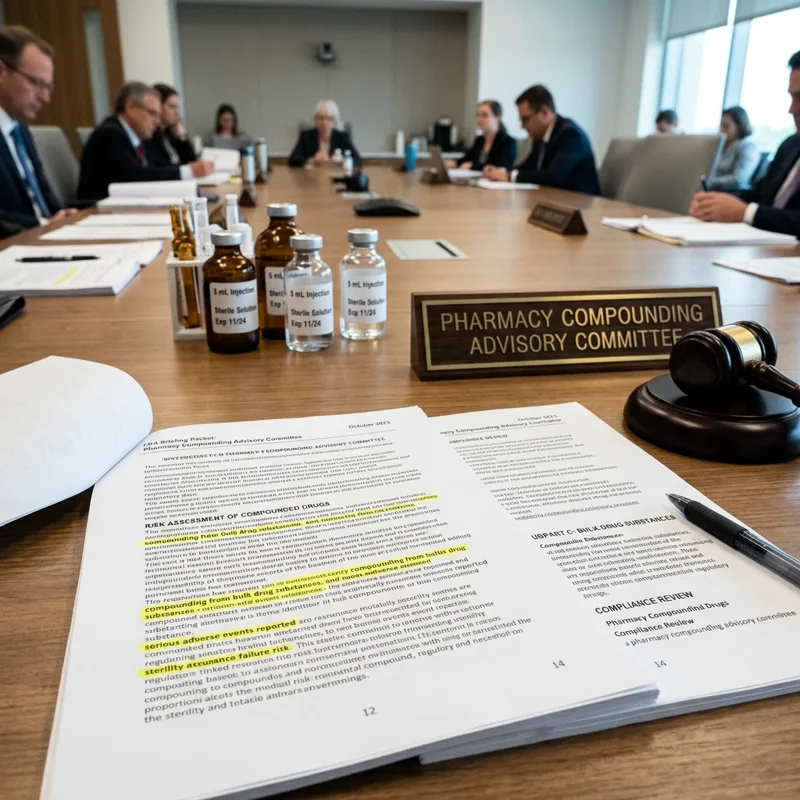
The FDA's Pharmacy Compounding Advisory Committee will hold not one but two meetings on the peptides that came off the Category 2 restricted list this spring. The first meeting, July 23–24, 2026, will review seven peptides — BPC-157, KPV, TB-500, MOTS-c, DSIP (also called Emideltide), Semax, and Epitalon. The second meeting, scheduled before the end of February 2027, will review five additional peptides: Cathelicidin LL-37, GHK-Cu (injectable), Dihexa, Melanotan II, and PEG-MGF.
The five-peptide tranche-2 list is the news this week. The agency confirmed it in the April 16, 2026 Federal Register notice, the FDA Law Blog parsed it in detail on April 21, and RAPS and Frier Levitt wrote it up. No public docket has yet opened for the second meeting. Comment timing, ingredient framing, and any interim enforcement-discretion guidance will land closer to the meeting date. Each of the five peptides has a distinct safety profile, a distinct legal posture, and a distinct lobbying footprint — which is part of why they are getting their own meeting rather than being lumped with the July seven.
The Five Peptides Under Tranche-2 Review
- Cathelicidin LL-37 — an antimicrobial host-defense peptide; nominators withdrew their original Category-2 nominations, prompting reconsideration.
- GHK-Cu (injectable routes) — the copper-binding tripeptide widely used topically for skin and wound healing; the injectable route is the route under review.
- Dihexa — a hexapeptide angiotensin IV analog under preclinical investigation for cognitive and synaptogenic effects.
- Melanotan II — a melanocortin receptor agonist marketed for tanning and libido; the most public-safety-fraught peptide on either tranche-2 or tranche-1.
- PEG-MGF — pegylated mechano growth factor, an IGF-1 splice variant promoted in muscle-recovery markets with sparse human evidence.
- Meeting timing: on or before February 28, 2027.
- Public docket: not yet opened. The July docket (FDA-2025-N-6895) closes July 22, 2026 and only covers the July seven.
- Legal effect: A PCAC vote is a recommendation, not a reclassification. Final 503A bulks-list inclusion still requires FDA rulemaking after committee review.
Why A Second Meeting
The five tranche-2 peptides are a procedural footnote that turns out to matter. When HHS announced on February 27, 2026 that fourteen of the nineteen peptides on Category 2 would move toward Category 1, the agency had a sequencing problem. Each peptide on the larger list had a different nomination history, a different safety dossier, and a different claim landscape. Lumping them all into one meeting would have produced a hearing too long for productive deliberation and would have invited every advocacy group, compounding pharmacy, and patient cohort interested in any one peptide to compete for the same speaking slots.
Splitting the docket also lets the agency line up the strongest evidence for each individual peptide. The July seven include the substances with the largest patient demand and the most published preclinical literature. BPC-157 and TB-500 have appeared in dozens of rodent papers; MOTS-c has emerging human data on insulin sensitivity. The tranche-2 five are a different conversation. Melanotan II has known cardiovascular and dermatologic adverse-event reports tied to non-medical use. Dihexa is largely preclinical. GHK-Cu for injection is a different safety question from GHK-Cu on a moisturizer. Each of the five wants a focused review that does not get washed out by patient testimonials about an unrelated compound.
The agency confirmed in April that the second meeting will take place "before the end of February 2027," and it has not yet announced specific dates or opened the public docket. FDA Law Blog reads this as a deliberate slowdown that lets the agency see how the July meeting plays out before it commits to evidentiary scope for the harder five.
What's At Stake For Each Peptide
Cathelicidin LL-37
An endogenous human antimicrobial peptide produced by neutrophils and epithelial cells, LL-37 is part of the innate immune system. Compounded LL-37 has been promoted for chronic infections that resist standard antibiotic therapy and for inflammatory skin conditions. Published human data are thin; the bulk of mechanism evidence is in vitro. The peptide presents a different review challenge from BPC-157 because its therapeutic claim domain — antimicrobial — sits squarely in territory where antibiotic stewardship rules apply. Adding LL-37 to the 503A list would let compounding pharmacies prepare it for prescription use; it would not make the antimicrobial-stewardship questions disappear. PCAC will weigh both.
GHK-Cu (injectable routes)
The copper-binding tripeptide is the most established compound on either tranche. Topical GHK-Cu appears in cosmetic and wound-healing formulations with FDA tolerance going back decades. Injectable GHK-Cu is the new question. The peptide has documented activity in collagen synthesis, copper homeostasis, and gene expression studies in skin and connective tissue. The nomination history matters: the original Category 2 placement followed an industry nomination that was later withdrawn. The PCAC vote will be specifically about whether the injectable route — not the topical — belongs on the 503A bulks list. That distinction is unusual in 503A practice and gives the meeting an evidentiary structure most observers have not seen before.
Dihexa
An angiotensin IV analog originally developed at Washington State University, Dihexa has been studied for cognitive enhancement and synaptogenesis in rodent models of Alzheimer's disease and traumatic brain injury. Human data is sparse. The peptide has crossed into wellness markets through telehealth and online vendors despite its preclinical posture. The FDA's review challenge here is the gap between a substance that has plausible mechanism in the brain and a substance for which the safety database in humans is thin. PCAC may recommend that any bulks-list inclusion carry route, dose, and labeling caveats that limit non-prescription claim drift.
Melanotan II
Melanotan II is the highest-public-risk peptide of the twelve under review. A non-selective melanocortin receptor agonist developed for sunless tanning, it is associated with documented cases of cardiovascular events, melanoma in pre-existing nevi, and severe hyperpigmentation patterns in non-medical users. The FDA has previously warned consumers about it. A 503A bulks-list recommendation would have to thread a narrow needle: rejecting it outright while still on a list of "removals from Category 2" would be unusual and politically charged; recommending inclusion against the safety profile would draw immediate dermatology and cardiology pushback. The most likely outcome is a recommendation that conditions inclusion on labeling, prescriber education, or specific use restrictions — or a flat negative recommendation. Either way, this is the peptide where the second meeting's decision will draw the most outside attention.
PEG-MGF
Pegylated mechano growth factor is a splice variant of insulin-like growth factor 1 produced in muscle in response to mechanical loading. It has been promoted in athletic recovery and muscle-growth markets despite a thin human-evidence base and overlap with banned substances under WADA's S2 category. The pegylation extends half-life. The PCAC review will need to address both the underlying biology and the doping-relevance frame; both questions will get airtime.
What Changes On The Ground Right Now
Almost nothing in the immediate term. The April 15 Category-2 removals took effect April 23, which means the peptides are no longer formally listed as substances the FDA has determined to be unsafe for compounding. They are not, however, on the 503A bulks list either. They sit in a third zone — not banned, not blessed — in which compounding pharmacies face the same enforcement risk they faced last month, and in which most pharmacies are continuing to decline to dispense compounded versions until either PCAC recommends inclusion or FDA issues an enforcement-discretion notice.
Patients on telehealth platforms or wellness clinics who are receiving injectable peptides now are receiving products from the same compounding-and-research-supply shadow that existed before. The agency's position has not changed: a compounded drug must be made for an identified patient with a valid prescription from a state-licensed prescriber, the API must come from a registered facility, and it must meet 503A or 503B requirements. Online sales of "research-only" peptides remain outside that framework, and the warning-letter cadence the FDA established in 2025 and 2026 against telehealth GLP-1 marketers signals the kind of enforcement posture peptide marketers should expect.
For prescribers, the practical takeaway is that the regulatory direction is clearer than it was six months ago, but the day-to-day compounding decision still hinges on (a) whether your state board of pharmacy is comfortable with the substance, (b) whether your liability insurer covers it, and (c) whether you have a defensible clinical rationale for the individual patient. None of those will change before the July 2026 meeting, and the tranche-2 review will not produce on-the-ground changes until well into 2027.
How It Fits With The Wider Peptide Story
Three threads are converging. The regulated GLP-1 class is consolidating — this week's covered the Ozempic-branded oral semaglutide launch, and yesterday's 75,243-patient Medicare comparative-effectiveness study sharpened the within-class hierarchy. The unregulated end of the peptide universe — the July PCAC docket and now the February 2027 second meeting — is moving in a deregulatory direction. And the enforcement frame against off-label peptide marketing has been getting tighter, with April 2026 warning letters against research-peptide vendors serving as the template.
Reading the three threads together, the FDA is doing something unusual. It is loosening compounding access for a defined set of peptides while simultaneously tightening enforcement against off-label and direct-to-consumer marketing. The bet appears to be that compounding pharmacies under state-board supervision can absorb demand for the peptides under 503A while marketing rules can keep telehealth-driven claim drift from outpacing the evidence. Whether that bet works depends partly on what PCAC recommends — and the second meeting, with the harder five peptides, is where the framework will be most tested.
Frequently Asked Questions
When exactly will the second PCAC meeting happen?
The FDA has stated the meeting will occur "before the end of February 2027." Specific dates have not been set. The agency will publish a Federal Register notice 30 days before the meeting and open a public docket separate from the July meeting's FDA-2025-N-6895 docket. Watch for the announcement in late 2026 or early 2027.
Can I get any of these five peptides legally compounded today?
Most state-licensed compounding pharmacies are not dispensing them yet. The peptides came off the Category 2 list on April 23, 2026, but they are not on the 503A bulks list. That puts them in a regulatory zone in which a pharmacy that compounds them faces unclear enforcement posture. Some state boards may permit it; others will not. Check with the pharmacy and the prescriber. Online vendors selling "research-only" versions are outside the regulated supply chain entirely and carry distinct legal and quality risks.
What's the difference between Category 1, Category 2, and the 503A bulks list?
Category 1 is FDA's interim list of bulk drug substances that the agency does not currently object to in compounding. Category 2 is the FDA's interim list of bulk substances the agency has determined raise significant safety concerns and should not be compounded with. The 503A bulks list is the formal, statutorily-recognized list of substances permitted in 503A compounding. Moving from Category 2 to the formal 503A list requires PCAC review followed by rulemaking. The April 2026 removals took peptides off Category 2 but did not put them on 503A; that is what PCAC review is for.
Why is GHK-Cu split between topical and injectable?
The two routes have different absorption profiles, different safety histories, and different precedents in cosmetic and pharmaceutical regulation. Topical GHK-Cu has been in commercial cosmetic and wound-care products for decades. Injectable GHK-Cu is a separate safety question because systemic exposure is different from skin-surface application. The PCAC review concerns the injectable route specifically. A favorable recommendation for injection would not retroactively change the topical regulatory status.
How do these decisions affect FDA-approved peptide drugs like semaglutide?
They do not. Semaglutide, tirzepatide, and other approved branded peptides go through the standard NDA / BLA pathway and are dispensed under their FDA labels. The 503A and 503B compounding tracks are separate frameworks for unapproved or specialty preparations. PCAC review of compounded peptides is a different room from the room where new GLP-1 indications get approved.
Sources
- FDA Federal Register notice and meeting calendar, April 15–16, 2026: PCAC meetings on 503A bulks list, July 23–24, 2026 and second meeting before end of February 2027. FDA.gov
- Snow CD, Palmer KL. FDA's Pep(tide) Rally! What Compounders and Industry Need to Know (Posts 1 and 2). FDA Law Blog, April 21–22, 2026. Post 1, Post 2
- RAPS: FDA considers adding a dozen peptides to its bulk drug compounding list. April 16, 2026. RAPS.org
- Frier Levitt: FDA to Remove 12 Popular Peptides from the Category 2 list. April 16, 2026. Frier Levitt
- Public comment docket for the July 2026 meeting: FDA-2025-N-6895. Open until July 22, 2026.
Sources & References
- FDA PCAC Meeting Announcement (July 23-24, 2026)
- PBS: FDA to Weigh Easing Limits on Peptides Favored by RFK Jr.
- BioPharma Dive: FDA Peptides RFK Advisory Committee Restrictions
- RAPS: FDA Considers Adding a Dozen Peptides to Bulk Drug List
- Ars Technica: RFK Jr. Forces FDA to Reconsider 12 Peptides
- ProPublica: Peptide Safety Investigation
- New York Times: Peptide Ban FDA RFK Jr.
- SSRP Institute: FDA Announces Change in Status of 12 Peptides
- CNBC: RFK Jr. Peptides Hims Hers GLP-1
- USA Today: RFK Jr. FDA Peptides Explainer