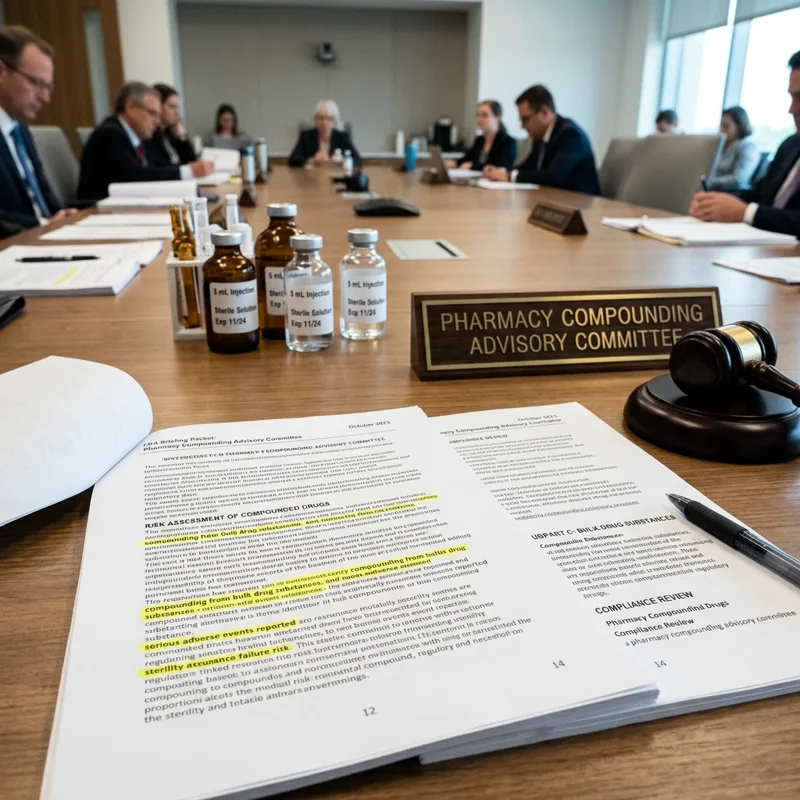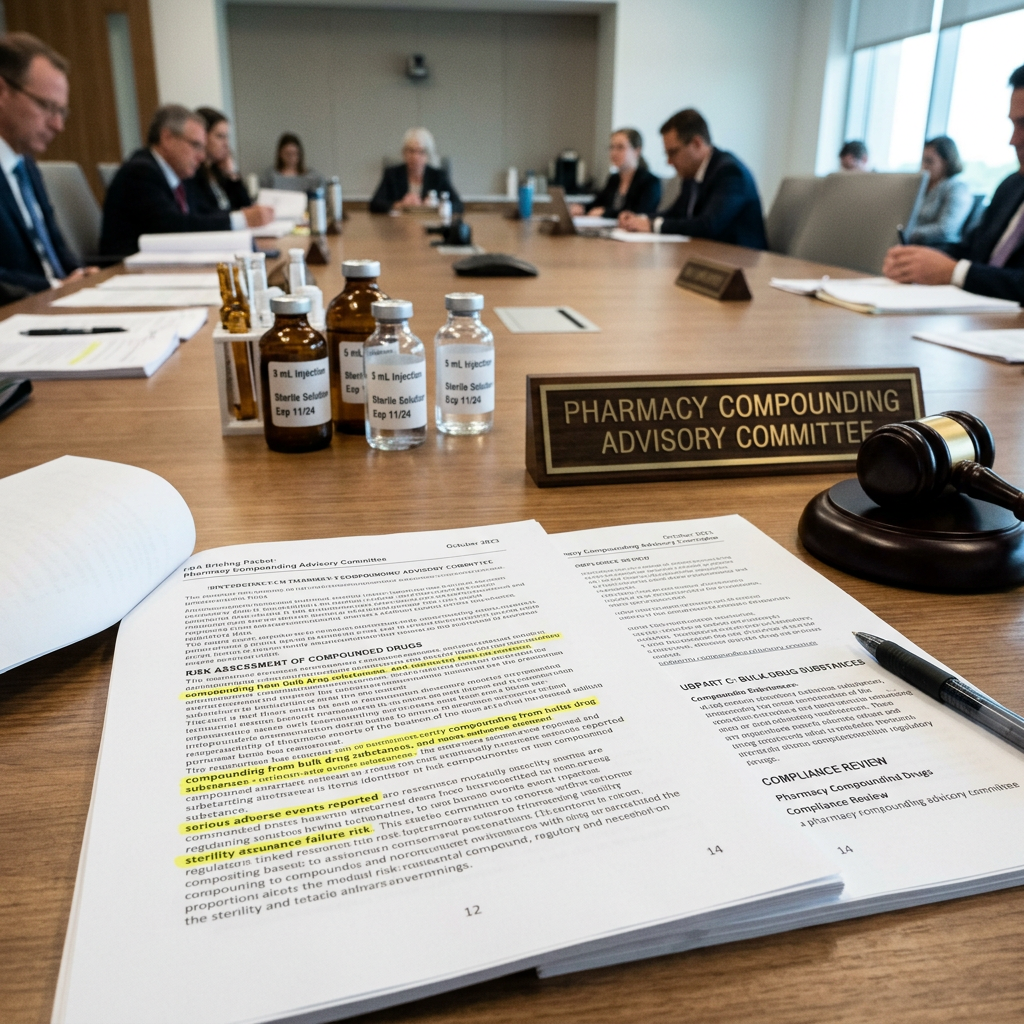
FDA will hold a two-day public meeting on July 23–24, 2026 to discuss seven peptide bulk drug substances nominated for possible inclusion on the 503A Bulks List—a wonky-sounding list that, in practice, helps determine what traditional compounding pharmacies can legally make when a patient needs something that isn’t available as an FDA-approved drug. The meeting sits at the intersection of influencer-driven peptide demand, a real gray market, and the FDA’s still-unresolved question: which peptides, if any, can be compounded with an evidence and quality posture that holds up in daylight. (FDA meeting notice)
If you’ve seen BPC-157 headlines or gym chatter about TB-500, this is the first time in years the agency has put specific research peptides on the agenda for an open, on-the-record advisory committee review. The Pharmacy Compounding Advisory Committee (PCAC) can’t “approve” these peptides as drugs, and its recommendations aren’t binding. But PCAC’s posture—skeptical, split, or cautiously permissive—often foreshadows where the agency is heading next. (FDA PCAC calendar)
What’s happening: the July 2026 PCAC peptide agenda, in plain English
The FDA’s PCAC will meet at the FDA White Oak campus in Silver Spring, Maryland, with remote public participation available. The agency says the committee will discuss bulk drug substances being considered for inclusion on the 503A Bulks List. For peptides, that means a narrow question: do these nominated substances meet the legal and scientific criteria for compounding under section 503A—not whether they “work” in the wellness sense. (FDA advisory committee calendar)
According to FDA’s meeting notice, the seven peptide bulk drug substances on the July agenda are: (FDA list of bulk drug substances)
- BPC-157 (free base / acetate) — evaluated for ulcerative colitis
- KPV (free base / acetate) — evaluated for wound healing and inflammatory conditions
- TB-500 (thymosin beta-4 fragment LKKTETQ; free base / acetate) — evaluated for wound healing
- MOTS-c (free base / acetate) — evaluated for obesity and osteoporosis
- Emideltide (DSIP) (free base / acetate) — evaluated for opioid withdrawal, chronic insomnia, and narcolepsy
- Semax (free base / acetate) — evaluated for cerebral ischemia, migraine, and trigeminal neuralgia
- Epitalon (free base / acetate) — evaluated for insomnia
The meeting also has two relevant public dockets: one for general public comment tied to the meeting, and another referenced for submissions. FDA’s page lists docket FDA-2025-N-6895 and also references FDA-2026-N-2979. (FDA docket numbers)
Why this matters (even if you never set foot in a compounding pharmacy)
Peptide buyers tend to lump everything into one bucket: “peptides.” Regulators don’t. The FDA is trying to separate (1) FDA-approved peptide drugs—think GLP-1 receptor agonists like semaglutide—from (2) research peptides marketed like lifestyle products, where the agency has argued the safety and quality risks are substantial. (PBS NewsHour)
The July PCAC meeting is important because it signals a procedural shift: instead of treating certain peptides as categorically too risky for compounding, FDA is bringing a handful into the formal 503A Bulks List pipeline. A May 12 legal analysis noted that FDA indicated an intent to remove certain peptides from the agency’s “Category 2” list (bulk drug substances that raise significant safety concerns), while still emphasizing that removal alone does not make a substance eligible for compounding. (JD Supra)
For clinics, prescribers, and compounders, the stakes are blunt: if PCAC and FDA say “no,” access shifts further to offshore suppliers and domestic gray-market sellers. If they say “maybe,” more of the market migrates to licensed pharmacies and prescription channels. And if they say “yes” for some substances, the industry will have to learn the difference between “compoundable under 503A in limited circumstances” and “FDA-approved drug.” Those are not synonyms.
503A vs 503B: the compounding distinction most peptide discussions miss
Most consumer peptide chatter ignores the legal plumbing. Yet this is where enforcement risk, quality standards, and patient protections are set.
- 503A compounding pharmacies generally compound patient-specific prescriptions. The 503A Bulks List is the list of bulk drug substances that may be used in compounding under 503A when certain conditions are met. (FDA meeting purpose)
- 503B outsourcing facilities are a different category with different oversight and business models. That distinction matters, because a “peptide crackdown” story can involve either pathway—or neither—depending on what FDA is targeting.
PCAC is the advisory body that weighs nominated substances for possible inclusion on the 503A Bulks List. That’s why the agenda matters. It’s the front door to a specific kind of legal compounding, not a blanket legalization of peptides.
Peptide-by-peptide: what FDA says it’s evaluating (and what that hints at)
BPC-157 (ulcerative colitis)
BPC-157 is the headline peptide because it’s both popular and poorly standardized. FDA’s meeting materials list ulcerative colitis as the evaluated use. That’s notable: it frames BPC-157 as a GI / inflammatory candidate rather than the internet’s preferred narrative of “injury healing for athletes.” (FDA agenda)
For readers: if you want a deeper reference page on claims, mechanisms, and safety caveats, start with our BPC-157 profile and treat everything beyond labeled clinical endpoints as provisional.
TB-500 (wound healing)
TB-500 is listed as thymosin beta-4 fragment (LKKTETQ), evaluated for wound healing. That matters because the marketplace often blurs TB-500 with full-length thymosin beta-4 and sells both under the same umbrella. If FDA is evaluating a specific fragment with a specific salt form, product substitution becomes a regulatory fault line. (FDA TB-500 listing)
KPV (wound healing / inflammatory conditions)
KPV is less famous than BPC-157, but its inclusion is a clue about what FDA is willing to entertain: small peptides nominated with defined uses and a plausible mechanism story. FDA lists wound healing and inflammatory conditions as evaluated uses. (FDA KPV listing)
MOTS-c (obesity / osteoporosis)
MOTS-c is listed for obesity and osteoporosis—two indications where approved peptide drugs exist (e.g., GLP-1s for obesity) but where the research-peptide ecosystem is still trying to invent shortcuts. FDA putting MOTS-c on the agenda doesn’t mean it believes the hype. It means a nomination exists and must be evaluated inside the 503A process. (FDA MOTS-c listing)
Emideltide / DSIP (sleep, opioid withdrawal)
FDA’s page notes emideltide is also referred to as delta sleeping inducing peptide (DSIP), and lists opioid withdrawal, chronic insomnia, and narcolepsy as evaluated uses. Those are high-consequence conditions. They also raise the bar for safety, standardization, and clinical evidence—especially given how loosely DSIP is marketed online. (FDA emideltide/DSIP note)
Semax (neurology indications)
Semax is evaluated for cerebral ischemia, migraine, and trigeminal neuralgia. That list reads like a neuro clinic’s differential diagnosis, not a wellness influencer’s product page. Semax has a long history of non-U.S. use narratives, which complicates U.S. regulatory conversations: it can be “known” culturally while still being unapproved and variably sourced in the U.S. market. (FDA Semax listing)
Epitalon (insomnia) and the Epitalon vs Epithalon naming mess
FDA lists epitalon for insomnia. Online, you’ll also see epithalon (and sometimes “epithalamin”), and the naming drift is part of the quality problem: consumers assume these are interchangeable, while regulators and pharmacists have to care about what substance, what sequence, what salt form, and what impurity profile is actually in the vial. (FDA Epitalon listing)
For consistency across PeptideKnow, we use Epithalon as the canonical profile page and treat “Epitalon” as a common alias used in regulatory and commercial contexts.
Category 2 removal isn’t “legalization”: what the May 12 analysis says
One reason this topic surged again this week: a May 12 legal analysis summarized FDA’s April 15 actions, including that FDA republished an interim 503A Bulks List and indicated its intent to remove certain peptides from its “Category 2” list of bulk drug substances that raise significant safety concerns. The analysis stressed a key point: being removed from Category 2 does not automatically make a peptide eligible for compounding under 503A. (JD Supra)
That distinction matters because internet summaries tend to compress “removed from a restricted list” into “legal again.” The FDA process is slower and narrower. The July meeting is one step. The final agency decisions, if any, come later.
RFK Jr., MAHA politics, and the enforcement reality
The politics are not subtle. The April 16 AP report carried by PBS described the meeting as part of a broader push—at least rhetorically—from HHS leadership to widen access to peptides favored by wellness and fitness communities, while acknowledging FDA’s long-standing concerns that many peptides are untested in humans and marketed illegally. (PBS NewsHour)
That tension—greater access vs. evidence gaps—also creates a practical enforcement issue. When FDA restricts licensed compounding, demand doesn’t vanish. It migrates. The agency itself has said the gray market makes it hard to know what consumers are injecting. That’s the policy frame behind a possible “ethical supplier” pathway, as described in the May 12 analysis. (JD Supra)
What to watch between now and July 23
Three things will tell you whether this meeting is mostly symbolic or the start of a real shift.
- Background materials: FDA says it intends to post background material and the live webcast link no later than two business days before the meeting. Those documents often reveal the agency’s specific safety and impurity concerns. (FDA event materials note)
- The docket record: FDA’s page lists FDA-2025-N-6895 and references FDA-2026-N-2979 for submissions. Public comments can shape the evidentiary framing, even if they don’t drive the vote. (FDA dockets)
- Scope creep: The May 12 analysis also named additional peptide-related substances FDA expects to evaluate at a later advisory committee meeting before February 2027, including LL-37, dihexa acetate, injectable GHK-Cu, PEG-MGF, and melanotan II. If those start appearing in official materials early, the “peptide list” conversation could broaden quickly. (JD Supra)
Frequently Asked Questions
Is FDA “approving” BPC-157, TB-500, Semax, or Epitalon at this meeting?
No. FDA approval is a drug-application process. This meeting is about whether certain bulk drug substances should be recommended for inclusion on the 503A Bulks List, which relates to compounding. (FDA meeting purpose)
If a peptide comes off “Category 2,” does that mean compounding is legal again?
Not necessarily. A May 12 legal analysis emphasized that removal from Category 2 does not itself establish eligibility for compounding under section 503A. The 503A Bulks List pathway still matters. (JD Supra)
Why these seven peptides?
FDA’s notice frames the question procedurally: these are bulk drug substances nominated for possible inclusion on the 503A Bulks List, and PCAC is being asked to discuss them. In other words, the nomination drives the agenda. (FDA agenda)
What safety issues is FDA worried about with research peptides?
FDA and mainstream reporting have highlighted that many peptides are not thoroughly tested in humans and may pose safety risks. The April 16 AP story carried by PBS cited regulator concerns and noted the limited research backing many popular claims. (PBS NewsHour)
What should patients or buyers do right now?
If you are considering any peptide that is not an FDA-approved drug, treat quality and medical supervision as the hard constraints, not afterthoughts. Regulatory status can change slowly; adverse events can happen fast. Talk to a licensed clinician, and be skeptical of products marketed for muscle gain, anti-aging, or “healing” without credible human data.
Sources (primary)
- FDA — July 23–24, 2026 PCAC meeting notice (accessed 2026-05-15)
- JD Supra — “FDA Signals Potentially Evolving Stance Toward …” (published 2026-05-12; accessed 2026-05-15)
- PBS NewsHour — “FDA to weigh easing limits on unproven peptides …” (published 2026-04-16; accessed 2026-05-15)
Medical and regulatory disclaimer: This article is for general information only and does not provide medical advice. Many peptides discussed here are not FDA-approved drugs. Laws and enforcement priorities can change; verify current status via FDA sources and qualified legal counsel.
Sources & References
- FDA PCAC Meeting Announcement (July 23-24, 2026)
- PBS: FDA to Weigh Easing Limits on Peptides Favored by RFK Jr.
- BioPharma Dive: FDA Peptides RFK Advisory Committee Restrictions
- RAPS: FDA Considers Adding a Dozen Peptides to Bulk Drug List
- Ars Technica: RFK Jr. Forces FDA to Reconsider 12 Peptides
- ProPublica: Peptide Safety Investigation
- New York Times: Peptide Ban FDA RFK Jr.
- SSRP Institute: FDA Announces Change in Status of 12 Peptides
- CNBC: RFK Jr. Peptides Hims Hers GLP-1
- USA Today: RFK Jr. FDA Peptides Explainer