
Medical disclaimer: This article is for education and reference. It is not legal advice. Marketing-claim enforcement is fact-specific. Brands, clinics, and providers should consult qualified counsel before changing marketing copy or substantiation files.
The news, in one paragraph
Federal Trade Commission enforcement against unsubstantiated health and efficacy claims in the peptide supplement and cosmeceutical space has accelerated materially in Q1–Q2 2026. (PeptideStaff, June 8, 2026) The Commission has issued enforcement letters and opened formal investigations against companies making three categories of claims: disease-treatment claims for supplement products, clinically unsubstantiated anti-aging or performance claims, and testimonial-based advertising that fails to disclose material connections under the Endorsement Guides. Civil penalties for violation of resulting consent orders can reach $50,120 per violation per day.
For peptide brands — especially those selling BPC-157, TB-500, GLP-1-adjacent supplements, or anti-aging blends — this isn’t an abstract regulatory trend. It is the regulatory layer that sits underneath the louder FDA compounding story.
What the FTC actually polices, and why it matters here
The FDA polices drug status, manufacturing, and compounding. The FTC polices truthful advertising. The two agencies frequently overlap on the same product because a marketing claim can flip a supplement into being treated as an unapproved drug. The FTC’s authority comes from Section 5 of the FTC Act, which prohibits “unfair or deceptive acts or practices in or affecting commerce.”
For health products, that translates to a single substantiation standard: claims must be supported by “competent and reliable scientific evidence,” which for significant health claims means “well-controlled human clinical studies” on the finished product at the marketed dose. (FTC Health Products Compliance Guidance)
Two consequences flow from that standard that peptide brands routinely miss.
First, ingredient-level studies are not enough. A pilot study on a synthetic BPC-157 analog in rats does not substantiate a claim that a finished oral peptide blend at 250 mcg per capsule “accelerates ligament healing in humans.” The FTC has been explicit on this point.
Second, the FTC treats “treat,” “cure,” “heal,” and “prevent” as drug claims regardless of what the product label says. A bottle that says “dietary supplement” on the front and “treats inflammation” on the back is a drug under the FD&C Act and an FTC violation simultaneously. (FDA Dietary Supplement Labeling Guide)
Who is on the radar this cycle
The PeptideStaff summary identifies the claim categories the Commission has been pursuing in 2026. They map cleanly onto the most common peptide-brand marketing patterns.
Disease-treatment claims on supplement-labeled products. Claims that BPC-157, TB-500, or related peptides “treat” inflammatory conditions, “accelerate injury healing,” or “cure” specific pathologies. These trigger both FTC deception charges and FDA unapproved-drug status. (PeptideStaff)
Anti-aging and longevity claims without clinical evidence on the finished product. “Reverses cellular aging,” “increases NAD+ by 40%,” “extends healthspan” — if the supporting evidence is in vitro, in mice, or on a different formulation, the claim fails the substantiation test.
Performance claims to athletes and fitness consumers. Muscle growth, recovery acceleration, athletic performance. The sports-supplement market has historically relied on testimonials and influencer content rather than randomized human trials. The FTC’s position is that those claims need the same substantiation as any other health claim.
GLP-1 adjacent supplement claims. Any language that implies clinical equivalence to, or complementarity with, prescription semaglutide or tirzepatide — “works like Ozempic,” “the natural GLP-1,” “same pathway as Wegovy” — is in the crosshairs without clinical evidence on the supplement itself.
Testimonial advertising without disclosure. The revised FTC Endorsement Guides (2023) require clear, conspicuous disclosure of material connections between brand and endorser — affiliate links, free product, paid posts. “#ad” buried at the end of a long Instagram caption isn’t enough.
The penalty math is what changes calculus
For most brand operators, the relevant number is $50,120 per violation per day for violation of a consent order. Read that number twice. A single piece of advertising copy left up after a consent order can cost six figures within a week. (FTC Act)
The full enforcement progression is: informal inquiry or surveillance, then an enforcement letter with an opportunity to cure, then a formal investigation, then a consent order, then civil penalties if the consent order is violated. (PeptideStaff) Time from first contact to consent order resolution ranges from six months to three-plus years.
A consent order typically requires three things: cessation of the challenged claims; documented substantiation for any future claims; and in some cases monetary relief paid to the FTC or to consumers. The substantiation requirement is the long tail. It binds the company for years, and it is enforceable independently of whether the original challenged claim was egregious.
What clinics and brands should do this week
The clean path is a marketing audit done now, before an enforcement letter arrives. The audit should produce two artifacts: a claims inventory and a substantiation file.
Claims inventory. Pull every claim, in every channel, for every SKU. Website copy, product pages, FAQ pages, blog posts, social posts, email sequences, affiliate-partner content, paid ads, influencer content. Tag each claim against a finite list of categories: structure/function, disease, performance, anti-aging, GLP-1-adjacent, testimonial. Flag every disease-treatment claim and every comparative drug claim for immediate removal.
Substantiation file. For each surviving claim, document the supporting evidence. If the evidence is an ingredient-level study, an animal model, or an in vitro assay, label it as such and ask whether the claim can be rewritten to match what the evidence actually shows. “Contains a peptide that has been studied for X” is closer to defensible than “treats X.” If the evidence file is empty for a claim, the claim has to come down.
Endorser audit. List every affiliate, ambassador, paid endorser, podcast guest, and influencer with a material connection. Confirm each one’s disclosure language is clear and conspicuous, not buried, and not in a font color that blends into the background. Document the disclosure policy in writing and require contractual compliance.
Internal review process. Establish a single internal owner who must approve any new claim before it goes live anywhere. That person owns the substantiation file. This is unfashionable in a fast-moving brand, but it is the difference between “we caught it before launch” and “we paid for it after launch.”
Where the FDA enforcement overlap bites hardest
A peptide product that an operator treats as a supplement for marketing purposes can be a drug for FDA purposes if the claims push it across the drug line. That overlap is exactly where 2025–2026 enforcement has been most concentrated. The 2025 FDA warning-letter wave against telehealth brands marketing “compounded GLP-1” products is the visible example; the underlying lesson is broader. (FDA Warning Letters)
A brand selling an oral BPC-157 supplement with the marketing claim “heals soft-tissue injury” faces three independent exposures at once: FDA unapproved-drug status, FTC deceptive-claim liability, and state attorney-general consumer-protection liability. Each agency can act independently. None has to wait for the others.
For peptides specifically on the 503A regulatory radar — BPC-157, KPV, Semax — the marketing layer matters even more, because aggressive consumer marketing of a substance the FDA has already flagged as not appropriate for routine compounding tends to draw faster enforcement than the same marketing on a less-flagged ingredient.
What to watch next
- Named FTC actions. The 2026 enforcement wave so far has been letters and investigations. The first named consent order against a peptide brand will set the public template for what the Commission considers an acceptable resolution.
- State attorney-general activity. States like California and New York increasingly mirror or precede federal enforcement on health-claim cases. Expect parallel state actions.
- Affiliate and influencer enforcement. Endorsement Guide enforcement has been theoretically robust and practically uneven. A high-profile peptide-brand action against an influencer would change behavior across the supplement category.
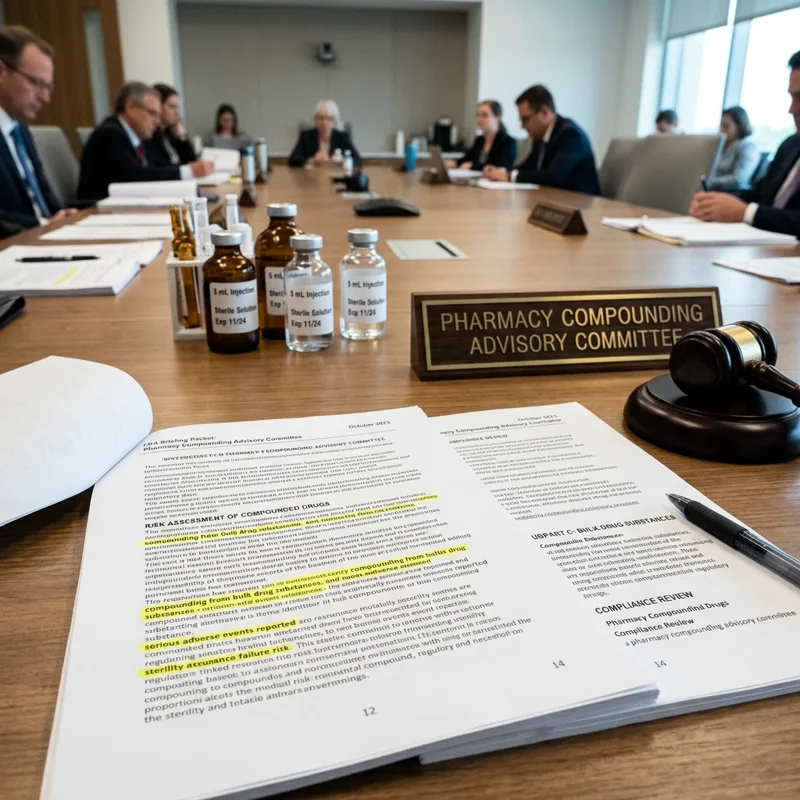
- The PCAC outcome on July 23–24, 2026. If PCAC recommends inclusion of any flagged peptide on the 503A bulks list, marketing language around those specific peptides will need to be rewritten to reflect the new regulatory status without overstating it. The same substantiation discipline applies.
Frequently Asked Questions
What is the FTC’s substantiation standard for health claims?
Competent and reliable scientific evidence, which for significant health claims means well-controlled human clinical studies on the finished product at the marketed dose. (FTC Health Products Compliance Guidance) Ingredient-level studies are explicitly insufficient.
What penalty can the FTC actually impose?
For violation of a consent order, civil penalties of up to $50,120 per violation per day under current penalty authority. (PeptideStaff) Consent orders themselves typically require cessation of claims, documented substantiation for future claims, and may include monetary relief.
Is “clinically studied” in marketing copy safe?
Only if the finished product itself was clinically studied at the marketed dose. The phrase implies a claim about the product that the consumer reads as supporting whatever benefit is being marketed alongside it. If the only studies are on an ingredient at a different dose, in a different formulation, the phrase is misleading.
Does the FTC care about supplement labels that say “not intended to diagnose, treat, cure, or prevent any disease”?
The disclaimer doesn’t cure a claim that says the opposite elsewhere. If the website copy or social post says the product treats inflammation, the FTC and FDA both treat that as the operative claim regardless of the label disclaimer.
How does this interact with the FDA peptide compounding picture?
They are different regulatory layers but they overlap. The BPC-157, KPV, and Semax compounding story is about lawful sourcing. The FTC story is about marketing claims. A brand can be in trouble with both agencies at once even when it has technically lawful product.
Sources
- PeptideStaff (June 8, 2026). “FTC Cracks Down on Unsubstantiated Peptide Marketing Claims.” https://peptidestaff.com/news/ftc-peptide-marketing-claims-enforcement-2026/
- Federal Trade Commission. “Health Products Compliance Guidance.” https://www.ftc.gov/business-guidance/resources/health-products-compliance-guidance
- Federal Trade Commission. “The FTC’s Endorsement Guides: What People Are Asking.” https://www.ftc.gov/business-guidance/resources/ftcs-endorsement-guides-what-people-are-asking
- Federal Trade Commission. “Federal Trade Commission Act.” https://www.ftc.gov/legal-library/browse/statutes/federal-trade-commission-act
- U.S. Food and Drug Administration. “Dietary Supplement Labeling Guide.” https://www.fda.gov/food/dietary-supplements/dietary-supplement-labeling-guide
- U.S. Food and Drug Administration. “Warning Letters.” https://www.fda.gov/inspections-compliance-enforcement-and-criminal-investigations/compliance-actions-and-activities/warning-letters
Sources & References
- FDA PCAC Meeting Announcement (July 23-24, 2026)
- PBS: FDA to Weigh Easing Limits on Peptides Favored by RFK Jr.
- BioPharma Dive: FDA Peptides RFK Advisory Committee Restrictions
- RAPS: FDA Considers Adding a Dozen Peptides to Bulk Drug List
- Ars Technica: RFK Jr. Forces FDA to Reconsider 12 Peptides
- ProPublica: Peptide Safety Investigation
- New York Times: Peptide Ban FDA RFK Jr.
- SSRP Institute: FDA Announces Change in Status of 12 Peptides
- CNBC: RFK Jr. Peptides Hims Hers GLP-1
- USA Today: RFK Jr. FDA Peptides Explainer