FDA just moved the GLP‑1 peptide supply chain from a background compliance issue to a frontline border action. On June 22, the agency published Import Alert 66‑80, titled “Detention Without Physical Examination of Glucagon‑Like Peptide‑1 (GLP‑1) Receptor Agonist Bulk Drug Substances.” The mechanics matter: it’s a DWPE alert—“detention without physical examination”—which flips the default posture at ports of entry from release unless FDA intervenes to detain unless the importer can overcome the appearance of a violation. For peptide buyers, compounding pharmacies, and anyone selling “research-use” GLP‑1 APIs, this is the kind of quiet operational change that can rewrite the market overnight.
This post explains what FDA actually said, why the agency built a “green list” pathway for GLP‑1 APIs, and what quality documentation is now effectively becoming table stakes if you want GLP‑1 peptide ingredients to keep moving.
What changed: GLP‑1 APIs are now a named DWPE target
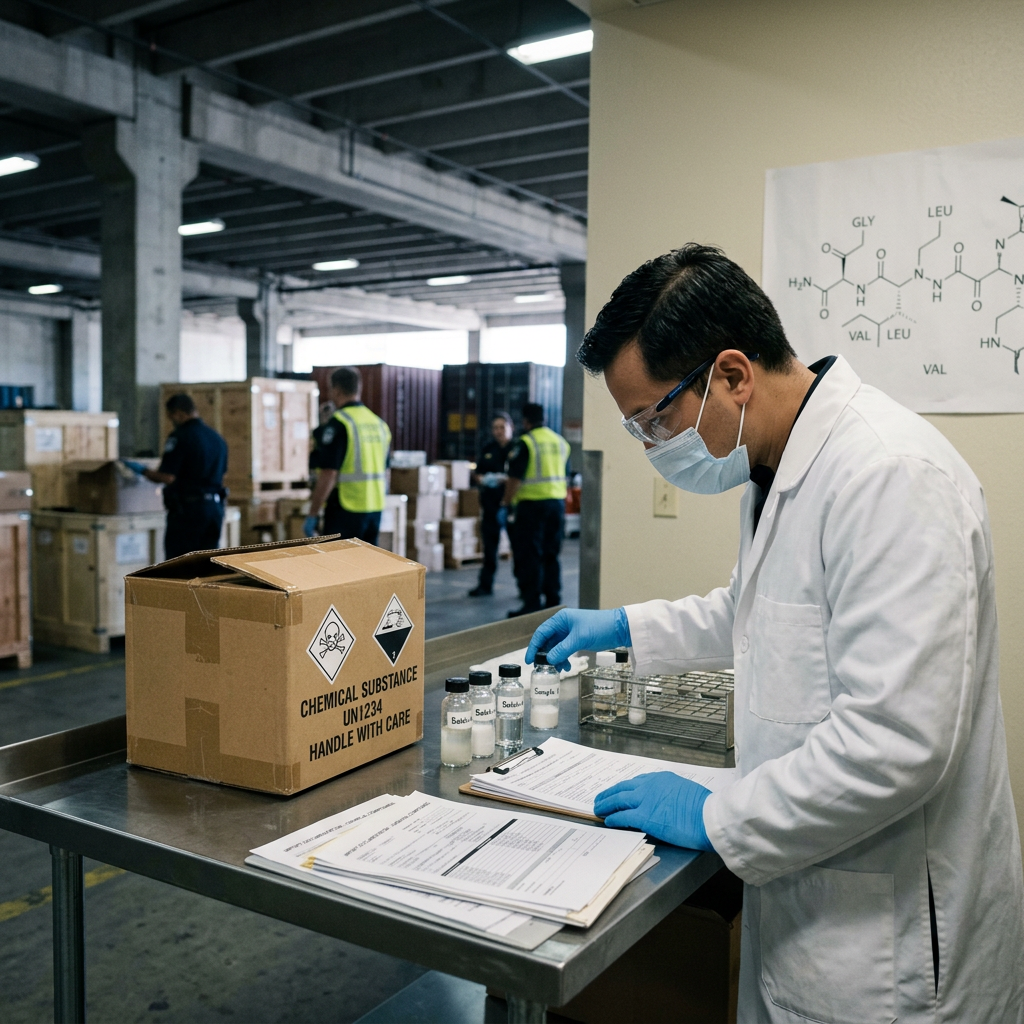
The import alert is unusually direct. It authorizes FDA field divisions to detain “shipments of GLP‑1 APIs offered for entry” without physical examination, with an exemption for products and firms listed on the alert’s Green List. That’s not a press release; it’s an instruction manual for what happens to cartons and drums when they arrive at a U.S. port.
FDA frames the alert as a response to a specific pattern in the GLP‑1 era: shortages of approved GLP‑1 drugs drove a surge in compounding, and compounding drove demand for bulk active pharmaceutical ingredients sourced globally. In the import alert text, FDA describes evaluating 48 GLP‑1 API sites via onsite inspections and remote assessments, and says 21% were found “noncompliant” under section 501 of the FD&C Act, either due to evidence of CGMP noncompliance or because firms didn’t respond to FDA’s records requests in time. The agency also flags a “register / offer for import / refuse to answer / deregister” pattern that makes the supply chain hard to police.
FDA’s logic is blunt: because the agency is concerned that GLP‑1 APIs used in compounding “may be adulterated,” “foreign‑sourced GLP‑1 APIs should be considered for detention without physical examination (DWPE) based on the appearance of adulteration.”
DWPE, in plain English: the burden shifts to the importer
“Detention without physical examination” sounds like a technical term, but its practical effect is immediate. Under DWPE, FDA doesn’t need to open each shipment or run its own lab tests to hold product. A shipment can be detained because it appears violative based on known risks, past evidence, or the characteristics of the product class. The importer is then the party who has to prove why this shipment should be released.
For peptide APIs, that’s not just a paperwork hassle. The DWPE model penalizes informal supply chains. If your GLP‑1 raw material moves through a broker, is relabeled as “research peptide,” or arrives with thin documentation, the practical outcome is predictable: delays, detention, and sometimes refusal.
The Green List is FDA’s “trusted lane” for GLP‑1 API manufacturers
FDA calls 66‑80 a “green list import alert” in its consumer-facing GLP‑1 warning page. The Green List concept is simple: the alert lists registered foreign manufacturers whose facilities and associated products, based on FDA’s evaluation of recent evidence, “appear to be in compliance with CGMP requirements.” If you’re on that list for a particular product code, the alert says your shipments are excluded from the recommendation for DWPE under 66‑80.
In other words: this isn’t a blanket ban on GLP‑1 APIs. It’s a sorting mechanism. FDA is building a lane for documented, inspected—or otherwise evaluated—manufacturing sites, while putting the default detention posture on the rest of the category.
That distinction matters for compounding conversations. FDA’s GLP‑1 advisory stresses that the import alert “does not stop the legal importation” of GLP‑1 APIs from compliant manufacturers and “does not create any new limits on the legal compounding of GLP‑1 drugs.” But it does change the operational reality of sourcing: if your upstream manufacturer can’t clear the documentation bar, it gets harder to treat imported GLP‑1 API as a reliable input.
Why GLP‑1 peptides got singled out
Peptide supply chains have been a longstanding enforcement target, but GLP‑1s are different for three reasons.
1) Demand is enormous, and the incentives are weird
When a therapy becomes culturally ubiquitous, markets form around it that don’t look like normal pharma. Telehealth brands pop up. “Weight loss clinics” resell mail-order injectables. “Research peptides” are marketed with wink-and-nod dosing guides. FDA’s June 15 statement warns about fraudulent compounded semaglutide and tirzepatide with false labels, including cases where the pharmacy listed on the label doesn’t exist, and cases where a real pharmacy’s name is used even though FDA says it didn’t compound the product.
2) Compounding can amplify upstream quality problems
In the import alert, FDA notes that API manufacturers are subject to CGMP requirements, but compounders operating under section 503A are exempt from CGMP, including requirements to ensure API meets certain specifications. FDA’s point isn’t that all compounding is unsafe; it’s that compounding can be a weak link for monitoring upstream variability. If a bulk drug substance has impurities, potency drift, or microbial issues, a non-CGMP compounding pathway may not catch it consistently.
3) FDA is treating bulk GLP‑1 ingredient quality as a border problem
FDA’s public-facing GLP‑1 warning page includes an “FDA actions at the border” section that explicitly ties the consumer safety message to Import Alert 66‑80. The agency describes the alert as a way to help stop GLP‑1 APIs with potential quality concerns from entering the U.S. supply chain, while carving out an exception for manufacturers that appear compliant based on inspections or other evaluation.
What FDA is asking manufacturers to submit (and why it matters)
The most operationally important part of Import Alert 66‑80 isn’t the title—it’s the documentation list FDA provides for manufacturers seeking removal from DWPE (i.e., addition to the Green List). Read it as a checklist of what FDA considers minimally persuasive evidence that a GLP‑1 API supply chain is real, stable, and controlled.
Examples from the alert include:
- Certificates of analysis (COAs) for the last ten lots (or all lots if fewer) and an example COA that would accompany each lot.
- Release specifications and testing methods, including justification for impurity, potency, and microbial specs for APIs intended for injectable drug products.
- Stability protocols and summary reports for each GLP‑1 API manufactured.
- Starting material specifications and testing reports.
- Test method validation (or USP verification) for release testing.
- Process validation protocols and reports, plus master batch records and recent batch records.
- Equipment lists (shared vs dedicated) and qualification dates.
- Out-of-specification (OOS) results and investigation reports.
- Quality unit org charts; SOP lists; and summaries of complaints, adverse events, recalls, and returns.
This is not the documentation footprint of an informal “research peptide” vendor who is simply reselling powder and hoping nobody asks questions. It’s a manufacturing-quality dossier. And even though the alert text is framed as guidance for FDA field personnel, it effectively sets a new baseline for how credible GLP‑1 API suppliers will need to look to keep product moving at scale.
What this means for compounders, clinics, and peptide buyers
There are two ways to read this alert.
One reading is defensive: it’s FDA reacting to a flood of questionable GLP‑1 bulk substances by creating a detention default and an off-ramp (the Green List) for suppliers who can document compliance.
The other reading is structural: FDA is shifting enforcement upstream. The agency isn’t only policing whether a finished syringe is misbranded. It’s trying to control what ingredients can reliably enter the country—and to make “paper thin” API provenance a non-starter.
Practical takeaways:
- If you compound or dispense GLP‑1s: supplier qualification suddenly looks less like a procurement formality and more like existential risk management. Expect questions about FEI numbers, inspection history, and documentation readiness.
- If you’re a clinic or telehealth brand: the “deep discount” supply chain becomes harder to defend. FDA’s June 15 page lists telehealth red flags (claims that compounded equals approved, suspicious pricing, damaged packaging, no prescription screening, label errors) that map directly onto the business models that have proliferated around GLP‑1 demand.
- If you’re a research buyer: you may see longer lead times and more volatility for GLP‑1-related materials that previously moved with minimal friction.
Related peptides and why they’re in the blast radius
FDA’s June 15 page explicitly warns that some companies have illegally sold unapproved drugs containing semaglutide and tirzepatide and have also sold products containing retatrutide that are falsely labeled “for research purposes” or “not for human consumption.” It also says retatrutide and cagrilintide “cannot be used in compounding under federal law,” and reiterates that semaglutide salt forms (semaglutide sodium and semaglutide acetate) are different active ingredients than those used in FDA-approved drugs.
Even if 66‑80 is written as a GLP‑1 import alert, the policy signal is broader: when a peptide category becomes a high-risk public-health story, FDA is willing to use import tools to shape the ingredient layer. That pattern is relevant well beyond incretin drugs.
Frequently Asked Questions
Does Import Alert 66‑80 ban GLP‑1 peptide imports?
No. It authorizes DWPE for GLP‑1 APIs offered for entry, with an exemption for products and firms on the alert’s Green List. FDA also says the action does not stop legal importation from compliant API manufacturers.
What is the “Green List” in an import alert?
In this context, it’s the list of registered foreign manufacturers and associated GLP‑1 API products that FDA says appear to be in compliance with CGMP requirements based on recent evidence. Products and firms on the Green List are excluded from the recommendation for DWPE under the alert.
Is FDA targeting compounded semaglutide and tirzepatide specifically?
FDA’s June 15 statement focuses on unapproved GLP‑1 drugs used for weight loss and flags fraudulent compounded semaglutide and tirzepatide, counterfeit Ozempic, and illegally marketed products labeled “for research purposes.” Import Alert 66‑80 targets the bulk API layer that can feed those channels.
If my supplier isn’t on the Green List, does that mean the API is illegal?
Not necessarily. The import alert is an enforcement instruction about detention posture at the border, not a statement that every non‑Green‑List API is unlawful. But operationally, being off the list raises the probability of detention and delays.
What evidence does FDA want to see from GLP‑1 API manufacturers?
Import Alert 66‑80 lists examples including COAs for recent lots, stability and validation documentation, release specifications and testing methods, batch records, process validation, equipment qualification, SOP lists, and quality system details. The point is to demonstrate CGMP-compliant manufacturing and distribution.
Sources (most recent first)
- FDA AccessData. Import Alert 66‑80: Detention Without Physical Examination of GLP‑1 Receptor Agonist Bulk Drug Substances (published June 22, 2026; accessed June 29, 2026).
- FDA. FDA’s Concerns with Unapproved GLP‑1 Drugs Used for Weight Loss (June 15, 2026; accessed June 29, 2026).
- FDA AccessData. Import Alerts by Publish Date (accessed June 29, 2026).
Medical note: This article is for information only and does not provide medical advice. GLP‑1 drugs are prescription medications; talk with a licensed clinician about treatment decisions.
Sources & References
- FDA PCAC Meeting Announcement (July 23-24, 2026)
- PBS: FDA to Weigh Easing Limits on Peptides Favored by RFK Jr.
- BioPharma Dive: FDA Peptides RFK Advisory Committee Restrictions
- RAPS: FDA Considers Adding a Dozen Peptides to Bulk Drug List
- Ars Technica: RFK Jr. Forces FDA to Reconsider 12 Peptides
- ProPublica: Peptide Safety Investigation
- New York Times: Peptide Ban FDA RFK Jr.
- SSRP Institute: FDA Announces Change in Status of 12 Peptides
- CNBC: RFK Jr. Peptides Hims Hers GLP-1
- USA Today: RFK Jr. FDA Peptides Explainer