
What's Actually Going On
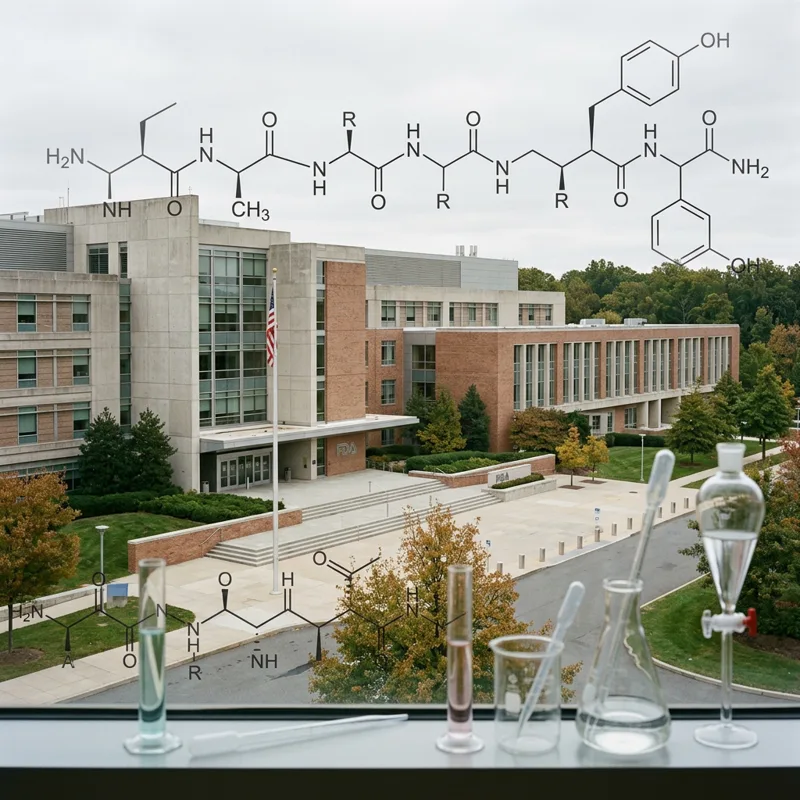
A Syracuse University research team led by Robert Doyle has been working on an experimental obesity peptide called GEP-44 since at least 2021. The compound is a 44-amino-acid chimeric peptide that activates three receptors at once — the GLP-1 receptor and two arms of the peptide YY receptor family, Y1 and Y2. In rodents, it reduces food intake and body weight, lowers fasting glucose, and produces almost no nausea-like behavior compared with the GLP-1-only reference drug used in those studies. A press release syndicated through the National Law Review on May 11, 2026 brought the program back into the popular news cycle. The underlying science is real. The framing in the syndicated piece is incomplete in ways worth correcting before anyone makes decisions based on it.
This article does three things. It walks through what GEP-44 actually is at the level of receptor pharmacology, drawing on the peer-reviewed papers rather than the press release. It explains what the rodent and shrew data show and what they do not show. And it flags two specific places where the press-release version of the story should not be taken at face value: the comparator drug, and the development stage.
Key Facts
- Compound: GEP-44, a 44-amino-acid chimeric peptide
- Receptor targets: GLP-1R, Y1R (NPY1R), Y2R (NPY2R)
- Lab: Robert Doyle Group, Syracuse University (chemistry); collaboration with James Blevins, VA Puget Sound / University of Washington (physiology)
- Stage: Preclinical — rodent and shrew models, no human trials yet
- Lead efficacy study: Brierley et al., Cell Reports Medicine, 2021 (PMID 33449689)
- Mechanism study: Honeycutt et al., Frontiers in Endocrinology, July 2024 (PMID 39104812)
- Energy expenditure follow-up: bioRxiv preprint, January 2025 (peer-reviewed February 2025, PMID 39829931)
- Comparator in published trials: exendin-4 (Ex-4), the rodent-research GLP-1 agonist analog of exenatide — not liraglutide, despite some press coverage
- Sister compound: KCEM1, also from the Doyle Group, similar receptor profile
- Practical limitation: Current formulation requires daily injection; team is working on a long-acting reformulation
Why Three Receptors
The clinical story of GLP-1 agonists in 2026 is roughly this. Semaglutide and tirzepatide work. They drive weight loss in the 15 to 22 percent range over roughly a year of dosing. They cause nausea, vomiting, and constipation in a meaningful fraction of patients, and a meaningful fraction of patients stop the drug because of those side effects. Real-world adherence at 12 months is well below the trial discontinuation rate. Newer multi-receptor agonists — retatrutide (GLP-1 plus GIP plus glucagon, Eli Lilly) and survodutide (GLP-1 plus glucagon, Boehringer) — push efficacy further but do not yet show a clearly cleaner GI profile.
GEP-44 takes a different bet. Instead of stacking more incretin and glucagon activity onto a GLP-1 backbone, the Doyle Group went after peptide YY signaling. PYY is a satiety hormone secreted from intestinal L-cells alongside GLP-1. PYY signals through several Y-type receptors. Y1R activation in arcuate nucleus neurons is broadly associated with feeding and metabolic regulation. Y2R is the receptor traditionally associated with appetite suppression and the satiety signal of postprandial PYY. The pharmacology is more layered than that, but the bet of GEP-44 is roughly: combine GLP-1R agonism (the validated weight-loss mechanism) with Y1R and Y2R agonism (an independent satiety mechanism that does not run through the same nausea pathway as GLP-1 alone).
The 2023 Doyle paper in PNAS reported something more counterintuitive: in pancreatic islets, GEP-44's effects on insulin secretion looked like GLP-1R-driven secretion that had been put through a Y1R-mediated brake. That is, the Y1R component partially antagonizes one of the GLP-1R downstream signals while letting the appetite-and-weight signal through. If that pattern holds in humans, it is a fundamentally different design philosophy from the additive multi-agonist drugs Lilly and Boehringer are pushing forward.
What the Published Data Actually Show
The 2021 paper is where GEP-44 first appears in print. Brierley and colleagues at Doyle's group screened a library of GLP-1/Y2R chimeric peptides, picked GEP-44, and ran it in lean and diet-induced obese rats against exendin-4 as the active comparator. GEP-44 produced greater body weight reduction than Ex-4 at matched doses. The shrew studies — shrews vomit, rats do not, so they are the standard animal model for assessing GLP-1 emesis — showed near absence of emesis for GEP-44 compared with Ex-4. That is the original signal: matched or better weight effect, dramatically fewer signs of GI distress.
The 2024 paper in Frontiers in Endocrinology filled in the mechanism by using GLP-1R knockout mice. In wild-type diet-induced obese mice, GEP-44 reduced body weight, food intake, core temperature, and fasting blood glucose. In GLP-1R knockout mice on the same diet, those effects largely disappeared. The conclusion: GEP-44's metabolic effects in mice are primarily GLP-1R dependent. The Y1 and Y2 contributions appear to modulate the GLP-1 signal — including the nausea pathway — rather than substitute for it.
The January 2025 preprint (peer-reviewed in February) addressed energy expenditure. The team had hypothesized that part of GEP-44's effect might come from increased thermogenesis. The data did not support that hypothesis. Weight loss was driven by reduced food intake and increased lipid oxidation, with energy expenditure actually decreasing on the drug. That last finding is honest negative data and worth attention. A drug that lowers EE while suppressing intake is a drug whose efficacy will eventually run into a wall as the body adapts. The authors note this.
So the body of evidence is: in rodents, GEP-44 outperforms exendin-4 on weight and glycemic control with substantially less GI distress signaling, works primarily through GLP-1R, and reduces rather than increases energy expenditure. All preclinical. All in animals.
The Comparator Problem
The syndicated press piece framed GEP-44 as achieving roughly 15 percent weight reduction versus around 9 percent for liraglutide. That framing is at minimum imprecise. The published trials compared GEP-44 against exendin-4, not against liraglutide. Exendin-4 is the rodent-standard GLP-1 analog, the molecule from which exenatide was developed. It is short-acting, used at high doses in rodent feeding studies, and is the standard for GLP-1 emesis screens in shrews. It is not what a patient on a 2026 weight-loss prescription is taking.
The relevant 2026 comparators are semaglutide (15 to 17 percent weight loss at 2.4 mg weekly, STEP trials) and tirzepatide (around 20 to 22 percent at 15 mg weekly, SURMOUNT trials). Liraglutide (Saxenda) is now a back-bench drug in this space, used mostly when semaglutide and tirzepatide are unavailable or denied by insurance. A preclinical chimeric peptide outperforming exendin-4 in rats is not the same data point as a drug outperforming semaglutide in humans. The two are years and several phases of clinical development apart.
That distance matters because GLP-1 drugs have a long history of looking better in animals than they do in humans on the GI side. Exendin-4 is a particularly clean model for nausea screening in shrews precisely because it produces clear emetic signals. A drug that suppresses those signals against Ex-4 in shrews may or may not do the same against weekly semaglutide in humans. The shrew data are encouraging. They are not predictive.
What "Preclinical" Means in Practical Terms
The Syracuse team has filed patents, talked to investors, and described intentions to advance toward IND-enabling studies and eventually Phase 1 trials. None of that is the same as an active IND filing or a registered Phase 1 trial. As of the May 2026 press cycle, GEP-44 is not listed on ClinicalTrials.gov in any active or recruiting trial. There is no first-in-human dose-escalation study underway that has been publicly disclosed.
For context: a preclinical peptide with strong rodent data and IND-enabling work pending typically reaches Phase 1 in roughly two to four years if everything goes well and the program is well-funded. Phase 1 reads out 12 to 24 months after start. Phase 2 follows. Phase 3 follows. A realistic earliest-possible FDA approval window for a preclinical compound publicized today, even one with no setbacks, is the early 2030s. For comparison, semaglutide's first GLP-1 paper to its first FDA approval (for diabetes) took roughly 12 years.
The other practical limitation is the daily-injection problem. Current GEP-44 formulation, per the Syracuse team's own published interviews, requires once-daily subcutaneous injection. The 2026 weight-loss market has moved to once-weekly injection (semaglutide, tirzepatide) and is moving toward once-monthly and oral options. A daily-injection peptide entering the market a decade from now would be at a substantial adherence disadvantage. The Doyle Group is working on a long-acting reformulation. That reformulation has not been disclosed in published efficacy or PK data. Until it has, the daily-injection limitation is a real and underappreciated piece of the GEP-44 story.
Why This Still Matters
None of the above is a dismissal of the program. The Doyle Group's chimeric peptide approach is scientifically interesting in a way most of the current next-generation GLP-1 race is not. The dominant industry pattern right now is additive multi-receptor agonism: GLP-1 plus GIP, GLP-1 plus glucagon, GLP-1 plus GIP plus glucagon. The bet is that more receptors equals more weight loss. The evidence so far supports that bet on efficacy but not on tolerability.
GEP-44's design is closer to a tuned signaling profile than a stacked one. The data suggesting Y1R can act as a modulating brake on GLP-1R-driven nausea, while leaving the appetite-suppressing arm intact, is the kind of finding that, if it translates, opens a different design space for obesity drugs. Not necessarily more potent than tirzepatide. Potentially cleaner. That is a real question worth funding through human trials.
The same Doyle Group has reported, in unpublished interview material and conference presentations, that GEP-44 reduces opioid-seeking behavior in addiction models. GLP-1 agonists more broadly are now in serious clinical evaluation for alcohol use disorder, cocaine use disorder, and opioid use disorder — semaglutide has shown signals in retrospective EHR analyses and small Phase 2 trials. A multi-receptor peptide that targets reward circuitry through both GLP-1 and PYY pathways could be a different kind of tool for those indications than a pure GLP-1 agonist. The addiction angle is preclinical, but it is the kind of mechanistic adjacency that small academic peptide programs sometimes turn into licensable IP faster than they turn into approved obesity drugs.
What This Means for Patients, Clinics, and Buyers
Nothing changes in clinical care this month. GEP-44 is not available by prescription. It is not available through compounding pharmacies. It is not on the FDA's bulk drug substance lists for compounding under section 503A. Any product sold online as "GEP-44," "GEP44," or "Syracuse triple agonist" is by definition not the compound described in the Doyle Group's papers. It is at best an unverified peptide from a research-chemical supplier with no chain of custody to the academic source material, and at worst is not the compound at all.
For clinicians fielding patient questions about GEP-44 after the May press cycle, the honest answer has three parts. First: this is a preclinical compound in rodents and shrews, not a human drug. Second: the press-release framing comparing it to liraglutide is imprecise; the published comparator was exendin-4, and no human data exists. Third: if it ever reaches the clinic, it will be after a multi-year IND, Phase 1, Phase 2, and Phase 3 sequence that has not yet started.
For investors and biotech watchers, the questions to track are concrete. Has the Doyle Group's licensee filed an IND? Has the long-acting reformulation been published with PK data? Is there a registered Phase 1 trial on ClinicalTrials.gov? These are the milestones that distinguish a strong preclinical academic program from a clinical-stage drug. None of them has happened yet.
Frequently Asked Questions
Is GEP-44 available now?
No. GEP-44 is preclinical. It has not been tested in humans. It is not FDA-approved. It is not sold by any legitimate pharmaceutical channel. Any product labeled as GEP-44 from a research-chemical supplier is not connected to the Doyle Group's academic program and has no quality control linking it to the published compound. There is no legitimate clinical or research-use pathway for GEP-44 outside future FDA-authorized trials, which have not been registered.
When could GEP-44 reach Phase 1?
The Syracuse team has described intentions to advance toward IND-enabling studies. That phrase covers a specific package of regulatory toxicology, manufacturing characterization, and pharmacokinetic work that the FDA requires before human dosing. The standard timeline from a strong preclinical compound to a first-in-human Phase 1 dose, assuming adequate funding and no setbacks, is roughly two to four years. As of May 2026, no IND has been publicly filed and no Phase 1 trial has been registered on ClinicalTrials.gov.
Why does the press say 15% versus 9% for liraglutide?
That framing is imprecise. The Doyle Group's published trials compared GEP-44 against exendin-4, the standard rodent-research GLP-1 analog, not against liraglutide. The "15 percent" is a rodent body weight reduction figure from a several-day study in diet-induced obese rats. The "9 percent for liraglutide" is a separate number from human trials of Saxenda. Comparing the two directly is a category error: different species, different study durations, different drugs, different comparators. The honest comparison is rodent GEP-44 versus rodent exendin-4, where GEP-44 did outperform. Whether it would outperform weekly semaglutide or tirzepatide in humans is not known and cannot be inferred from the published data.
Does GEP-44 actually have less nausea?
In shrew studies it produced near-absence of emesis at doses where exendin-4 produced clear vomiting. Shrews are the standard animal model for GLP-1-induced nausea because rats and mice do not vomit. The shrew result is the basis for the "less nausea" claim. Whether the same advantage holds against modern long-acting GLP-1 agonists (semaglutide, tirzepatide) in humans is unknown. There are no human studies. The shrew data are encouraging but are not predictive of clinical tolerability.
Is GEP-44 the same thing as retatrutide or survodutide?
No. Retatrutide (Eli Lilly) is a triple agonist targeting GLP-1, GIP, and glucagon receptors. Survodutide (Boehringer Ingelheim) is a dual GLP-1/glucagon agonist. GEP-44's three receptor targets are GLP-1, Y1, and Y2 — a different mechanistic family. The PYY-receptor arm is the distinctive feature of GEP-44 and is what differentiates it from the incretin-and-glucagon multi-agonist class that currently dominates next-generation obesity drug development.
What is KCEM1?
KCEM1 is a sister peptide from the same Doyle Group at Syracuse University. It targets a related receptor profile and was developed alongside GEP-44 as part of the lab's chimeric peptide program. Less data has been published on KCEM1 than on GEP-44. Both compounds have been described in interviews and conference settings as candidates for further development.
How does the GLP-1 plus PYY mechanism actually reduce nausea?
The leading hypothesis from the Doyle Group's PNAS work is that Y1 receptor agonism acts as a partial brake on one branch of GLP-1 receptor downstream signaling — the branch involved in producing nausea — while leaving the appetite-suppressing and glucose-regulating branches intact. The 2024 GLP-1R knockout study supports the broader claim that GEP-44's metabolic effects depend on GLP-1R activation, with Y1 and Y2 modulating rather than substituting for that signal. The detailed signal-bias pharmacology is the most distinctive piece of GEP-44 and the part that, if it translates to humans, could matter most.
Sources
- The Next Generation of the GLP-1 Revolution Is Already Underway — National Law Review press-release syndication, May 11, 2026 (proximate trigger for this article)
- Design and Evaluation of Peptide Dual-Agonists of GLP-1 and Y2R — Brierley et al., 2021 (PMID 33449689) (original GEP-44 efficacy and shrew emesis data)
- A peptide triple agonist of GLP-1, neuropeptide Y1 and Y2 receptors — Doyle Group, 2023 (PMID 37308546) (the Y1R/GLP-1R signal-bias pharmacology in pancreatic islets)
- The novel chimeric multi-agonist peptide (GEP44) reduces body weight in DIO mice via GLP-1R — Honeycutt et al., Frontiers in Endocrinology, July 2024 (PMID 39104812) (GLP-1R-knockout mechanism study)
- Frontiers in Endocrinology full text — same 2024 paper, full text version
- The Chimeric Peptide (GEP44) Reduces Body Weight via Lipid Oxidation and Reduced Energy Intake — Roth Group / Doyle Group, February 2025 (PMID 39829931) (energy expenditure follow-up)
- Peptide Drug Advances Being Made on Syracuse University Campus — Syracuse University News, January 2025 (Doyle Group long-acting reformulation work and opioid-addiction adjacency)
- Seattle Children's Hospital — Chimeric Peptide Therapeutics partnership opportunity — Blevins/Roth Group collaboration overview
- Once-Weekly Semaglutide in Adults with Overweight or Obesity — Wilding et al., NEJM, 2021 (STEP 1, the human semaglutide efficacy benchmark)
- Tirzepatide Once Weekly for the Treatment of Obesity — Jastreboff et al., NEJM, 2022 (SURMOUNT-1, tirzepatide efficacy)
- ClinicalTrials.gov — the public registry where any active GEP-44 Phase 1 trial would appear (no current GEP-44 trial listed as of May 2026)
Sources & References
- FDA PCAC Meeting Announcement (July 23-24, 2026)
- PBS: FDA to Weigh Easing Limits on Peptides Favored by RFK Jr.
- BioPharma Dive: FDA Peptides RFK Advisory Committee Restrictions
- RAPS: FDA Considers Adding a Dozen Peptides to Bulk Drug List
- Ars Technica: RFK Jr. Forces FDA to Reconsider 12 Peptides
- ProPublica: Peptide Safety Investigation
- New York Times: Peptide Ban FDA RFK Jr.
- SSRP Institute: FDA Announces Change in Status of 12 Peptides
- CNBC: RFK Jr. Peptides Hims Hers GLP-1
- USA Today: RFK Jr. FDA Peptides Explainer