Eli Lilly said Thursday that its triple-agonist obesity drug retatrutide hit every primary and key secondary endpoint in TRIUMPH-1, the Phase 3 registration trial that will anchor the company's expected FDA filing. Participants on the 12 mg dose lost an average of 28.3% of their body weight over 80 weeks. Placebo: 2.2%. That gap is the largest reported in any Phase 3 obesity trial. It puts retatrutide on a different efficacy plateau than the GLP-1 and dual-incretin agonists that have driven the obesity drug market for the last three years.
The data were released through a Lilly press announcement on May 21, 2026. They have not been peer-reviewed. They have not been published in a journal. Lilly says it plans full presentation at a scientific congress later this year, and the FDA filing will follow on a schedule the company has not yet specified publicly. None of that is unusual; topline obesity data has been released this way for the entire class. What is different here is the size of the effect.
What TRIUMPH-1 Actually Reported
TRIUMPH-1 randomized 2,339 adults with obesity (BMI ≥30) or overweight with at least one weight-related comorbidity, without diabetes, 1:1:1:1 across three retatrutide doses and placebo. The trial ran 80 weeks. A subset of 532 participants with BMI ≥35 at baseline who tolerated their assigned dose continued into an extension out to 104 weeks. Average baseline weight in the main 80-week analysis was 112.7 kg (248.5 lbs), BMI 40.0. The population skewed heavier than ATTAIN or SURMOUNT, which matters when comparing across programs.
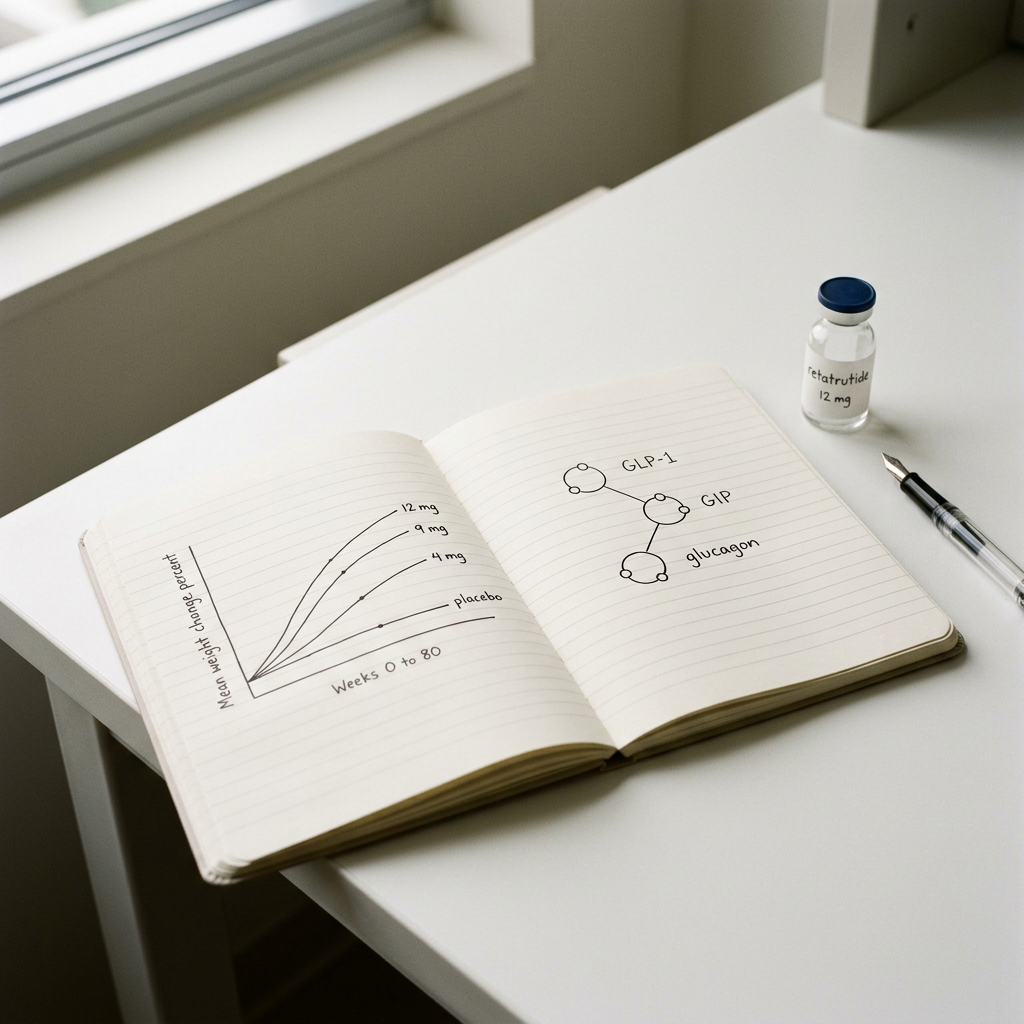
Mean percent body weight change at 80 weeks, by dose:
- Retatrutide 4 mg: −19.0% (−47.2 lbs)
- Retatrutide 9 mg: −25.9% (−64.4 lbs)
- Retatrutide 12 mg: −28.3% (−70.3 lbs)
- Placebo: −2.2% (−5.5 lbs)
Responder rates at the 12 mg dose are the more interesting number for clinicians. 62.5% of participants lost at least 25% of their body weight. 45.3% lost at least 30%. 27.2% lost at least 35%. Those are surgical-range outcomes from a once-weekly injection. 65.3% of participants on 12 mg ended the 80-week trial with a BMI under 30 — meaning they no longer met the clinical definition of obesity. Among the subgroup that started in class 3 obesity (BMI ≥40), 37.5% finished under 30.
The extension data are also worth reading carefully. At 104 weeks, participants on 12 mg lost an average of 30.3% (−85.0 lbs). The 9 mg arm lost 29.5%. Weight loss continued past the 80-week primary endpoint rather than plateauing, which is the question every obesity drug has to answer eventually.
Waist circumference fell by 24.1 cm (9.5 in) in the 12 mg arm versus 3.6 cm on placebo.
The Triple-Agonist Mechanism, Briefly
Retatrutide (LY3437943) is a synthetic peptide that activates three receptors at once: GLP-1, GIP, and glucagon. Semaglutide hits one (GLP-1). Tirzepatide hits two (GLP-1 and GIP). Retatrutide adds glucagon receptor agonism on top.
The glucagon piece is the part most people get wrong. Glucagon raises blood sugar in the short term, which sounds like exactly the wrong direction for a diabetes or obesity drug. But chronic glucagon receptor activation also increases resting energy expenditure, promotes fat oxidation in the liver, and reduces hepatic steatosis. The combination — GLP-1 suppressing appetite and slowing gastric emptying, GIP improving insulin sensitivity and adding to weight loss, glucagon burning more energy and pulling fat out of the liver — is the bet Lilly has been testing for half a decade.
TRIUMPH-1 looks like the bet paid off. Whether it pays off in the populations not yet read out — type 2 diabetes (TRIUMPH-2), sleep apnea (TRIUMPH-3), cardiovascular outcomes (TRIUMPH-CVOT) — is the next set of questions.
How This Compares to Tirzepatide and Semaglutide
The honest version of the comparison: cross-trial comparisons in obesity are unreliable. Different populations, different baseline weights, different durations, different definitions of completion. With that caveat, here is what the published Phase 3 data say at peak dose, in adults with obesity and without diabetes:
| Drug | Class | Trial | Duration | Mean weight loss |
|---|---|---|---|---|
| Semaglutide 2.4 mg | GLP-1 | STEP-1 | 68 weeks | ~14.9% |
| Tirzepatide 15 mg | GLP-1 + GIP | SURMOUNT-1 | 72 weeks | ~22.5% |
| Retatrutide 12 mg | GLP-1 + GIP + glucagon | TRIUMPH-1 | 80 weeks | 28.3% |
The roughly 6-percentage-point gap between retatrutide and tirzepatide at peak dose, sustained across more than 2,000 participants, is the data point payers and prescribers will spend the next year arguing about. For a 250-pound starting weight, that's roughly 15 additional pounds lost — clinically meaningful, especially in the heaviest subgroups.
The trial also reported that 65.3% of participants on 12 mg ended below the obesity threshold. No previously approved obesity medication has cleared two thirds of its high-dose arm out of clinical obesity.
The Safety Profile
Adverse events tracked the familiar GLP-1-class pattern, scaled up by dose. At 12 mg: nausea 42.4%, diarrhea 32.0%, constipation 26.1%, vomiting 25.3%. Placebo nausea was 14.8%. None of those numbers will surprise anyone who has prescribed semaglutide or tirzepatide. Most are gastrointestinal, dose-dependent, more common early in titration, and tend to ease with continued treatment.
Two things stand out from the safety package.
First, dysesthesia — the tingling or altered skin sensation that has been retatrutide's signature non-GI side effect since Phase 2 — was lower than expected: 12.5% on 12 mg versus 0.9% on placebo. The earlier TRIUMPH-4 osteoarthritis trial reported 20.9% on the same dose. The TRIUMPH-1 number suggests the signal may be population-dependent. It is still well above what tirzepatide and semaglutide produce, and patients starting the drug need to be told to expect it.
Second, the discontinuation rate due to adverse events was 11.3% on 12 mg. That is higher than placebo (4.9%) but actually lower than the 18.2% reported in TRIUMPH-4. It sits between tirzepatide (around 14.9% in SURMOUNT-1) and semaglutide (around 6.9% in STEP-1). For a drug producing nearly 30% weight loss, an 11.3% discontinuation rate is the kind of trade-off most patients and most clinicians will accept.
Serious adverse events, including gallbladder issues and pancreatitis, are not yet reported in the topline package. Those numbers will appear in the full scientific presentation. They are the ones to read carefully.
What This Does to the Obesity Market
The obesity drug market in May 2026 is essentially a two-company duopoly. Novo Nordisk runs semaglutide and cagrilintide programs. Lilly runs tirzepatide and orforglipron and now retatrutide. Pricing is around $1,000 to $1,500 per month in the US before rebates. Coverage is uneven. Compounded copies have been a recurring regulatory fight, including last week's FDA warning letter to Gram Peptides that named retatrutide explicitly.
TRIUMPH-1 changes the competitive shape in two directions at once. For Lilly internally, retatrutide moves from a hopeful pipeline asset to a pillar of the company's late-decade franchise — alongside tirzepatide, which still dominates the dual-agonist segment, and oral orforglipron, which has its own ATTAIN-1 data showing 12.4% loss in non-diabetic adults. Lilly now has injectable retatrutide for the highest-efficacy patients, injectable tirzepatide for the broad obesity population, and oral orforglipron for patients who refuse injections.
For Novo Nordisk, the answer has to be CagriSema. The cagrilintide plus semaglutide combination has Phase 3 readouts expected throughout 2026 and is targeting weight loss in the 25% range. Whether that closes the gap to retatrutide depends on the actual data, but the strategic logic — adding a second mechanism to semaglutide because semaglutide alone can no longer compete on efficacy — is now obvious. Boehringer Ingelheim's survodutide, a GLP-1/glucagon dual agonist without the GIP component, is a different shape of bet on the same hypothesis: that going beyond pure GLP-1 is where the next decade of obesity pharmacology lives.
Academic peptide programs are working the same problem from different angles. The Syracuse University-developed GEP44 triple agonist uses GLP-1 plus PYY rather than glucagon. The newer cyclic peptide work coming out of the Suga lab is exploring intracellular targets that injectable peptides can't reach. None of those compete with retatrutide on a TRIUMPH-1 timeline; all of them suggest the field believes triple-mechanism peptides are where therapeutic ceilings stop being theoretical and start being practical.
What Has to Happen Before FDA Approval
Lilly has not announced an NDA filing date. The base case, based on the company's prior pattern with tirzepatide, is that filing follows within roughly six months of TRIUMPH-1 topline. Approval would come 10 to 12 months after that under a standard review, faster under priority review. A realistic window: late 2027.
Several pieces of data still need to land before approval can be assumed. The other TRIUMPH trials, especially TRIUMPH-2 in type 2 diabetes and TRIUMPH-3 in sleep apnea, will feed into label breadth. TRIUMPH-CVOT, the cardiovascular outcomes trial in roughly 10,000 patients with established cardiovascular disease, is not expected to report until 2028 or 2029, but interim safety reviews matter. The full TRIUMPH-1 safety package — pancreatitis rates, gallbladder events, hepatic enzymes, cardiovascular signals — has to be acceptable in the FDA review. Manufacturing capacity needs to scale before launch; Lilly has been investing aggressively, but the company has had supply constraints on tirzepatide that compounding pharmacies stepped into. A retatrutide launch into uncovered demand would create the same conditions.
Payer coverage is the other variable. At an expected price in the $1,200 to $1,500 per month range, US insurance plans are going to push back. The argument for coverage is that retatrutide is durable enough to push patients out of obesity entirely in two thirds of cases — which over a decade is cheaper than treating the cardiovascular, metabolic, and orthopedic complications of long-term obesity. Whether actuaries believe that argument is a different question, and 2026 to 2028 is when the answer gets built.
For Clinicians Reading This Today
Retatrutide is not yet approved. It is not legally prescribable in the US outside of clinical trial enrollment. Any product sold online or by a compounding pharmacy as "retatrutide" is, at best, a research chemical of uncertain identity and purity, and at worst what the FDA called out in its May 2026 warning letter — unapproved drug products misbranded for human use. Patients asking about it should be told the trial data are real, the drug is on a credible path to FDA review, and the right move is to wait, not to source it through grey channels.
For patients on tirzepatide or semaglutide today, TRIUMPH-1 does not require any change. Both drugs remain effective. Switching is not an option yet. The relevant clinical conversation, when it becomes one, is for patients who plateau on existing therapy or who would otherwise be candidates for bariatric surgery — a population for whom retatrutide's responder rates start to look like a genuine alternative.
Frequently Asked Questions
How is retatrutide different from semaglutide or tirzepatide?
Think of the receptors as engines. Semaglutide has one engine: GLP-1, which dampens appetite and slows gastric emptying. Tirzepatide has two: GLP-1 plus GIP, the latter contributing both glycemic control and additional weight effects. Retatrutide adds a third: glucagon, which sounds counterintuitive but in chronic activation raises energy expenditure and pulls fat out of the liver. More engines, more pull on more metabolic levers, more weight off. That's the short version.
Is 28.3% weight loss really the highest in any Phase 3 trial?
Among approved or late-stage obesity drugs taken once weekly by injection in adults without diabetes — yes. Bariatric surgery still produces more weight loss on average (35 to 40% with gastric bypass, 25 to 30% with sleeve gastrectomy), but it involves anatomical change. Retatrutide is the first medication to approach the lower end of surgical outcomes in the average patient.
When will retatrutide be available?
Lilly has not committed to a filing date. A reasonable estimate, based on how tirzepatide moved, is FDA submission in late 2026 and a decision in late 2027. Anything earlier would require priority review, which is possible but not the default for obesity. Approval doesn't mean immediate access — coverage, supply, and titration capacity all gate the real availability ramp.
What about the dysesthesia side effect?
In TRIUMPH-1 it occurred in 12.5% of participants on 12 mg, compared to under 1% on placebo. It's typically mild — tingling, altered sensation, especially in the limbs — and dose-dependent. It is also higher than what tirzepatide produces. Whether the mechanism is glucagon-related or peptide-specific isn't fully understood. Patients starting the drug, when it eventually launches, will need to be told to expect the possibility.
How much will it cost?
Lilly has not announced US pricing. Based on tirzepatide's launch price, $1,200 to $1,500 per month before insurance and rebates is the working assumption. Annualized, that's $15,000 to $18,000. Real out-of-pocket cost depends on coverage, which for obesity drugs is currently uneven and likely to remain so until the case for long-term cost offset is settled.
Is there a cheaper or earlier option?
Yes. Tirzepatide and semaglutide are both FDA-approved, available, and effective. Lilly's oral orforglipron is in late-stage development and would arrive as a pill rather than an injection, at presumably lower price. Novo Nordisk's CagriSema combination is reading out throughout 2026 and is the most direct competitor to retatrutide on the injectable side. None of those reach 28%, but all are usable today or close to it.
Sources
- Eli Lilly press release via PR Newswire/Morningstar. "Lilly's triple agonist, retatrutide, delivered powerful weight loss in pivotal Phase 3 obesity trial." PR Newswire. May 21, 2026.
- Mandavilli A. "Experimental Drug Yields Dramatic Weight Loss." The New York Times. May 21, 2026.
- Hopkins JS. "Eli Lilly's New Weight-Loss Treatment Shows Promising Results." The Wall Street Journal. May 21, 2026.
- Constantino A. "Eli Lilly says next-generation weight loss drug clears crucial obesity trial." CNBC. May 21, 2026.
- Jastreboff AM, Kaplan LM, Frías JP, et al. "Triple-Hormone-Receptor Agonist Retatrutide for Obesity — A Phase 2 Trial." New England Journal of Medicine. 2023;389:514-526.
- ClinicalTrials.gov. "A Study of Retatrutide (LY3437943) in Participants Who Have Obesity or Are Overweight (TRIUMPH-1)." NCT05929066.
Sources & References
- FDA PCAC Meeting Announcement (July 23-24, 2026)
- PBS: FDA to Weigh Easing Limits on Peptides Favored by RFK Jr.
- BioPharma Dive: FDA Peptides RFK Advisory Committee Restrictions
- RAPS: FDA Considers Adding a Dozen Peptides to Bulk Drug List
- Ars Technica: RFK Jr. Forces FDA to Reconsider 12 Peptides
- ProPublica: Peptide Safety Investigation
- New York Times: Peptide Ban FDA RFK Jr.
- SSRP Institute: FDA Announces Change in Status of 12 Peptides
- CNBC: RFK Jr. Peptides Hims Hers GLP-1
- USA Today: RFK Jr. FDA Peptides Explainer