
On May 26, the Alabama State Board of Medical Examiners told the state's physicians to stop. No nurse practitioner, no physician assistant, no certified nurse midwife working under any Alabama physician may prescribe, compound, administer, or even recommend a peptide that the U.S. Food and Drug Administration has not approved. A patient consent form will not help. A "research-grade" label on the vial will not help. The Board's notice was four pages, plainly written, and gave no carve-out for clinic protocols, telehealth networks, or wellness practices.
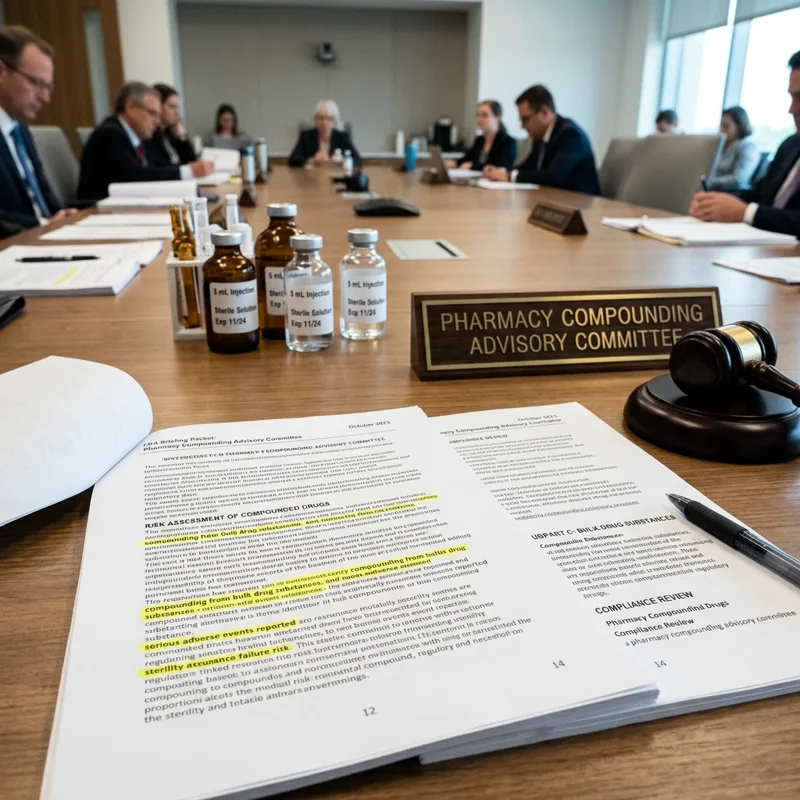
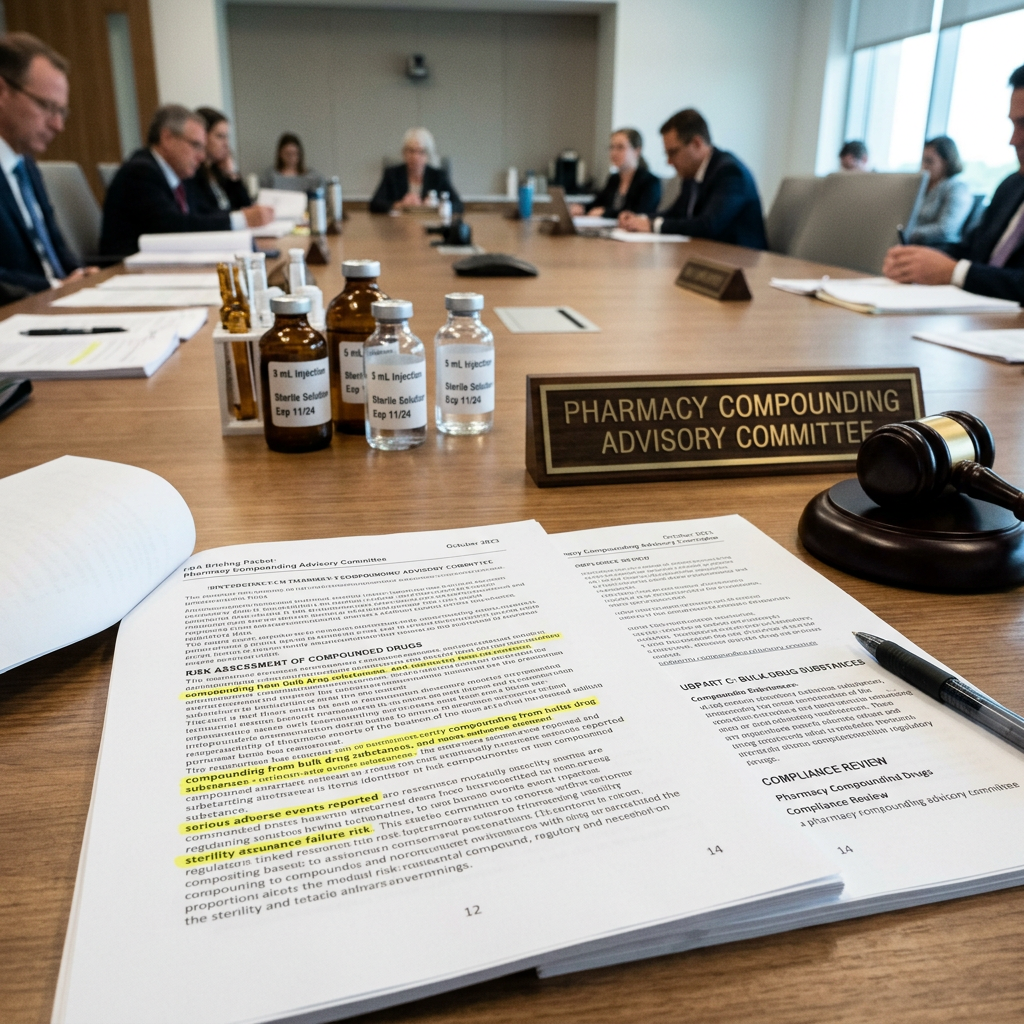
The warning lands seven weeks before the FDA's Pharmacy Compounding Advisory Committee is set to vote on whether emideltide, semax, and epitalon belong on the 503A Bulks List — three of the peptides that have driven the longevity-clinic and wellness-injection economy. Alabama's move is the most direct statement yet by a state medical board that the FDA's pending federal question is, at the state license-to-practice level, already decided.
What the Notice Says
The official notice from the Board carries the headline "Board Issues Official Notice Concerning the Prescribing of Non-FDA Approved (Research-Grade) Peptides." Its operative language is short. Physicians "must purchase all prescription products, drugs, and ingredients from an entity permitted by the Alabama State Board of Pharmacy." Everything they administer to a patient must be "prescription quality." From there, the Board draws the line: "under no circumstances is it permissible for a physician to compound, administer, or dispense a non-FDA approved or research grade peptide to a patient."
The notice closes the obvious workarounds in advance. A physician cannot delegate the purchase, administration, or dispensing of these substances to a Certified Nurse Midwife, Certified Registered Nurse Practitioner, or Physician Assistant. CNMs, CRNPs, and PAs may only handle drugs on a formulary approved jointly by the Board of Medical Examiners and the Alabama Board of Nursing, and "no research grade or non-FDA approved peptide is included on any approved formulary." The prohibition reaches advising, recommending, supplying, prescribing, and administering. Patient consent forms identifying a product as research-grade "are ineffective and do not mitigate or eliminate the health care provider's professional or legal liability."
The Board's only acknowledgement of patient autonomy is narrow: if a patient acquires and self-administers a research-grade peptide entirely independently, the risk is theirs. Any clinical involvement at all — recommending a source, supplying a vial, drawing the syringe — pulls the practitioner back across the line.
Why the Board Moved Now
This is not the Alabama Board's first action against research-grade injectables. In July 2024, the Board issued a Declaratory Ruling at the request of the Alabama Board of Pharmacy, ruling that physicians cannot compound or dispense GLP-1 products using non-prescription-quality ingredients, must purchase only from suppliers permitted by the state Board of Pharmacy, and must comply with USP 797 standards when compounding sterile preparations. That ruling was specific to semaglutide and other tirzepatide-class agonists, prompted by physician offices that had been buying "research grade" GLP-1 powder and the salt forms of semaglutide.
Six months ago, the state's Attorney General opened a second front. In November 2025, AG Steve Marshall filed suit against Aurora IV and Wellness, a Cullman, Alabama IV-infusion clinic, alleging the clinic had advertised tirzepatide and semaglutide as "pharmaceutical-grade" while injecting patients with research-grade versions. The complaint dates the conduct to May 2025. Civil consumer-protection enforcement against one clinic, however, did not stop physicians elsewhere in the state from running the same playbook on BPC-157, ipamorelin, CJC-1295, and the longevity stack. The May 26 notice closes the gap. It applies to every Alabama-licensed prescriber, every peptide that lacks an FDA approval, every modality of involvement.
One thing the notice does not do is enumerate peptides by name. The Board did not write a list. It wrote a category. Anything sold or labeled as research-grade is in. Anything that the FDA has not approved for the specific indication in which it is being used is in. The compounding pathway under section 503A — which still exists for true ingredient shortages and is currently the legal posture under which compounding pharmacies sell semaglutide and tirzepatide — is not blocked by the notice, but the Board reminds physicians that even when 503A applies, the active ingredient must be prescription grade, sourced from a permitted supplier, and compounded to USP standards.
What Changes for Clinics Tomorrow Morning
Most Alabama wellness practices and longevity clinics that prescribe peptides do not run their own compounding suites. They write a prescription, hand the patient a vial they ordered from an online supplier, or draw a syringe from a multi-dose vial in the clinic. Each of those workflows is now squarely inside the prohibition.
A clinic that has been buying BPC-157 or TB-500 from a research-chemical website and reselling it to patients is, by the notice, practicing medicine in violation of the Board's standards. So is a clinic where the medical director signs a standing order and a nurse practitioner draws the doses. So is a clinic that maintains a "consent and waiver" form acknowledging that the product is research-grade — the Board specifically called that workaround out. A medical director who routes patient communications about peptide products through a non-physician staffer is still "recommending" the substance for purposes of the notice.
The narrow zone that remains: an FDA-approved peptide drug, prescribed for an FDA-approved indication, dispensed by a licensed pharmacy, is unaffected. Semaglutide as Wegovy or Ozempic, tirzepatide as Mounjaro or Zepbound, liraglutide as Saxenda, orforglipron once it clears FDA review — these are not what the notice targets. Compounded semaglutide and tirzepatide remain legal in Alabama only to the extent 503A or 503B compounding rules independently permit them, and only when the ingredient is prescription-grade and the compounder is USP-compliant. A bulk drug substance sourced as "research chemical" through a peptide marketplace fails both tests on its face.
The July FDA Question Alabama Just Answered
The Board's notice arrives in a particular window. The FDA's Pharmacy Compounding Advisory Committee will meet July 23 and 24, 2026, to consider whether emideltide (also called delta sleep-inducing peptide, DSIP), semax, and epitalon should be added to the 503A Bulks List — the federal mechanism that would, if expanded, give traditional compounding pharmacies a legal route to produce these peptides for individual prescriptions. The committee will not vote on BPC-157, TB-500, or MOTS-c at this meeting, but the substances are part of the same regulatory conversation. Industry comments to the federal docket have argued that licensed compounders can produce these peptides safely; clinical and pharmacy organizations have pushed back, citing impurity profiles, missing human data, and the inability to verify what is in a vial purchased from an offshore marketplace.
Alabama did not wait. The Board's notice means that even if FDA decides in July that a compounding pharmacy may produce semax or epitalon under 503A, an Alabama physician still cannot prescribe a research-grade preparation of the same molecule purchased from an unpermitted supplier. The state's question is upstream of the federal one: regardless of what 503A allows, prescription-quality sourcing and USP compounding are required at the practitioner level.
Other state boards have moved in the same direction over the past year, generally one substance at a time. Texas, Florida, and Georgia have all issued physician guidance on compounded semaglutide sourcing. Alabama's notice is broader than most state actions and is closer in framing to Australia's Therapeutic Goods Administration April advisory, which named BPC-157, GHK-Cu, TB-500, retatrutide, and CJC-1295 specifically as unapproved peptide products carrying documented adverse events including anaphylaxis, systemic inflammatory response syndrome, and severe hypersensitivity reactions. Alabama declined to publish a list. The category-based approach makes the prohibition harder to game.
The Business Model This Disrupts
The "research-grade peptide" economy depends on two assumptions. The first is that "for research purposes only" labeling allows online vendors to ship vials to consumers and clinics under a regulatory fiction — that no one is actually injecting these molecules into humans. The second is that a physician's involvement converts the gray-market vial into something resembling a legitimate prescription. Alabama's notice rejects both. The label does not matter to the Board. The physician's involvement does not legitimize the source.
The clinic operator's calculus changes too. A clinic that sources BPC-157 from a peptide-marketplace website is paying perhaps twenty to forty dollars per vial. The same molecule from a 503A compounding pharmacy, if and when one is willing to make it, would cost several times that — and only if a future FDA ruling adds it to the bulks list, which has not happened. The margin in the current model comes from buying research chemical and charging a wellness fee on top. Alabama's notice attacks the supply side of that margin directly.
The notice also reaches the medical directors who have been signing standing orders for telehealth networks operating in Alabama. A medical director domiciled outside the state who holds an Alabama license — common in cross-state telehealth peptide operations — is bound by the Board's standards in the same way as a clinic doctor in Birmingham. The "advising, recommending, supplying, prescribing, or administering" language extends across the state's licensure perimeter.
What This Signals for Other States
Two patterns are likely. The first is direct emulation. State medical boards talk to each other, and a four-page notice that cleanly forecloses the research-grade workaround is the kind of artifact that travels. Boards in states with large GLP-1 telehealth and wellness-clinic populations — Florida, Texas, Tennessee, Arizona — have constituencies that the Alabama language addresses neatly. The second pattern is federal pre-emption pressure. Industry groups will argue that a patchwork of state-board notices creates compliance uncertainty, and will push the FDA's July committee toward a clearer federal rule. Either outcome narrows the gray market.
Patients are not the explicit subject of the notice, but they are downstream of it. An Alabama patient who has been receiving BPC-157 injections from a wellness clinic will likely find, in the weeks ahead, that the clinic discontinues the protocol, refers them to physical therapy, or pivots to FDA-approved alternatives where any exist. For the longevity stack — CJC-1295, ipamorelin, MOTS-c, epitalon — there are no FDA-approved alternatives in the same indication. The clinical alternative is to stop.
Frequently Asked Questions
What does "research-grade" actually mean on a peptide vial?
It means the vendor has not represented the product as a human pharmaceutical. The label is a legal disclaimer aimed at U.S. import and marketing rules, not a statement about purity. A research-grade vial may contain the labeled peptide, a related impurity, a salt form with different pharmacokinetics, or — in cases the FDA has cited in warning letters — a different molecule altogether. The Alabama notice cites this verification problem directly: "neither the provider nor the patient can fully assess, quantify, or understand the potential risks associated with their use," and the contents of any given vial cannot be verified.
Does the notice ban compounded semaglutide and tirzepatide in Alabama?
Not by itself. Compounded semaglutide and tirzepatide are regulated by section 503A of the federal Food, Drug, and Cosmetic Act, which permits traditional compounding when a drug is on the FDA's shortage list or when the API is sourced and handled to defined standards. The Alabama notice does not override 503A. It does layer additional state requirements on top: the API must be prescription-quality, the supplier must be permitted by the Alabama Board of Pharmacy, and the compounder must follow USP 797. A compounded GLP-1 product that meets those tests is not prohibited. One that does not — including any product sourced as research chemical — is.
What about a patient who buys a peptide on their own and injects it at home?
The notice draws a narrow exception for patient self-administration when the patient acquires the product independently. The risk in that case rests with the patient. But the moment a physician advises on a source, supplies the substance, or administers the injection, the prohibition applies. A clinic that hands a patient a vial to take home and self-inject is "supplying" under the notice.
Why peptides specifically? What is biologically different about them?
Peptides are short chains of amino acids — usually fewer than fifty, sometimes as few as five. They sit between small-molecule drugs and proteins on the size and complexity spectrum. They are sensitive to manufacturing variation in a way that small molecules often are not. The same amino acid sequence can fold differently, carry different counter-ions, or arrive contaminated with truncated chains that differ from the intended product by a single residue. Distinguishing real BPC-157 from a near-miss requires mass spectrometry and HPLC purity testing that research-chemical vendors do not perform to pharmaceutical standards. This is the technical fact behind the Alabama notice's verification language. It is also why the FDA's bulks-list deliberations are slow: the agency is being asked to assess the analytical chemistry of substances for which there is little manufacturer accountability and little published clinical safety data.
Will the FDA's July meeting change any of this?
Possibly for three substances — emideltide, semax, and epitalon — if the committee recommends adding them to the 503A Bulks List and the FDA accepts the recommendation. That would give traditional compounding pharmacies a federal pathway to produce those three peptides for individual prescriptions, subject to standard compounding requirements. Even if that happens, an Alabama physician would still need to source the product from a state-permitted compounding pharmacy that follows USP 797. A vial bought from a research-chemical website would remain prohibited under the Board's notice. The committee will not address BPC-157, TB-500, CJC-1295, or MOTS-c at the July meeting.
What should an Alabama prescriber do this week?
Audit current prescribing. Any peptide currently dispensed that did not come from an FDA-approved manufacturer or a state-permitted compounding pharmacy should stop. Patient communications should be updated. Standing orders and protocols that reference research-grade peptides should be rescinded. The Board did not announce an enforcement grace period; the notice is in effect.
Sources
- Alabama State Board of Medical Examiners. "Board Issues Official Notice Concerning the Prescribing of Non-FDA Approved (Research-Grade) Peptides." May 26, 2026.
- Reuters via U.S. News. "Alabama Warns Healthcare Providers Against Use of Non-FDA-Approved Peptides." May 26, 2026.
- Alabama State Board of Medical Examiners. "Declaratory Ruling on GLP-1 Compounding." July 18, 2024.
- Office of the Alabama Attorney General. "Attorney General Steve Marshall Files Suit Against Cullman IV Infusion Clinic for Administering Dangerous Unapproved Weight Loss Drugs." November 10, 2025.
- U.S. Food and Drug Administration. "July 23–24, 2026 Meeting of the Pharmacy Compounding Advisory Committee." Federal Register notice.
- U.S. Food and Drug Administration. "Warning Letter to Gram Peptides." March 31, 2026.
- Therapeutic Goods Administration (Australia). "Understanding your responsibilities when importing, compounding and supplying unapproved peptide products." April 2026.
Sources & References
- FDA PCAC Meeting Announcement (July 23-24, 2026)
- PBS: FDA to Weigh Easing Limits on Peptides Favored by RFK Jr.
- BioPharma Dive: FDA Peptides RFK Advisory Committee Restrictions
- RAPS: FDA Considers Adding a Dozen Peptides to Bulk Drug List
- Ars Technica: RFK Jr. Forces FDA to Reconsider 12 Peptides
- ProPublica: Peptide Safety Investigation
- New York Times: Peptide Ban FDA RFK Jr.
- SSRP Institute: FDA Announces Change in Status of 12 Peptides
- CNBC: RFK Jr. Peptides Hims Hers GLP-1
- USA Today: RFK Jr. FDA Peptides Explainer