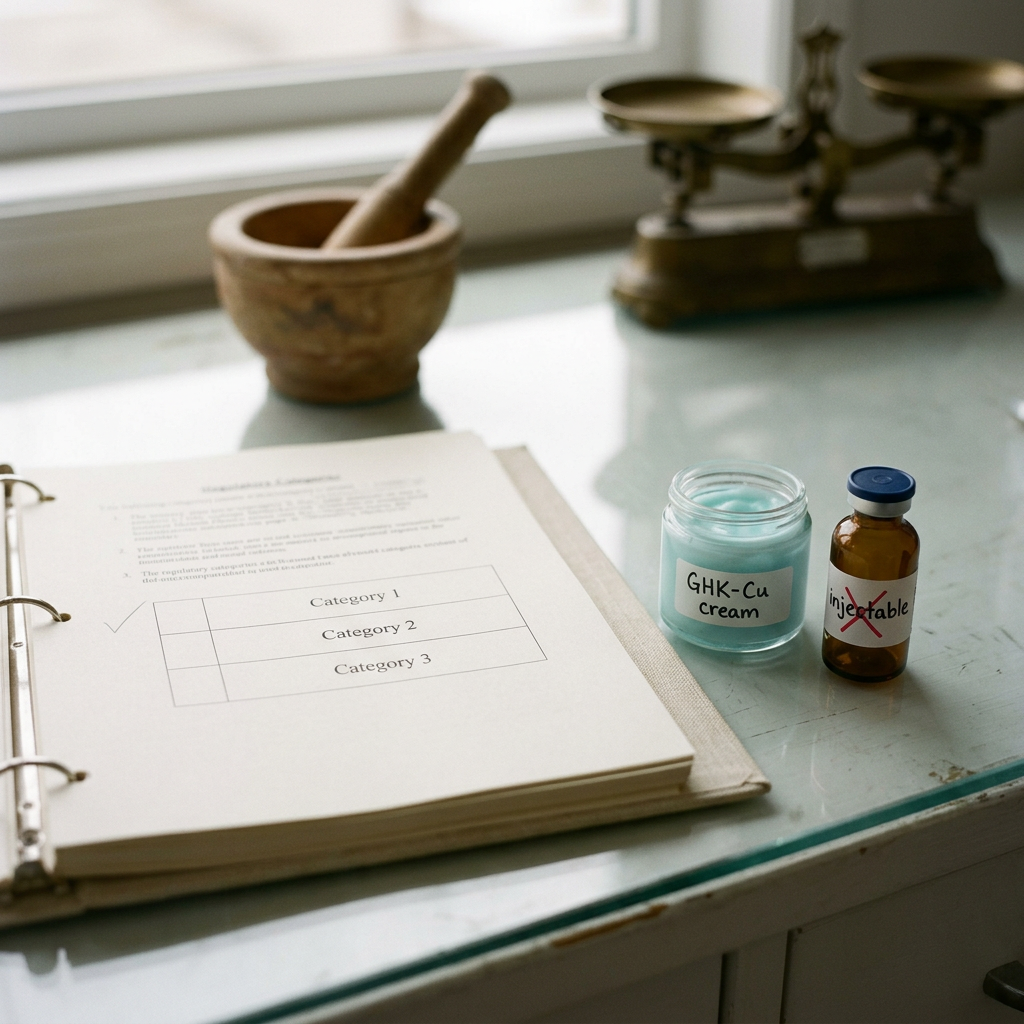
The FDA has restored GHK-Cu for non-injectable use to Category 1 of its 503A bulk drug substances list, reversing an April 22, 2026 removal that compounding pharmacies had been scrambling to interpret for the better part of a month. The reversal is documented in the agency's 503A bulk substances reference document, updated May 14, 2026. Injectable GHK-Cu remains excluded.
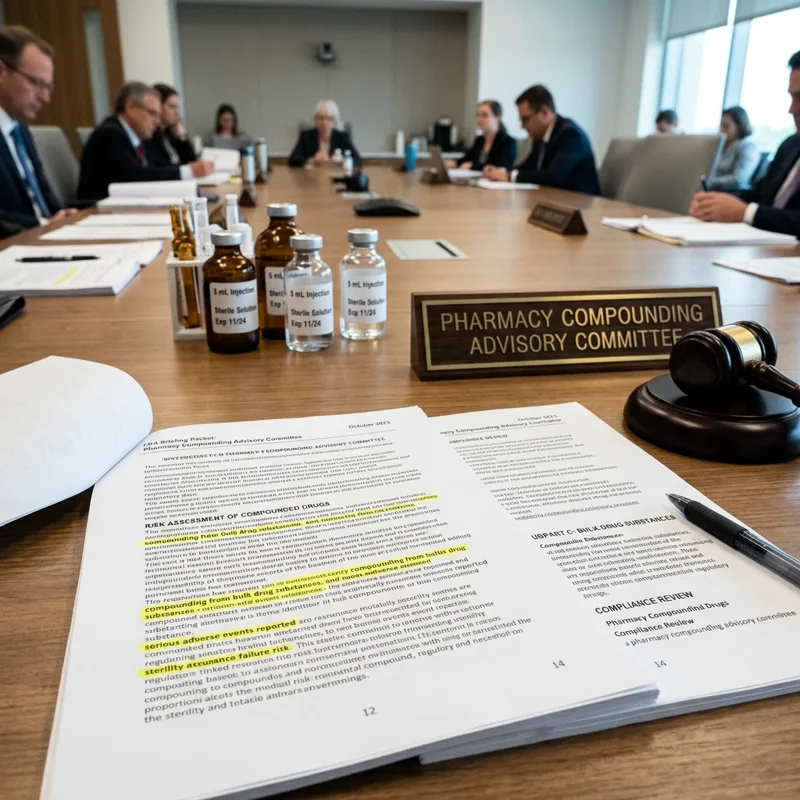
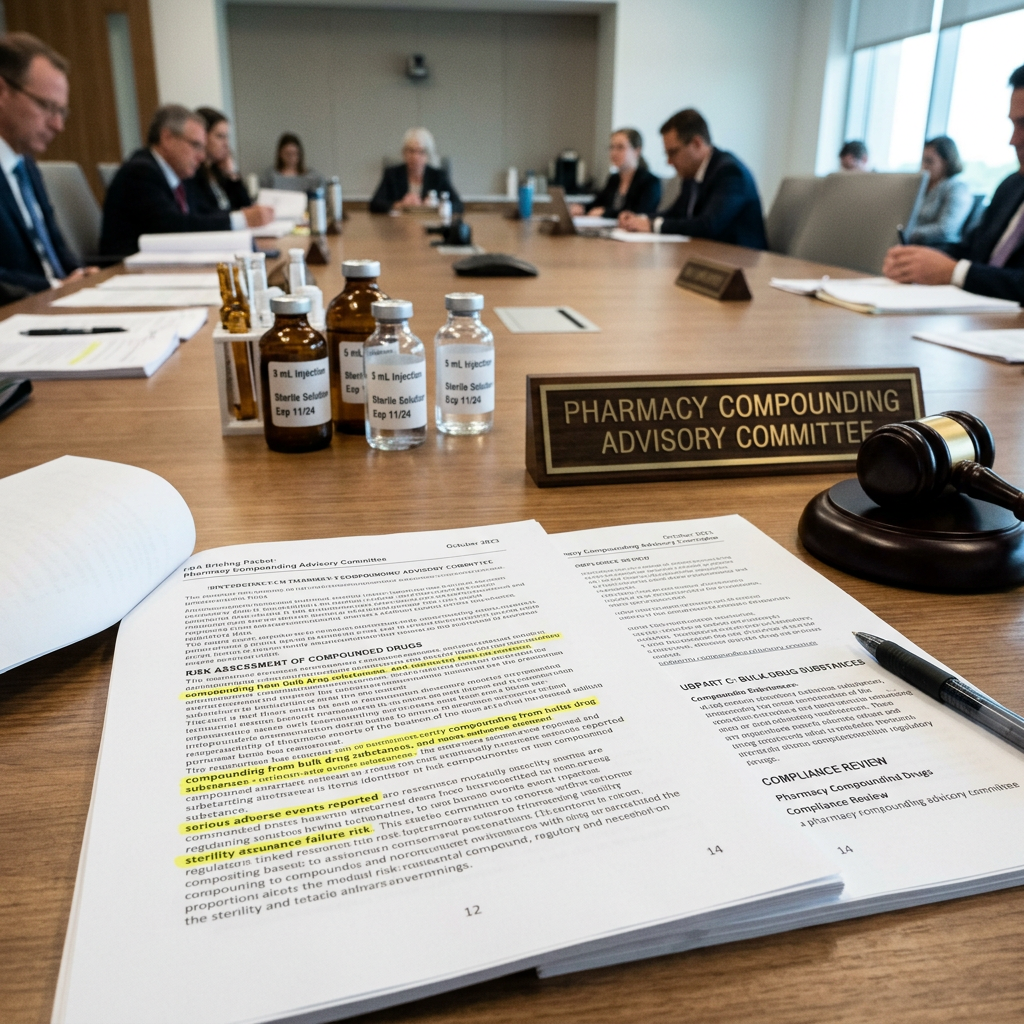
This is a narrow technical action that matters more than its scope suggests. It restores the legal status quo for topical and cosmetic compounding of one of the most prescribed peptides in the dermatology and aesthetic medicine space, and it sets up a Pharmacy Compounding Advisory Committee review before the end of February 2027 that will eventually decide whether GHK-Cu lands on the permanent 503A bulks list at all. For clinics and pharmacies operating in that gap, the cost of getting the call wrong has not gone down.
What Happened, in Order
On April 22, 2026, FDA removed GHK-Cu (except for injectable routes of administration) from Category 1 of the 503A bulks reference list. The basis, per the FDA document, was that the nominators of the substance had withdrawn their nominations. Without an active nomination, the agency had no formal record of who was asking the substance be added, and the listing came off.
On May 5, 2026, one of those nominators clarified its position. Per the FDA document: it had intended to withdraw only the injectable route nomination, not the non-injectable. The agency accepted the clarification. GHK-Cu (except for injectable routes of administration) goes back into Category 1.
The FDA document was updated May 14, 2026 to reflect the reversal and to flag that the agency will consult the Pharmacy Compounding Advisory Committee, or PCAC, before the end of February 2027 about whether GHK-Cu should be added to the permanent 503A bulks list. That is the next consequential meeting on this substance.
Reading the dates as a sequence: a clerical issue (a withdrawn nomination), a three-week regulatory gap (April 22 to May 5), a clarification, an updated reference document (May 14), and a future PCAC review that will run alongside the broader peptide policy fight already on the agency's calendar. Compounding pharmacies that paused topical GHK-Cu preparation during the gap can resume. Compounding pharmacies that did not pause should examine their own compliance posture.
The Five-Minute 503A Category Explainer
Section 503A of the Federal Food, Drug, and Cosmetic Act lets state-licensed pharmacies compound drugs from bulk substances under specific conditions. The substance used must be the subject of an FDA-approved drug, on the USP/NF, or on a list FDA maintains of bulk substances permitted for compounding. The bulks list is the relevant lever for peptides, almost none of which are FDA-approved drugs in their compounded forms.
FDA sorts nominated bulk substances into categories while it works through the review process:
- Category 1 — under evaluation. Compounding from these substances is permitted while FDA decides on permanent listing. This is where most peptides currently sit, including BPC-157, CJC-1295, ipamorelin, and now once again non-injectable GHK-Cu.
- Category 2 — significant safety concerns. Compounding from these substances is not permitted, and the agency is reviewing whether they should be added to the do-not-compound list.
- Category 3 — nominated without adequate support. The nomination did not include the safety, identity, and clinical-rationale data the agency needs to evaluate. Compounding is not permitted from Category 3 substances.
Permanent inclusion on the 503A bulks list is a separate, slower process. PCAC, the advisory committee that meets a few times a year, reviews substances and makes recommendations to the agency. Substances that clear PCAC and the subsequent rulemaking land on the permanent list. Substances that PCAC recommends against go to the do-not-compound list. The agency does the final paperwork either way.
GHK-Cu (non-injectable) is back in Category 1. It is not on the permanent list. It is not on the do-not-compound list. The February 2027 PCAC meeting is when its permanent fate gets discussed.
Why Injectable Is Still Out
Two things are happening here, and they need to be kept separate. The first is that no nominator currently wants injectable GHK-Cu on the 503A bulks list, because the original nomination was withdrawn and the May 5 clarification only restored the non-injectable scope. With no active nomination, FDA has no formal record of who wants injectable compounding permitted, and the agency does not maintain listings for substances nobody is asking about.
The second is that injectable formulations of any peptide carry a different risk profile than topical or oral ones. Sterile injectables require sterility testing, endotoxin testing, and stability data appropriate to the route. Even with an active nomination, injectable GHK-Cu would face a tougher path through PCAC because the safety bar for an injectable is higher than for a cream.
For prescribers and patients used to seeing copper peptide injectables sold through grey-market suppliers, the regulatory message has not changed: compounding pharmacies cannot legally produce injectable GHK-Cu from bulk substance under 503A. They can produce topical and other non-injectable preparations. Anything injectable sold today is either an outsourcing-facility product (503B, different rules, currently no 503B authorization for GHK-Cu either), a clinical-trial supply, or a research chemical being misrepresented as a pharmaceutical product.
How This Fits With the 503B GLP-1 Fight
The GHK-Cu reversal happens against a louder regulatory backdrop. On April 30, 2026, FDA proposed to exclude semaglutide, tirzepatide, and liraglutide from the 503B bulks list. The 503B framework governs outsourcing facilities, which are the larger industrial compounders that can ship to clinics and hospitals without patient-specific prescriptions. Excluding the three big GLP-1 active ingredients from the 503B bulks list would, if finalized, cut off legal large-scale compounded production of those drugs even when the brand products are no longer in shortage.
The public comment period for that 503B proposal closes June 29, 2026. State pharmacy boards, compounding trade groups, telehealth obesity-medicine practices, and individual clinicians have been organizing comments. The PeptideKnow archive covers this in detail in the 503B GLP-1 compounding proposal explainer and in the 503B exclusion analysis.
The two stories live on parallel tracks. The 503A track (where GHK-Cu sits) governs traditional state-licensed pharmacies serving individual prescriptions. The 503B track governs the larger outsourcing facilities. Substances move on and off both lists for different reasons. A compounding pharmacy serving a single dermatology clinic with a topical GHK-Cu cream is governed by 503A. A 200-pharmacy chain receiving compounded semaglutide vials from an outsourcing facility is governed by 503B. The May 14 GHK-Cu update and the April 30 GLP-1 proposal are separate policy actions, but they read together as one signal: FDA is actively curating both lists, and the regulatory ceiling for peptide compounding is being lowered for some substances and held for others.
Practical Compliance Checklist for Clinics and Pharmacies
For pharmacies that paused topical GHK-Cu preparation between April 22 and May 14, the work to restart is procedural rather than scientific:
- Confirm with state board of pharmacy that the state recognizes the May 14 FDA reference document as authoritative. Most do, automatically. A few states layer their own restrictions on top of FDA's 503A list.
- Verify the bulk GHK-Cu substance source is from an FDA-registered facility with current Certificates of Analysis. Identity, purity, and endotoxin documentation as appropriate for the route (lower bar for topical than injectable, but documentation is still required).
- Confirm the formulation route is non-injectable. Topical creams, transdermal preparations, oral mucosal products are permitted. Injectable preparations are not.
- Document the prescriber-pharmacist-patient triangulation specific to each prescription. 503A is patient-specific by design.
- Maintain awareness that the listing is provisional and the PCAC review is on the calendar before end of February 2027. A pharmacy operating GHK-Cu topical programs should be tracking the PCAC meeting schedule.
For clinics that prescribe topical GHK-Cu, the post-May-14 prescribing environment is the same as the pre-April-22 environment, with one practical caveat. Some compounders did fully stop sourcing during the gap, and some bulk suppliers temporarily pulled inventory. Confirming the dispensing pharmacy's supply chain is intact before sending high-volume prescriptions is reasonable due diligence for the next few weeks.
For patients buying topical GHK-Cu products from the cosmetic and skincare market: this regulatory action does not touch the cosmetic GHK-Cu category, which has always been regulated separately under FDA's cosmetic rather than drug authorities. The cosmetic GHK-Cu products sold at retail are not what this 503A action governs.
A Note on the Underlying Molecule
GHK-Cu is the copper-bound form of glycyl-L-histidyl-L-lysine, a tripeptide first identified in human plasma in the early 1970s by Loren Pickart. The peptide chelates divalent copper with high affinity, and the bound complex has been the subject of work on wound healing, hair follicle stimulation, anti-inflammatory effects in the skin, and a broad set of downstream gene expression changes related to collagen synthesis and extracellular matrix remodeling.
Clinical evidence for GHK-Cu in topical applications is modest but real, dominated by small open-label studies and a smaller number of controlled trials in cosmetic dermatology and wound healing. Injectable GHK-Cu has a thinner evidence base — much of what has been published is preclinical, with isolated clinical reports. The regulatory asymmetry between topical and injectable in the 503A list reflects, in part, that asymmetry in the evidence.
The substance is broadly safe in topical use at typical formulation concentrations of 0.05 to 0.2 percent. Most reported adverse events are local irritation or contact dermatitis, generally mild and self-limited. The systemic safety profile from any meaningful absorption from a topical preparation is favorable; the systemic safety profile from injectable use is less well characterized.
What to Watch Through End of 2026
Two regulatory dates frame the rest of the year for peptide compounding.
June 29, 2026: comment period closes on the FDA 503B proposal to exclude semaglutide, tirzepatide, and liraglutide from the outsourcing-facility bulks list. The agency typically issues a final decision four to nine months after the comment period closes, putting an answer somewhere in the November 2026 to March 2027 window. That decision shapes the compounded GLP-1 market for hospitals, clinics, and telehealth obesity programs that have been buying through outsourcing facilities.
End of February 2027: PCAC meets to discuss potential permanent inclusion of GHK-Cu (non-injectable) on the 503A bulks list. PCAC also reviews other peptides at scheduled meetings; the agenda for that meeting will determine which other substances are reviewed alongside GHK-Cu. The committee's recommendation, while not binding, is heavily weighted in the agency's subsequent decision on permanent listing.
Between now and those two dates, expect the agency to continue updating the 503A bulks reference document as nominations come in, get withdrawn, get clarified, and shift between categories. The May 14 update to non-injectable GHK-Cu is unlikely to be the last category change of 2026.
Frequently Asked Questions
Is GHK-Cu legal to compound right now?
Non-injectable GHK-Cu is permitted for 503A compounding by state-licensed pharmacies under the May 14, 2026 FDA reference document. Injectable GHK-Cu is not. The Category 1 status is provisional pending PCAC review before end of February 2027.
Why was it removed and then put back?
The nominators of GHK-Cu withdrew their nominations in early April 2026. With no active nomination, FDA removed the substance from Category 1 on April 22. On May 5, one of those nominators clarified that the withdrawal was meant to apply only to the injectable route. FDA accepted the clarification and restored the non-injectable listing in its May 14 document update.
Does this apply to injectable copper peptide products sold online?
No. Injectable GHK-Cu sold through unregistered websites, peptide-sales sites, or research-chemical vendors is not the subject of this action and is not legal under 503A regardless. Those products operate outside the compounding framework entirely.
What is PCAC and why does its February 2027 meeting matter?
The Pharmacy Compounding Advisory Committee is the federal advisory body that reviews substances nominated for the 503A bulks list and makes recommendations to FDA on whether they should be permanently listed, sent to the do-not-compound list, or kept under evaluation. PCAC's recommendation on GHK-Cu before end of February 2027 will be the next major decision point. The agency's final action follows, typically within a year of the PCAC vote.
How does this connect to the FDA action on GLP-1 compounding?
Both are part of FDA actively curating its compounding bulks lists, but they sit on different tracks. GHK-Cu is a 503A action (traditional state-licensed compounding for individual prescriptions). The GLP-1 proposal is a 503B action (outsourcing facilities producing larger batches). The two policy moves happen on parallel calendars and serve different parts of the compounded-drug market.
Should pharmacies be worried about a future GHK-Cu reversal?
A pharmacy operating a topical GHK-Cu program should plan for the possibility that PCAC recommends against permanent listing in February 2027 or later. That outcome would move GHK-Cu off Category 1, likely toward Category 2 or the do-not-compound list. Building a contingency for that scenario — alternative substances, alternative formulation approaches, communication plans for affected prescribers — is reasonable risk management even though the May 14 update restored the current operating environment.
Sources
- US Food and Drug Administration. "Bulk Drug Substances Nominated for Use in Compounding Under Section 503A of the Federal Food, Drug, and Cosmetic Act." FDA reference document. Updated May 14, 2026.
- US Food and Drug Administration. "FDA proposes to exclude semaglutide, tirzepatide, and liraglutide from the 503B bulks list." FDA press announcement. April 30, 2026.
- US Food and Drug Administration. "Pharmacy Compounding Advisory Committee (PCAC)." FDA committee page.
- Pickart L, Vasquez-Soltero JM, Margolina A. "GHK Peptide as a Natural Modulator of Multiple Cellular Pathways in Skin Regeneration." BioMed Research International. 2015;2015:648108.
Sources & References
- FDA PCAC Meeting Announcement (July 23-24, 2026)
- PBS: FDA to Weigh Easing Limits on Peptides Favored by RFK Jr.
- BioPharma Dive: FDA Peptides RFK Advisory Committee Restrictions
- RAPS: FDA Considers Adding a Dozen Peptides to Bulk Drug List
- Ars Technica: RFK Jr. Forces FDA to Reconsider 12 Peptides
- ProPublica: Peptide Safety Investigation
- New York Times: Peptide Ban FDA RFK Jr.
- SSRP Institute: FDA Announces Change in Status of 12 Peptides
- CNBC: RFK Jr. Peptides Hims Hers GLP-1
- USA Today: RFK Jr. FDA Peptides Explainer