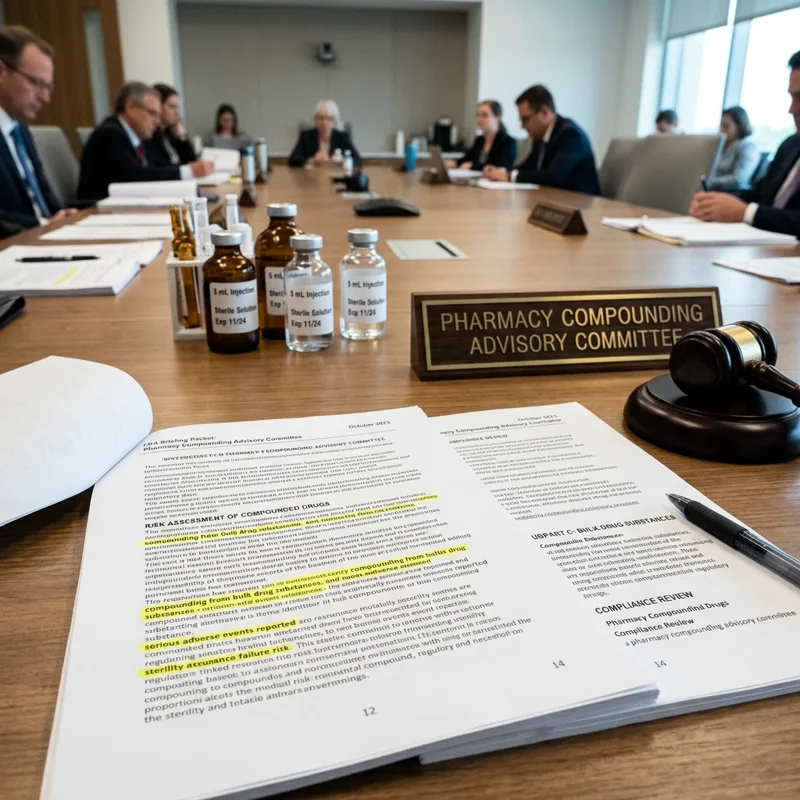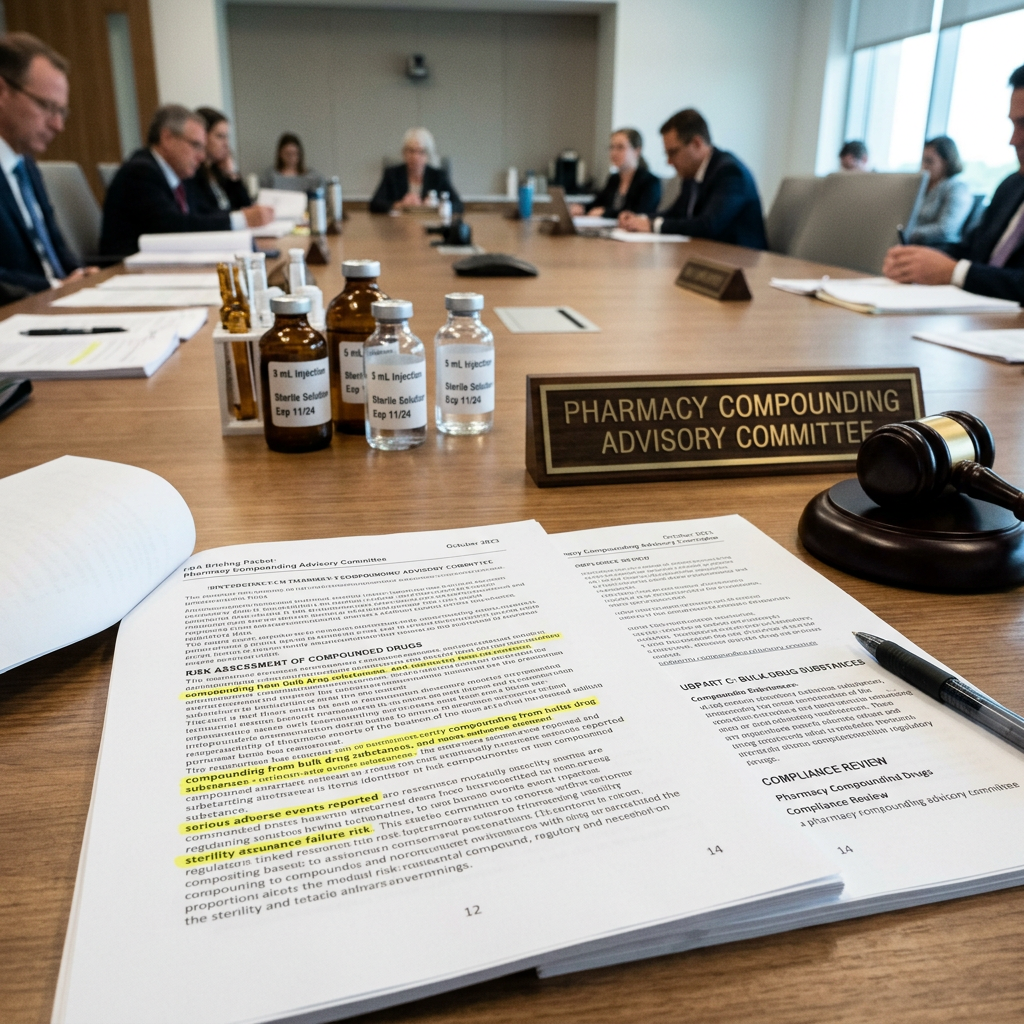

Summary: A quiet shift is underway in peptide enforcement. It’s not just the FDA. In April and May 2026, state pharmacy and medical boards in Texas, Florida, California, and Ohio took visible disciplinary steps tied to compounded peptides and compounded GLP-1 products—often focusing less on the molecules and more on records, prescriber-patient relationships, and distribution patterns that look like manufacturing. The message is procedural: if a peptide product is moving through a pharmacy channel, regulators want patient-specific documentation, controlled-substance compliance where applicable, and state-law compliance that can exceed federal 503A/503B arguments.
For clinics, compounders, and even informed patients trying to tell “legit compounding” from a gray-market supply chain, these state actions matter because they sit closer to the day-to-day practice of prescribing and dispensing than Washington does. They also hint at how enforcement may scale: state boards can act faster than federal agencies, and they can discipline licenses directly.
Background: why state boards moved now
Two trends collided in the first half of 2026. The first was federal: FDA enforcement letters in Q1 and Q2 created national headlines and gave state inspectors a record to point at when they opened their own files. The second was operational: telehealth-fronted peptide and compounded GLP-1 businesses kept growing through the spring, and the volume started showing up in pharmacy-board complaint logs. Patients reported sterility concerns. Insurers flagged claims patterns. Local prescribers raised the question of who, exactly, was evaluating these patients.
State boards don't need a new statute to act on any of this. The Texas State Board of Pharmacy can discipline a license for inadequate recordkeeping under existing rules. The Medical Board of California can investigate a prescriber-patient relationship under standards that predate the GLP-1 boom by decades. What changed in April and May 2026 was not the law but the willingness to use it on peptide and compounded GLP-1 cases at scale.
What happened: state boards moved from warnings to discipline
Reporting collected by PeptideStaff describes a cluster of April–May actions across multiple states—disciplinary cases, audits, and policy clarifications—tied to compounded peptide products and GLP-1 compounding practices. The pattern isn’t a single “new rule.” It’s regulators applying existing pharmacy and medical-practice standards to an industry that grew quickly on telehealth, mail-order fulfillment, and vague documentation.
In plain terms: the enforcement story is drifting away from debates about whether a peptide “should be allowed” and toward whether a pharmacy or clinic can demonstrate, on paper, that it acted like a patient-specific compounder rather than a manufacturer.
Texas: penalties for DEA registration gaps and GLP-1 recordkeeping
Texas is the most aggressive example in the roundup, with formal disciplinary action against 11 pharmacies in April–May 2026. The issues described include missing or inadequate DEA registration for certain peptide classifications and incomplete prescription documentation for compounded GLP-1 products. The reported administrative penalties—$50,000 to $150,000 per pharmacy—are large enough to change business models, not just behavior.
The peptides named in the Texas context include melanotan II and PT-141 (bremelanotide). Those two molecules show why state-level controlled-substance analog rules can become an operational trap: a compounder can be “federally compliant” in its own narrative and still collide with a state’s scheduling, analog definitions, or registration requirements.
Separately, Texas scrutiny of compounded GLP-1 documentation reflects a simple question inspectors can ask: do the records match patient-specific compounding intent, or do they look like standardized products shipped at scale?
Florida: physician license suspensions tied to prescriber-patient relationship
Florida’s actions in April–May 2026 reportedly included suspending the prescribing licenses of three physicians for issuing peptide prescriptions without an adequate practitioner–patient relationship. The allegation is procedural but consequential: relying on questionnaires without a true clinical encounter, or without reviewing relevant medical history, may not satisfy state expectations for a valid relationship—especially when the prescription is used to justify ongoing fulfillment of compounded products.
This lands in the middle of the telehealth peptide business model. A clinic may see itself as a platform. A medical board sees a prescriber whose name is on a prescription and asks what evaluation happened before the signature.
California: policy clarification that state law still governs (even if you cite 503A/503B)
California’s Board of Pharmacy reportedly issued a formal enforcement policy document in April 2026 clarifying that pharmacies dispensing compounded peptide products must comply with California’s own Business and Professions Code requirements—independently of any federal 503A or 503B compliance claims. In practice, this “dual-compliance” framing matters because it makes it harder for a pharmacy to treat federal arguments as a shield against state inspections.
For patients, the takeaway is less about legal doctrine and more about process: a pharmacy that can’t explain its state-law obligations—counseling, packaging, documentation, prescriber verification—may be the kind of shop regulators are watching.
Ohio: audits and the distribution-pattern test (patient-specific vs. manufacturing)
Ohio’s approach, as described in the roundup, centered on auditing 34 licensed compounding pharmacies and referring 8 to formal disciplinary proceedings. The apparent trigger was distribution patterns: high out-of-state dispensing volume inconsistent with patient-specific compounding. Some pharmacies were described as shipping compounded peptide products to 40+ states—a pattern regulators can characterize as drug manufacturing with a prescription wrapper.
This isn’t a chemistry debate. It’s a logistics debate. Auditors can quantify it.
Why this is the peptide story (not just a pharmacy story)
Peptides sit at an awkward intersection: they’re often discussed like supplements in online communities, treated like investigational drugs in clinical research, and sold like specialty medications in some clinical practices. That mismatch creates predictable failure points.
- Documentation becomes the enforcement lever. Regulators don’t need to opine on whether a peptide “works” to discipline a pharmacy for incomplete prescription records or missing verification steps.
- State law can be stricter than federal frameworks. A pharmacy that cites federal 503A/503B language still has to satisfy state boards that control licensure and day-to-day practice.
- Distribution volume signals intent. When a pharmacy ships across dozens of states, regulators can argue it’s behaving like a manufacturer, not compounding for individual patients.
This matters for the bigger peptide ecosystem because state actions can reshape supply quickly. When a license is suspended, the supply chain changes overnight. When a board issues a policy clarification, risk officers rewrite SOPs. The end result can be fewer vendors willing to touch peptides, more expensive compliance, and higher barriers for legitimate patient-specific compounding.
Practical implications for clinics and compounders
For a clinic or pharmacy reading these actions and trying to figure out what to change Monday morning, the practical posture is narrower than the headlines suggest. None of the state actions described above invented a new compliance obligation. They surfaced existing ones and asked whether the paperwork supports them.
Three operational shifts follow naturally. First, prescriber-patient documentation needs to look like a clinical encounter and not a questionnaire. That means a visible chart note, a relevant history, an explicit indication, and an identifiable evaluating clinician. Second, peptide and compounded GLP-1 records need to tie each prescription to a specific patient with corresponding compounding logs, not to a SKU that ships at scale. Third, ingredient sourcing needs a paper trail: Certificate of Analysis, supplier qualification, lot tracking. A pharmacy that can produce these on request looks different to an inspector than one that cannot.
None of this is novel. The novelty is that state boards are reportedly asking for it in the peptide context.
What to watch next (June–July 2026)
Federal attention still matters—especially around 503A bulk substance evaluation and GLP-1 shortage-related enforcement posture—but the near-term operational story is likely at the state level: more audits, more targeted inspections, and a growing expectation that telehealth-plus-mail-order peptide businesses document clinical encounters like traditional practices.
For readers tracking the compounding-status side of the story, see the broader regulatory landscape pages for BPC-157 and TB-500, which are frequently discussed in the compounding context and remain the subject of ongoing regulatory attention.
Frequently Asked Questions
Is state board enforcement separate from the FDA?
Yes. The FDA regulates drugs and certain manufacturing/marketing practices. State pharmacy and medical boards regulate professional licenses and pharmacy operations. In practice, state boards can move faster on documentation, scope-of-practice, and dispensing rules, even when federal questions remain unsettled.
Does higher enforcement mean all compounded peptides are illegal?
No. Enforcement actions described here focus heavily on process: prescriber–patient relationships, records, controlled-substance compliance, and patterns that suggest non–patient-specific distribution. Legal status varies by molecule, formulation, and context, and readers should treat broad claims as suspect.
What’s the simplest red flag for patients?
One red flag is a “prescription” that doesn’t involve a real clinical evaluation. Another is a pharmacy or clinic that can’t explain where its peptide ingredients come from, what testing documentation (like Certificates of Analysis) it relies on, and what state rules govern its dispensing.
How does this relate to GLP-1 products like semaglutide or tirzepatide?
The actions described include documentation scrutiny for compounded GLP-1 products. Even when patients and prescribers focus on demand and cost, regulators often focus on whether compounding is truly patient-specific, whether the supply chain is compliant, and whether documentation supports any claimed medical necessity.
Sources (updated June 11, 2026)
- PeptideStaff — “State Pharmacy Boards Escalate Peptide Enforcement Actions” (June 6, 2026)
- Clinical Trials Arena — “ADA26: AstraZeneca unveils positive data for Phase III-ready oral GLP-1RA” (June 9, 2026)
Medical + legal note: This article is for educational purposes and does not provide medical or legal advice. Regulations and enforcement actions can change quickly; consult qualified professionals for decisions related to prescribing, dispensing, or personal health.
Sources & References
- FDA PCAC Meeting Announcement (July 23-24, 2026)
- PBS: FDA to Weigh Easing Limits on Peptides Favored by RFK Jr.
- BioPharma Dive: FDA Peptides RFK Advisory Committee Restrictions
- RAPS: FDA Considers Adding a Dozen Peptides to Bulk Drug List
- Ars Technica: RFK Jr. Forces FDA to Reconsider 12 Peptides
- ProPublica: Peptide Safety Investigation
- New York Times: Peptide Ban FDA RFK Jr.
- SSRP Institute: FDA Announces Change in Status of 12 Peptides
- CNBC: RFK Jr. Peptides Hims Hers GLP-1
- USA Today: RFK Jr. FDA Peptides Explainer