
Medical disclaimer: This article is for education and reference. It does not provide medical advice. Compounded medications carry unique risks; patients should discuss options with a licensed clinician and use state-licensed pharmacies.
On June 1, 2026, the U.S. Food and Drug Administration (FDA) said it intends to take “decisive steps” to restrict GLP-1 active pharmaceutical ingredients (APIs) used in non-FDA-approved compounded drugs that are being mass-marketed as alternatives to branded products. (FDA statement)
That’s a regulatory story, not a science story. But it lands right in the center of the modern peptide market because GLP-1 medicines are peptides, and the shortage-driven compounding boom has pulled peptide manufacturing, advertising, and clinical practice into the same legal argument. The FDA’s message is simple: if you are manufacturing, distributing, or marketing unapproved compounded GLP-1 products at scale—and claiming they’re basically “generic Wegovy” or “the same active ingredient”—you should expect enforcement.
What the FDA actually said (and what it didn’t)
The FDA announcement is framed as an “intent” statement: a public marker that the agency plans to restrict GLP-1 APIs used for non-FDA-approved compounded products, particularly those mass-marketed direct-to-consumer. (FDA press announcement)
Two lines matter for clinics, telehealth prescribers, and compounding-adjacent brands:
- Advertising claims: the FDA says promotional materials cannot claim unapproved compounded products are “generic versions” or “the same as” FDA-approved drugs. (FDA press announcement)
- Enforcement tools: the agency says it will use “all available compliance and enforcement tools,” explicitly naming seizure and injunction as possibilities. (FDA press announcement)
The FDA does not publish a new rule in this statement. It doesn’t list a new set of compounds. It doesn’t rewrite the compounding statute. What it does do is set a tone: the easy era of mass-market GLP-1 “compounding-as-a-brand” is ending.
Why GLP-1 enforcement is a peptide story (not just a weight-loss story)
GLP-1 receptor agonists, dual agonists, and related incretin drugs are peptides (or peptide-like). Some are endogenous hormones or close analogs; others are engineered for half-life, potency, and tolerability. Whatever your view of “peptide therapy,” the modern GLP-1 pipeline is one of the most commercially successful uses of peptide pharmacology.
For PeptideKnow readers, two concepts matter more than the headlines:
- API sourcing and quality controls become the center of the regulatory fight when products are made outside the approved supply chain.
- Claims become the center of the enforcement fight when marketers tell consumers the unapproved product is equivalent to the approved one.
This is why “compounded semaglutide” discourse often turns into a proxy debate about whether peptides can be treated as supplements, research chemicals, compounded drugs, or approved drugs. Different lanes. Different standards. Different liabilities.
Four questions clinics and telehealth prescribers should be asking this week
1) Are you prescribing a patient-specific compounded product, or enabling a mass-market product?
The FDA’s statement emphasizes products “being mass-marketed by companies” as alternatives to approved drugs. (FDA press announcement) A patient-specific compounded prescription is not the same thing as a nationwide brand of unapproved GLP-1 injections with influencer marketing.
2) What does your marketing say?
The FDA calls out claims that compounded drugs are “generic versions,” “the same,” or “clinically proven” in the way the approved products are. (FDA press announcement) If your landing pages use those phrases, the risk is no longer theoretical.
3) Can you document API provenance and testing?
When regulators look at compounding supply chains, the conversation moves fast from “patient access” to lot-level testing, identity, purity, and sterility controls. Even if you are not the manufacturer, you can be the storefront.
4) What’s your plan for switching patients?
If enforcement tightens, clinics will need protocols for transitions: dose conversion, monitoring, side-effect triage, insurance pathways, and informed consent that explains what is (and isn’t) FDA-approved.
How we got here: shortage, scale, and a marketing problem
To understand the FDA’s posture, rewind two years. Branded semaglutide and tirzepatide spent much of 2023 and 2024 on the FDA drug shortage list. That listing opened a legal pathway for 503A and 503B compounding pharmacies to prepare versions of those drugs to meet patient demand. Telehealth platforms scaled fast. Marketing scaled faster. By the time the FDA declared the tirzepatide shortage resolved in late 2024, an entire consumer category had been built around the word “compounded.”
Then the resolution itself became the trigger. Once a drug is off the shortage list, the basis for routine compounding of essentially-copy products narrows. The FDA spent 2025 sending warning letters to telehealth and wellness brands using “generic Wegovy,” “same as Ozempic,” and similar phrases that the agency considers misbranding. The June 1, 2026 announcement is the next step on the same line.
Consumer-protection reporting has been catching up too. A June 1, 2026 Atlanta Journal-Constitution investigation describes Georgia clinics offering peptides, exosomes, and other loosely supervised therapies, and notes that the FDA’s 2023 list of peptides not appropriate for compounding is expected to be revisited under the current administration. That’s the context the FDA is operating in: more scrutiny on storefronts, more political pressure on the underlying lists.
The other side of the market: peptide innovation keeps moving
Even as regulators warn about unapproved compounding and advertising, the branded pipeline keeps expanding. On May 31, 2026, Genentech said it will present late-breaking Phase 2 data at the American Diabetes Association (ADA) 2026 meeting for enicepatide (CT-388), a dual GLP-1/GIP receptor agonist, and petrelintide, a long-acting human amylin analog. (Genentech press release)
That matters because the “GLP-1 era” is quickly turning into an incretin + amylin + combination era. Amylin analogs are not new, but a once-weekly amylin analog designed for co-formulation is a different commercial object than the daily injections most clinicians remember. (Genentech press release)
In plain terms: regulators are trying to reassert a bright line between (a) drugs that have manufacturing and labeling oversight and (b) products that use drug-like ingredients without that oversight. Meanwhile, industry is moving to newer peptides and peptide-like combinations that will be even harder to imitate outside the approved supply chain.
PeptideKnow glossary: the peptide profiles behind today’s story
- Semaglutide (GLP-1 receptor agonist)
- Tirzepatide (dual GIP/GLP-1 receptor agonist)
- Enicepatide (CT-388) — investigational GLP-1/GIP receptor agonist (not yet FDA-approved)
- Petrelintide — investigational long-acting amylin analog (not yet FDA-approved)
If you’re browsing by topic, start with our weight loss & metabolic peptides category.
What to watch next
Today’s statement is a starting gun. The next steps are usually quieter: warning letters, seizures, injunctions, and a tightening of what platforms and payment processors will tolerate. The FDA also signals it is watching direct-to-consumer marketing language closely after warning letters in 2025. (FDA press announcement)
For consumers, the practical consequence is that “cheap GLP-1 peptides” marketed online may become harder to find—and, if history is any guide, more likely to move into less transparent channels. For clinicians, the consequence is documentation: consent, sourcing, and claims discipline.
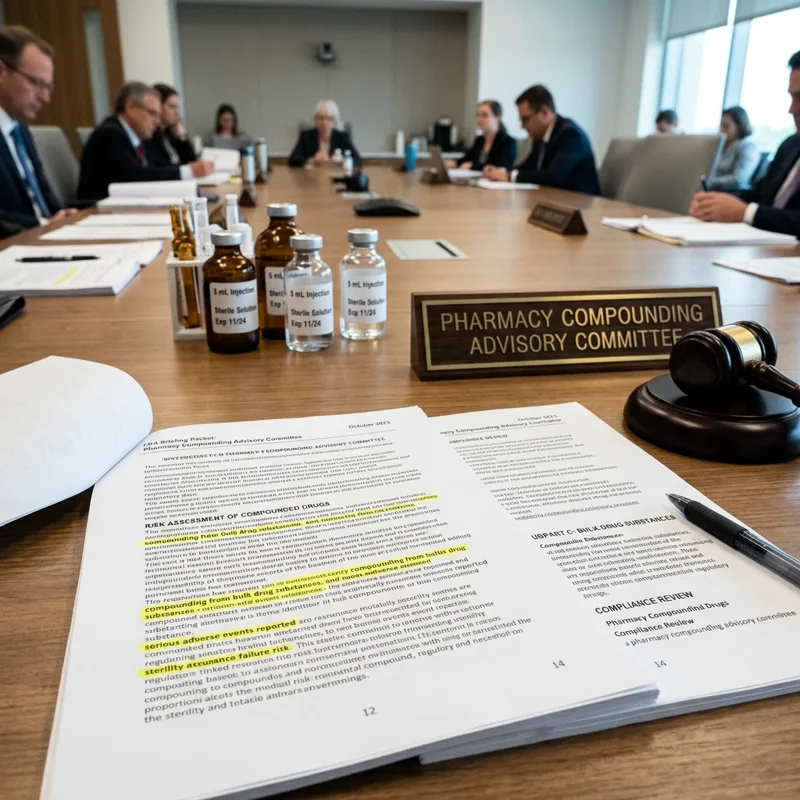
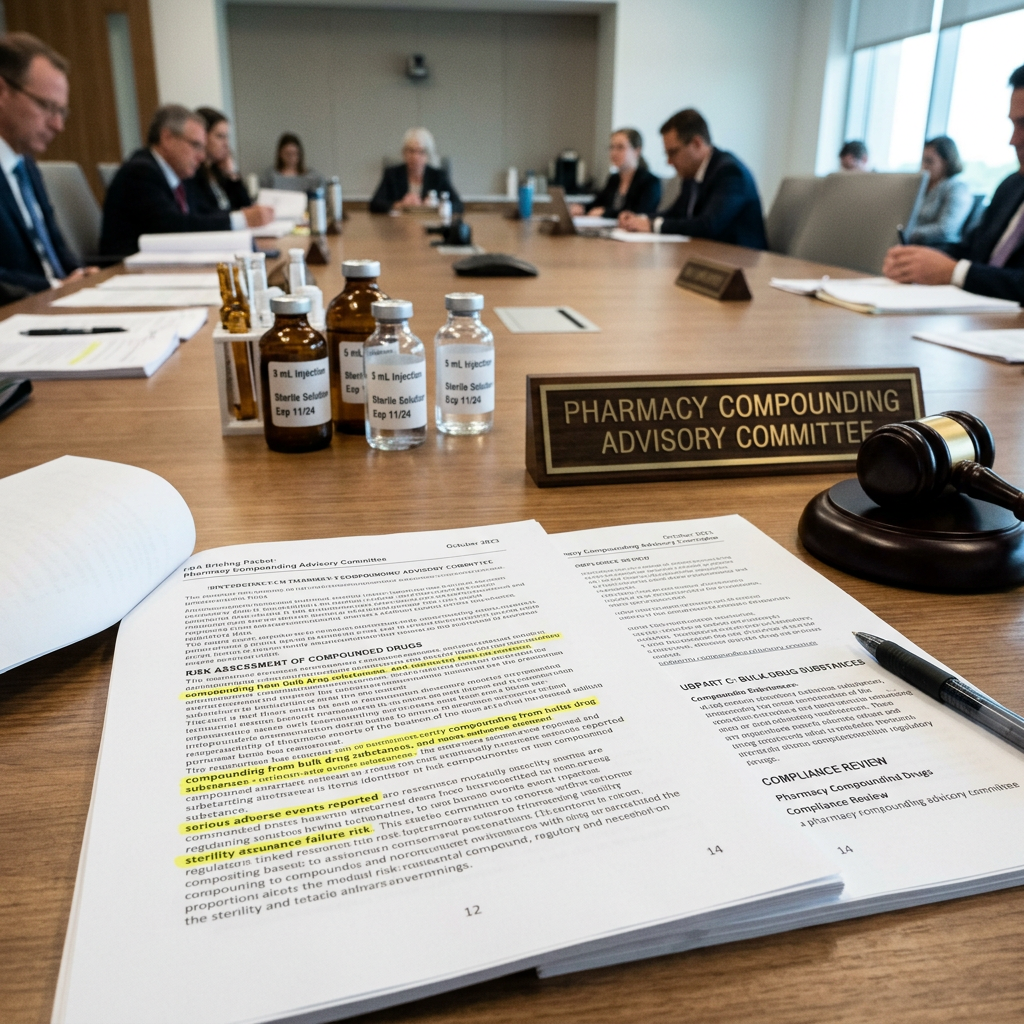
One narrower watch item: the FDA’s 2023 list of bulk drug substances nominated for 503A compounding included several peptide categories the agency explicitly declined to add. Whether that list expands, contracts, or gets republished with new categories is the quieter regulatory story behind the GLP-1 headlines. A revised list could legitimize some peptides for compounding while permanently closing the door on others. Patients and clinics that rely on a particular peptide should track that docket alongside the GLP-1 enforcement news.
Frequently Asked Questions
Is compounding GLP-1 drugs always illegal?
No. Compounding law is nuanced and fact-specific. The FDA’s June 1, 2026 statement focuses on restricting GLP-1 APIs used in non-FDA-approved compounded drugs that are being mass-marketed as alternatives to approved drugs. (FDA press announcement) Patients should consult state-licensed clinicians and pharmacies about lawful options and risks.
Why does the FDA focus so much on advertising claims?
Claims are how consumers decide. The FDA says promotions cannot present unapproved compounded products as “generic” versions or “the same as” FDA-approved drugs, and cannot claim they are clinically proven the way approved drugs are. (FDA press announcement)
What is petrelintide?
Petrelintide is an investigational long-acting human amylin analog being evaluated for weight management; Genentech says late-breaking Phase 2 data will be presented at ADA 2026. (Genentech press release)
What is enicepatide (CT-388)?
Enicepatide (CT-388) is an investigational once-weekly dual GLP-1/GIP receptor agonist; Genentech says late-breaking Phase 2 data will be presented at ADA 2026. (Genentech press release)
Sources (selected)
- FDA (June 1, 2026). “FDA Intends to Take Action Against Non-FDA-Approved Compounded GLP-1 Drugs.” https://www.fda.gov/news-events/press-announcements/fda-intends-take-action-against-non-fda-approved-glp-1-drugs
- Genentech (May 31, 2026). “Genentech to Present New Data Advancing Its Obesity Portfolio at the ADA 2026 Scientific Sessions.” https://www.gene.com/media/press-releases/15114/2026-05-31/genentech-to-present-new-data-advancing-
- Atlanta Journal-Constitution (June 1, 2026). “Welcome to Georgia, where questionable therapies flourish with little oversight.” https://www.ajc.com/news/2026/06/welcome-to-georgia-where-questionable-therapies-flourish-with-little-oversight/
Sources & References
- FDA PCAC Meeting Announcement (July 23-24, 2026)
- PBS: FDA to Weigh Easing Limits on Peptides Favored by RFK Jr.
- BioPharma Dive: FDA Peptides RFK Advisory Committee Restrictions
- RAPS: FDA Considers Adding a Dozen Peptides to Bulk Drug List
- Ars Technica: RFK Jr. Forces FDA to Reconsider 12 Peptides
- ProPublica: Peptide Safety Investigation
- New York Times: Peptide Ban FDA RFK Jr.
- SSRP Institute: FDA Announces Change in Status of 12 Peptides
- CNBC: RFK Jr. Peptides Hims Hers GLP-1
- USA Today: RFK Jr. FDA Peptides Explainer