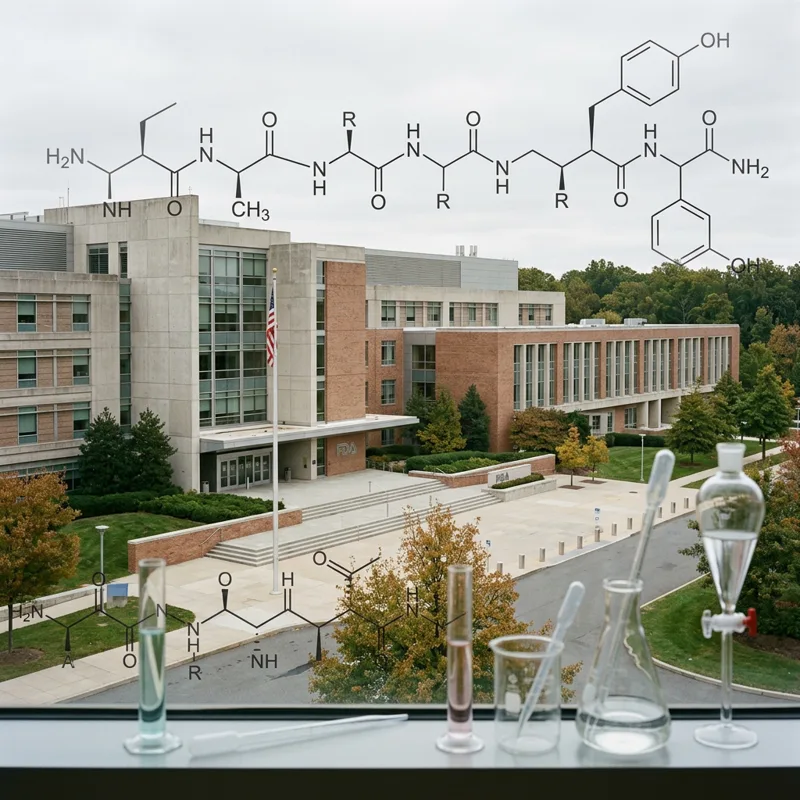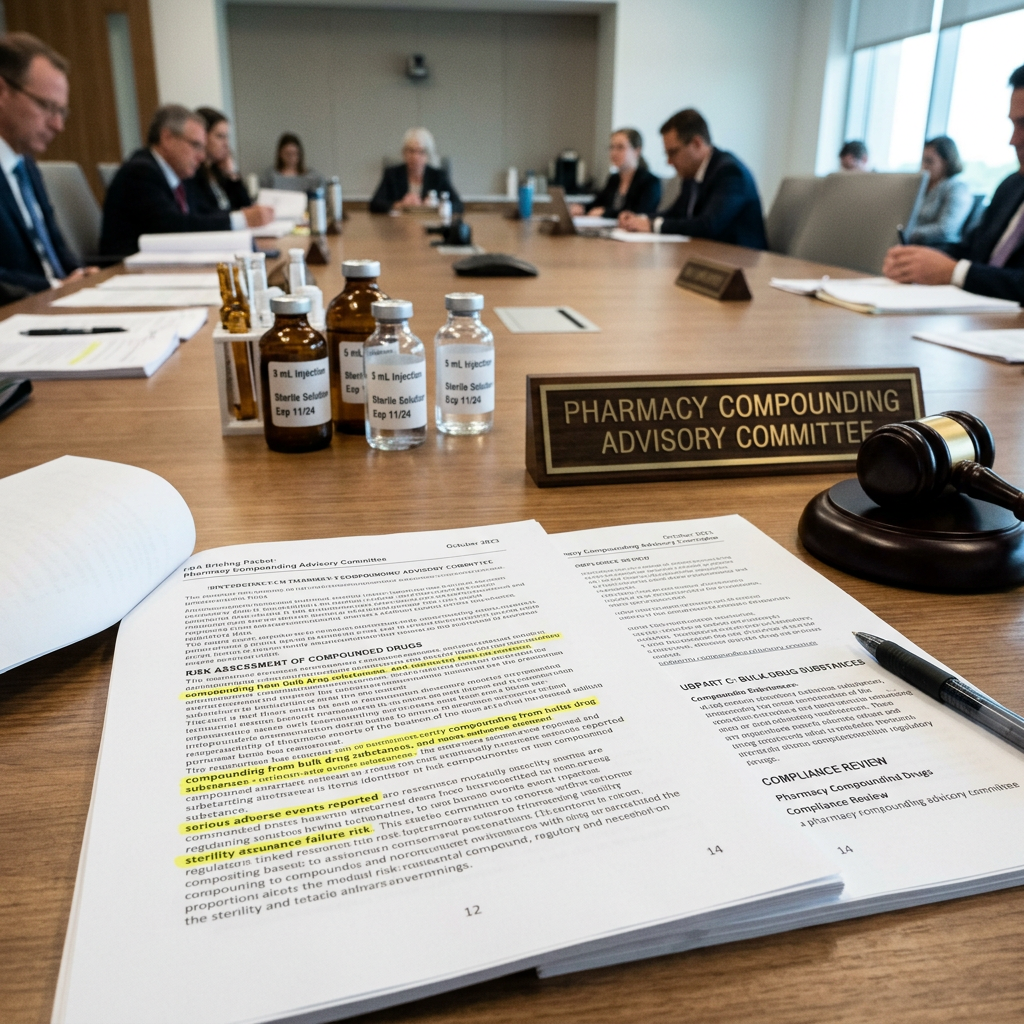
The FDA’s career scientific reviewers have delivered an unusually blunt message ahead of the agency’s July 23–24 Pharmacy Compounding Advisory Committee (PCAC) meeting: the evidence on seven high-profile peptides isn’t strong enough to justify a legal pathway into 503A pharmacy compounding. That recommendation doesn’t decide the outcome on its own. But it sets the tone for the next three weeks of lobbying, medicine-by-podcast debate, and behind-the-scenes legal positioning.
The short version: FDA staff say the proposed benefits are thin, the human data are scarce, and the uncertainty around quality and immunogenicity is not a paperwork problem—it’s the safety question.
What FDA staff actually said (and why it matters)
Reuters reported that FDA staff reviewers concluded available evidence does not support allowing compounding pharmacies to manufacture seven popular peptides that have become staples in the U.S. gray market. The staff reviews were published ahead of PCAC’s July 23–24 meeting, where the committee will consider whether any of the substances should be eligible for the 503A Bulks List.
If you’re tracking this space, the staff posture is the headline. Advisory committees can recommend “yes,” “no,” or “more data,” but FDA briefing materials often preview how the agency is thinking and what kind of evidentiary record it will accept. In practice, clinics and compounders treat these staff reviews like the guardrails.
The seven peptides under review
According to Reuters and NBC News, the seven peptides on the July PCAC agenda are:
- BPC-157 (nominated for ulcerative colitis)
- TB-500 (nominated for wound healing)
- KPV (nominated for wound healing and inflammatory conditions)
- MOTS-c (nominated for obesity and osteoporosis)
- Emideltide / DSIP (delta sleep-inducing peptide) (nominated for opioid withdrawal, insomnia, narcolepsy)
- Semax (nominated for cerebral ischemia, migraine, chronic pain)
- Epitalon (Epithalon) (nominated for insomnia)
These are not obscure research reagents. They’re among the most talked-about compounds in peptide forums and “optimization” clinics—and they’re often marketed alongside (or in the same supply chains as) compounded GLP‑1 drugs. That’s why PCAC’s stance matters well beyond this list.
For background on the legal mechanics, see our explainer on regulatory and related compounds context and the 503A compounding framework.
Why the FDA is skeptical: the evidentiary gap
1) Limited (or missing) human clinical data
NBC News highlighted a recurring theme across the staff reviews: for several peptides, FDA scientists said they could not find published human studies where the substances were administered. When a compound is being proposed for wide access through compounding—without the manufacturing controls and labeling requirements of an FDA-approved product—that absence is hard to paper over.
2) Immunogenicity and uncertainty about “what” is being evaluated
Peptides can exist as different salt forms, different purities, and different manufacturing byproducts. FDA reviewers, per NBC News, raised concerns about whether the versions being nominated were defined well enough to evaluate. That sounds bureaucratic until you remember what the risk is: immune reactions that depend on sequence, impurities, aggregation, and dose.
3) Quality and supply-chain reality
The compounding debate is often framed as a choice between “unsafe gray market” and “safer domestic compounding.” In theory, 503A compounding can improve oversight. In practice, the safety hinges on whether high-quality API exists, whether testing is adequate, and whether sterile injectable practices are consistently followed. Those assumptions are exactly what the FDA is stress-testing.
RFK Jr., MAHA politics, and the PCAC roster question
This isn’t just a technical dispute. NBC News reported that HHS Secretary Robert F. Kennedy Jr. has advocated for deregulating a number of peptides, while FDA scientists say the evidence base is insufficient. POLITICO reported that the advisory panel’s roster has drawn scrutiny, including concerns about members who may benefit from broader compounding access.
That tension—career scientific review vs. a political push for “access”—is the story investors, compounders, and clinicians are now gaming out. The committee’s recommendation is not binding, but it can shape what happens next: petitions, rulemaking timelines, and enforcement emphasis.
What happens next: realistic scenarios after July 23–24
Scenario A: PCAC recommends “no” for most or all
If the committee aligns with FDA staff, the likely outcome is the status quo: no 503A bulks eligibility, continued enforcement uncertainty, and continued demand moving through “research-only” channels. For consumers, it means the safety and labeling problems don’t go away—they just remain outsourced.
Scenario B: PCAC recommends “yes” for one or more peptides
A “yes” recommendation would not instantly legalize compounding. It would start a longer process (often rulemaking) and create an evidentiary record that the FDA may or may not adopt. Even then, the practical bottleneck is quality: legitimate API supply, validated testing, and sterile production.
Scenario C: “More data” becomes the middle ground
This is the most plausible compromise in contentious settings. It doesn’t satisfy the access advocates, and it doesn’t resolve the safety concerns. But it buys time—and it shifts the conversation from influencer anecdotes to what a real clinical package would look like.
How to read “compounded peptide” claims right now
If you’re a clinician, patient, or researcher trying to stay rational in a loud market, start with the boring questions:
- Is there credible human dosing data, not just rodent injury models?
- Is the exact substance defined (salt form, sequence, purity specs)?
- Is it sterile injectable, and what is the compounding environment?
- Are adverse events monitored and reported in a meaningful way?
For further reading, see our background pages on related compounds and pain & inflammation peptides (where many of these compounds are marketed).
Frequently Asked Questions
Are these peptides legal to compound in the U.S. today?
The FDA’s current posture is that these substances are not eligible for routine 503A compounding unless and until they are added to the bulks list through the relevant process. The July PCAC meeting is a step in that pathway, not the finish line.
What is the Pharmacy Compounding Advisory Committee (PCAC)?
PCAC is an FDA advisory committee that reviews whether certain bulk drug substances should be allowed in 503A compounding. Its recommendations are non-binding, but they often inform what the FDA does next.
Why is BPC-157 so controversial?
BPC‑157 is heavily promoted for injuries and inflammatory conditions, but the public evidence base is largely preclinical. The regulatory question isn’t whether it’s “interesting.” It’s whether the safety, characterization, and human data are strong enough to justify broad access through compounding.
Does this affect GLP‑1 compounding?
Not directly. But the logic is connected: once a market normalizes around compounding for high-demand injectable therapies, regulators tend to look harder at supply chains, sterility practices, and the difference between clinical evidence and marketing.
Sources
- Reuters (June 30, 2026): US FDA staff highlights peptide risks, says little evidence of benefits
- NBC News (June 30, 2026): RFK Jr. wants to make it easier to get peptides. FDA scientists disagree.
- POLITICO Prescription Pulse (June 30, 2026): FDA unveils peptides position
Sources & References
- FDA PCAC Meeting Announcement (July 23-24, 2026)
- PBS: FDA to Weigh Easing Limits on Peptides Favored by RFK Jr.
- BioPharma Dive: FDA Peptides RFK Advisory Committee Restrictions
- RAPS: FDA Considers Adding a Dozen Peptides to Bulk Drug List
- Ars Technica: RFK Jr. Forces FDA to Reconsider 12 Peptides
- ProPublica: Peptide Safety Investigation
- New York Times: Peptide Ban FDA RFK Jr.
- SSRP Institute: FDA Announces Change in Status of 12 Peptides
- CNBC: RFK Jr. Peptides Hims Hers GLP-1
- USA Today: RFK Jr. FDA Peptides Explainer