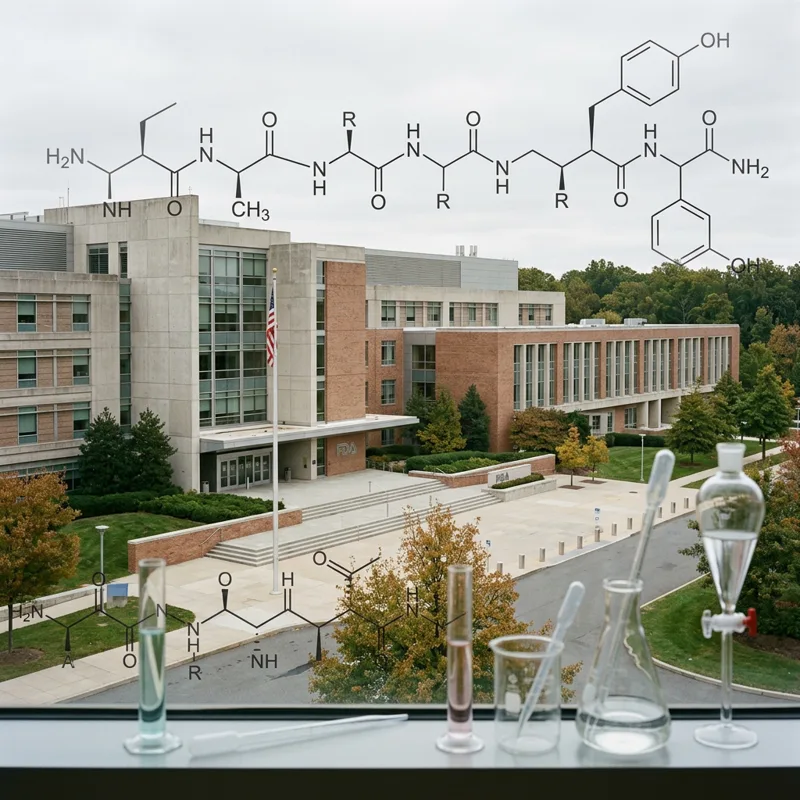

A research group at the University of Wisconsin–Madison published a paper in Nature Chemistry on June 16, 2026 that should reshape how medicinal chemists think about an entire family of injectable peptide drugs. The team, led by Sam Gellman, took two of the best-characterized peptide hormones in pharmacology — glucagon and the N-terminal fragment of parathyroid hormone, PTH(1–34) — and broke the rules they were thought to follow. They put D-amino acids into selected positions of these otherwise all-L peptides, destabilized the alpha-helical shape the textbooks insist is required for receptor activation, and the molecules still worked. They didn’t just work weakly. They produced cAMP signaling at potencies comparable to the natural peptides. And they did one thing the natural peptides cannot: they pulled apart the “helpful” signaling from the “harmful” signaling at the same receptor.
The paper’s title is “Potent and biased agonists of class B1 GPCRs from a heterochiral design strategy.” That phrase is doing a lot of work, and the rest of this piece unpacks it.
Why shape was thought to be everything
Class B1 G-protein-coupled receptors are a family of seven transmembrane proteins that respond to peptide hormones — glucagon, glucagon-like peptide 1, glucose-dependent insulinotropic polypeptide, parathyroid hormone, secretin, calcitonin, and a handful of others. They are also the receptor side of some of the best-selling peptide drugs in the world. Ozempic and Wegovy (semaglutide) hit the GLP-1 receptor. Mounjaro and Zepbound (tirzepatide) hit GLP-1 and GIP. Forteo (teriparatide) hits PTH1R. Glucagon itself, used to rescue patients from severe hypoglycemia, hits GCGR. Together these molecules represent more than $50 billion in annual revenue. They are also, almost without exception, alpha-helical when they bind their targets.
X-ray and cryo-EM structures of these peptides in their bound state are striking in their uniformity. A flexible chain in solution becomes a tight right-handed helix when it docks into the receptor’s extracellular and transmembrane pockets. The N-terminus of the peptide dives into the seven-helix bundle and triggers the conformational change on the inside of the cell that lets a heterotrimeric G protein bind. For thirty years the working assumption in peptide medicinal chemistry has been straightforward: if you want activation at a class B1 GPCR, you need that helix. Disrupt it, and you lose the message.
The Gellman group’s paper is a structured refutation of that assumption.
What they actually did
The technique is called heterochiral design. Every natural amino acid in a peptide drug is left-handed — the L-form. A peptide chain made of L-amino acids has a strong preference for a right-handed alpha-helix. Substitute even a few D-amino acids into specific positions and that helical preference collapses: the chain prefers to be looser, kinkier, more entropically free.
Russ Gibadullin, who earned his PhD in the group in 2022 and is first author on the paper, did the foundational work on glucagon. He picked positions in the 29-residue peptide where D-substitutions should be most helix-destabilizing without obliterating the side chains that contact the receptor. He synthesized the analogs, ran them at glucagon receptor in cell-based assays, and watched the cAMP response curve. He expected loss of activity. He got activity matching the all-L parent.
Lauren Tran, a current PhD student in the same lab, ran the same playbook on PTH(1–34) at PTH1R, the receptor target of Forteo. Same result. Heterochiral analogs of the 34-residue parathyroid fragment retained the potency of the natural sequence in producing cAMP through the receptor.
The headline finding is that two unrelated class B1 receptors — one for a 29-residue energy-homeostasis hormone, one for a 34-residue calcium-homeostasis hormone — both tolerated heterochiral redesign. This is what makes the paper general rather than anecdotal. Sam Gellman’s reaction, quoted in the UW–Madison release carried by Phys.org: “That’s what I would have guessed.”
Where it gets interesting: biased agonism
cAMP is one signal a class B1 GPCR can send when activated. It is the “classical” signal — the one drug developers usually optimize for. But the same receptor, when bound by the same peptide, can also recruit a second protein called β-arrestin, and arrestin recruitment kicks off a separate cascade. For some receptors arrestin signaling is the goal. For others it is a problem — it correlates with desensitization, downregulation, and, in some therapeutic settings, side effects you don’t want.
The pharmacological term for designing a ligand that activates one signaling pathway at a receptor while sparing another is “biased agonism.” In opioid receptor pharmacology, biased agonism is a multi-decade quest to separate analgesia from respiratory depression. In GLP-1 pharmacology, the question of whether arrestin recruitment matters — and whether you can tune around it — has produced a lot of preclinical work and very little clean clinical answer.
Heterochiral substitution, in the Gellman group’s hands, separated the two pathways. The new glucagon and PTH analogs hit cAMP as hard as their natural parents. They recruited β-arrestin less. For the glucagon analogs the researchers also measured receptor internalization — the process by which an activated GPCR gets pulled off the cell surface into endosomes — and the heterochiral compounds drove less of it. The peptide is doing something different inside the receptor pocket. The same N-terminus is engaging, but the geometry of the engagement is producing a different conformational signature, and that signature is read out as a different pathway profile.
None of this proves clinical benefit. Plenty of biased ligands have looked beautiful in vitro and produced nothing in patients. But it does establish a synthesis-friendly handle on a problem that has been chemistry-resistant for a long time.
What it could change in obesity, bone, and diabetes drug design
Take three concrete examples of what a heterochiral handle on class B1 GPCRs could open up.
Bone-anabolic drugs. Teriparatide is approved for severe osteoporosis but the label carries a daily-injection schedule and a duration limit. The receptor-internalization profile of natural PTH(1–34) is one of the reasons the molecule’s pharmacology is hard to push further. A PTH analog that produces equivalent cAMP signaling with less arrestin recruitment and less internalization is the molecular profile bone biologists have been asking for. Several companies, including the developers of canvuparatide and EB613, are already trying to push past Forteo with different chemistries. Heterochiral PTH is a new chemistry on the same biological problem.
Glucagon rescue and dual-agonist obesity therapy. Glucagon itself is used in hospital and ambulance kits to reverse severe hypoglycemia in patients with diabetes. The pharmacology question with glucagon is short-acting potency without the long-tail consequences of repeated dosing. The hotter question is in obesity: GLP-1/glucagon dual agonists and GLP-1/GIP/glucagon triple agonists are deep in clinical development. The glucagon arm of those programs is what produces the additional energy expenditure on top of GLP-1’s appetite effect — but it’s also the arm whose receptor-internalization profile is hardest to manage long-term. A heterochiral glucagon arm could be a real engineering lever.
GLP-1 itself. The Wisconsin paper does not report GLP-1 receptor data. But the GLP-1 receptor is a class B1 GPCR, and the structural similarity to glucagon receptor is high. If heterochiral design generalizes — and the paper’s authors explicitly suggest it should — then a heterochiral semaglutide analog with the same cAMP potency and less arrestin recruitment is a logical next experiment. Whether that profile means anything for the side-effect picture that has dogged the GLP-1 class (nausea, gastrointestinal motility, the unresolved question of long-term lean-mass loss) is an empirical question. It is at least a testable empirical question now.
Where heterochiral design sits in the broader modality stack
Peptide drug design has accumulated several tricks over the past two decades to push past the limits of natural sequences. Each one solves a specific problem. Heterochiral design is not the first of them, and it doesn’t replace any of them — it sits alongside.
- Fatty-acid acylation — the trick that produced once-weekly semaglutide. A lipid sidechain binds serum albumin and slows clearance. The peptide sequence stays mostly natural; the addition is the pharmacokinetic lever.
- Cyclization and stapling — locking the helical shape in place with covalent bridges so it survives proteases. Stapled peptides have produced several oncology programs. The lever is conformational stability.
- Backbone modification — β-amino acids, N-methylation, peptoid linkages. The lever is proteolytic stability without losing pharmacology.
- Dual and triple agonism — chimeric sequences that bind two or three receptors. The lever is integrating multiple endocrine arms in one molecule.
- Heterochiral design — selectively flipping L to D in specific positions. The lever is signaling bias at a single receptor.
That last lever is the one Wisconsin has just demonstrated for class B1 GPCRs. It is independent of the others. You can imagine an acylated, heterochiral, dual-agonist analog — pharmacokinetically tuned, biased toward cAMP, hitting two receptors. The combinatorics of medicinal chemistry just expanded by one dimension.
The caveats worth holding
Three honest ones.
One. The paper’s data are cell-based. cAMP production and β-arrestin recruitment in HEK293 or similar lines are the standard early-stage readouts and they are predictive, but they are not the same as efficacy in a glucose tolerance test or a bone density study. The translation from heterochiral analog at the bench to a candidate that holds up in primate or human pharmacokinetics is not automatic. D-amino acid substitutions can do unpredictable things to half-life and tissue distribution, and the paper, on the page content available, did not detail in vivo pharmacology.
Two. “Biased agonism” is a concept that has produced a long line of clinical disappointments. Oliceridine, the most heralded biased mu-opioid agonist of the last decade, got an FDA approval but did not deliver the side-effect separation its early data suggested. The reasons are technical — the bias measured in cell assays does not always reproduce in the integrated pharmacology of a living human. A heterochiral glucagon analog could be the next clean test or it could be another reminder that pathway separation in a dish does not always translate.
Three. D-amino acid synthesis is more expensive than all-L. For a research compound that’s irrelevant. For a once-weekly chronic injectable manufactured at the ton scale, every unnatural residue is a cost the program has to justify. Heterochiral analogs are not free at scale, and the case for them at scale has to rest on a clinical advantage real enough to fund the synthesis route.
Frequently Asked Questions
What does “heterochiral” actually mean?
A peptide chain made entirely from L-amino acids is homochiral. Insert even a few D-amino acids and the chain becomes heterochiral — mixed-handedness. Natural peptides are almost always homochiral L. Heterochiral analogs are designed in the lab and synthesized residue by residue.
Why do D-amino acids destabilize the alpha-helix?
A right-handed alpha-helix is built from L-amino acids with characteristic backbone torsion angles. D-residues prefer different torsion angles. When a D-residue sits inside what would be a helical segment, it punishes the helix energetically and the chain spends more of its time in non-helical conformations.
If the helix is what binds the receptor, how does the peptide still work?
That is exactly the surprise. The traditional model says full helicity in the bound state is needed for activation. The Wisconsin data say that for class B1 GPCRs the bound state can tolerate substantial helix destabilization while still triggering the conformational change inside the receptor that activates G proteins. The peptide is presumably still adopting some helical character against the receptor, but less than the all-L parent — and that “less” is enough to change pathway selectivity.
What is β-arrestin recruitment and why care less of it?
β-arrestins are proteins that bind activated GPCRs and serve two jobs: they desensitize the receptor (turn off G-protein signaling) and they kick off their own arrestin-mediated signaling cascade. For some therapeutic targets less arrestin recruitment means less desensitization and a cleaner signal. For some it means avoiding side-effect pathways. Which version applies to glucagon or PTH is what the Wisconsin paper invites further work to answer.
Does this affect Ozempic or Mounjaro?
Not directly — semaglutide and tirzepatide remain all-L. But GLP-1 receptor is a class B1 GPCR, and the Wisconsin paper’s implication is that the same heterochiral lever should work on it. Whether a future heterochiral GLP-1 analog is meaningfully better than what exists is an empirical question that the field is now in a position to ask.
How long until a heterochiral peptide drug reaches patients?
Years, in any honest reading. The paper is a chemistry paper, not a clinical readout. Even if a biotech licensed the chemistry tomorrow and started medicinal chemistry optimization, the path runs through animal pharmacology, an IND, a Phase 1 in healthy volunteers, and at least a Phase 2 efficacy readout before anything is in the clinic. The fastest analogous timeline for a peptide-design breakthrough — from concept paper to approved drug — is a decade. The honest answer is that the value of this paper is what it changes about what programs are launched in 2026, not what reaches the pharmacy in 2026.
Sources
- Gibadullin R, Tran L, et al. “Potent and biased agonists of class B1 GPCRs from a heterochiral design strategy.” Nature Chemistry, June 16, 2026. DOI 10.1038/s41557-026-02182-x. https://www.nature.com/articles/s41557-026-02182-x
- Kimberly M. Hazen, “Drug peptides defy shape rules, activating receptors without full spiral form,” Phys.org / UW–Madison Department of Chemistry, June 23, 2026. https://phys.org/news/2026-06-drug-peptides-defy-receptors-full.html
- Gellman Group, University of Wisconsin–Madison Department of Chemistry. Group page and prior publications on backbone-modified peptide design.
- U.S. Food and Drug Administration, prescribing information for Forteo (teriparatide) and for the glucagon hypoglycemia rescue kits.
Related on PeptideKnow: Glucagon profile · Teriparatide (PTH 1–34) profile · Semaglutide profile · Tirzepatide profile · Canvuparatide (MBX 2109) · EB613 oral PTH · Category: Bone & Mineral Metabolism · Category: Weight Loss & Metabolic
Sources & References
- FDA PCAC Meeting Announcement (July 23-24, 2026)
- PBS: FDA to Weigh Easing Limits on Peptides Favored by RFK Jr.
- BioPharma Dive: FDA Peptides RFK Advisory Committee Restrictions
- RAPS: FDA Considers Adding a Dozen Peptides to Bulk Drug List
- Ars Technica: RFK Jr. Forces FDA to Reconsider 12 Peptides
- ProPublica: Peptide Safety Investigation
- New York Times: Peptide Ban FDA RFK Jr.
- SSRP Institute: FDA Announces Change in Status of 12 Peptides
- CNBC: RFK Jr. Peptides Hims Hers GLP-1
- USA Today: RFK Jr. FDA Peptides Explainer