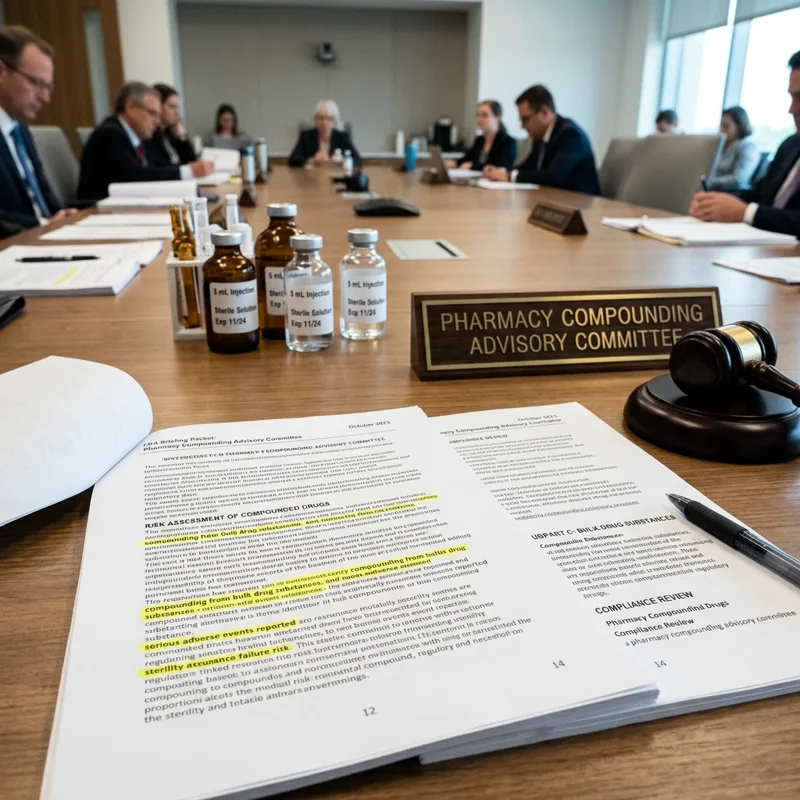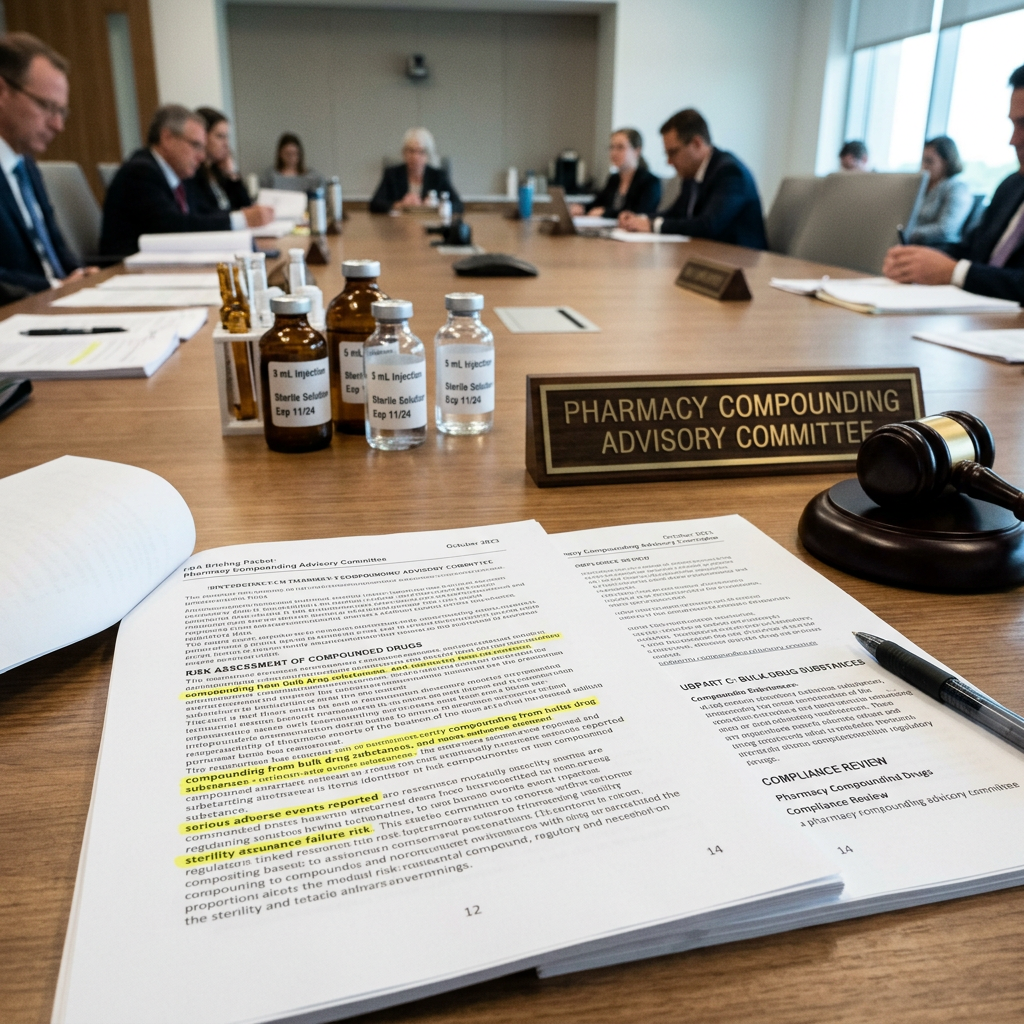

In late July 2026, a little-noticed FDA advisory committee meeting is set to collide with one of the loudest corners of the wellness internet. The Pharmacy Compounding Advisory Committee (PCAC) is slated to discuss whether seven unapproved peptides should be candidates for inclusion on the federal 503A “bulks list” — a bureaucratic phrase that, in practice, can shape what licensed compounding pharmacies may legally prepare. For clinics that prescribe peptides, for pharmacies that compound them, and for patients trying to separate hype from risk, this meeting matters less as a verdict on “peptides” and more as a stress test of how the U.S. wants to regulate gray-market biology.
This post explains what PCAC is actually evaluating, why BPC-157 became the headline peptide, and what it would (and wouldn’t) mean if FDA ultimately moves any of these substances forward. Along the way, we’ll map the seven peptides on the agenda — BPC-157, KPV, TB-500, MOTS-c, Emideltide (DSIP), Semax, and Epitalon — and make one point that tends to get lost: compounding policy is mostly about quality, not vibes.
What PCAC is — and why this meeting is bigger than one peptide
PCAC is an FDA advisory committee that gives recommendations on compounding policy. That can sound like inside baseball until you translate it into practical outcomes. Under Section 503A of the Federal Food, Drug, and Cosmetic Act, traditional pharmacies can compound certain medications under specific conditions, but the bulk drug substances they use typically must meet one of a few criteria — including appearing on a formal 503A bulks list established through rulemaking. Legal analysts following the July 2026 meeting have emphasized that inclusion on the 503A bulks list is the pathway that can make compounding of a given substance defensible under federal law, while removal from interim “Category 2” lists is not the same thing as authorization (National Law Review).
That distinction matters because the peptide conversation has been flattened into a binary: “FDA banned them” versus “FDA legalized them.” The reality is procedural and slow. PCAC can recommend; FDA can accept or reject; and if FDA wants to add a substance to the bulks list, it generally has to go through notice-and-comment rulemaking. In other words, a July meeting can be consequential without producing an overnight change in what’s legally safe to compound.
Why BPC-157 is the headliner (and why scientists keep asking the same questions)
BPC-157 is a 15–amino acid peptide that has lived two lives: one in a long-running research program centered in Croatia, and another as a gray-market product marketed for everything from tendon injuries to “gut repair.” A recent longform investigation co-published by STAT and Undark traced the peptide’s origin story to a decades-long project led by Predrag Sikiric at the University of Zagreb — a project that produced lots of animal and cell studies, but far less in the way of modern, reproducible human clinical data (STAT).
The same investigation highlighted why mainstream peptide scientists remain uneasy: questions about whether the peptide is naturally produced in humans, incomplete details in early patent documents, and the absence of a clearly identified receptor target — the kind of anchor point many peptide drugs have (STAT). The American Peptide Society summarized these concerns bluntly, noting that limited detail and missing sequence information make the original work difficult to reproduce (American Peptide Society).
None of that proves BPC-157 is useless. It does explain why “it helped my friend’s shoulder” is not a regulatory standard. When FDA asks whether something should be a permissible bulk substance for compounding, the agency isn’t adjudicating internet testimonials. It’s weighing whether the substance can be consistently characterized, whether there are safety concerns (including impurities and immunogenicity), and whether the proposed uses have any credible evidence behind them.
The seven peptides on the July 2026 agenda — a quick map
Legal and industry summaries of the July 2026 PCAC meeting converge on the same list of seven peptides: BPC-157, KPV, TB-500, MOTS-c, Emideltide (DSIP), Semax, and Epitalon (National Law Review). Each has its own mini-economy of claims and clinics.
- BPC-157: marketed for wound healing, soft-tissue injury, “gut repair.” Evidence is heavily preclinical; human data are thin (STAT).
- TB-500: commonly described as a thymosin beta-4 fragment used for tissue repair; popular in sports-recovery marketing.
- KPV: a tripeptide fragment associated with anti-inflammatory signaling in lab work; discussed in IBD and dermatology-adjacent contexts.
- MOTS-c: a mitochondria-derived peptide studied for metabolic effects; frequently bundled into longevity narratives.
- Emideltide (DSIP): an INN name used in regulatory discussions for DSIP, historically explored for sleep-related effects.
- Semax: a peptide developed in Russia with claims around neuroprotection and cognition.
- Epitalon: a short peptide associated with pineal signaling and longevity claims, often discussed alongside sleep.
It’s tempting to read that list as a referendum on “anti-aging peptides.” But FDA’s framing is more constrained: can these substances be compounded safely and consistently, and is there enough evidence to justify the proposed uses? That’s a different question than whether the peptides make for good podcast content.
Category lists, enforcement discretion, and the gray zone people keep misreading
If you’ve been tracking peptide news, you’ve likely seen a recurring claim: “FDA removed peptides from Category 2, so they’re allowed again.” That’s not how the legal mechanics work. In a May 2026 analysis, Polsinelli attorneys wrote that FDA’s procedural removal of certain peptide nominations from Category 2 should not be interpreted as a green light to compound, because FDA has not necessarily moved the peptides into Category 1 or stated it will exercise enforcement discretion (National Law Review).
The key practical point: if you run a clinic or a pharmacy, “regulatory uncertainty” is not an abstract phrase. It’s a risk that shows up as sourcing problems, insurer scrutiny, state board attention, and potential FDA action. It also shows up for patients in the least glamorous way possible: inconsistent potency, sterility failures, and mislabeled vials.
What would actually change if FDA ultimately moves a peptide toward the 503A bulks list?
Think in layers. Layer one is the public narrative: headlines that imply the FDA is blessing peptides. Layer two is the legal pathway: whether a substance becomes eligible for compounding under 503A through the formal bulks list process. Layer three is the clinical reality: what prescribers can responsibly do with limited evidence and limited safety monitoring infrastructure.
If FDA ultimately adds a peptide to the 503A bulks list, that doesn’t make it FDA-approved. It doesn’t create a package insert. It doesn’t tell clinicians what dose to use, what lab monitoring to order, or what adverse event rate to expect. It does something more concrete and more consequential: it sets a clearer federal lane for licensed compounding pharmacies to prepare the substance under prescription — and reduces use of “research use only” suppliers that have no clinical quality obligations (National Law Review).
That lane is still narrow. Section 503A compounding has conditions. Pharmacies need certificates of analysis, validated sourcing, and good documentation. And the policy backdrop that got peptides into trouble in the first place hasn’t gone away: peptides can be hard to characterize, impurities can be clinically meaningful, and sterile injectable compounding is not forgiving.
Why quality and characterization are the quiet story behind the headlines
Most peptide discourse treats safety as “side effects.” That’s the wrong mental model for gray-market injectables. The more common hazards are boring and preventable: endotoxin contamination, mislabeling, microbial contamination, incorrect salt forms, and analytic shortcuts that turn a “99% purity” claim into marketing poetry.
This is why regulatory lawyers keep returning to characterization. If a substance can’t be consistently characterized, you can’t build reliable sterility assurance and batch-release testing around it. If you can’t build that, you can’t responsibly scale compounding. And if you can’t responsibly scale compounding, patients get pushed back toward the least regulated part of the market.
There’s also a second-order effect: once a substance becomes popular, the incentive to cut corners rises. Demand surges, suppliers multiply, and some players will chase margin. The safest version of this market is one where the “normal” supply chain is boring: registered establishments, clear COAs, stable analytics, and traceable lots. That’s not a guarantee of safety. It’s the minimum bar for an injectable product category that has already attracted opportunists.
How to read the July 2026 meeting if you’re a patient, clinician, or pharmacy
For patients: Treat the meeting as a signal about the regulatory direction of travel, not as proof a peptide is safe or effective. If you’re considering a peptide, ask where it’s sourced, how sterility is assured, and what evidence exists for your specific condition. “It’s being discussed by FDA” is not a substitute for data.
For clinicians: The meeting is a reminder to separate mechanism stories from clinical evidence. If you prescribe peptides, build a plan for informed consent, adverse event reporting, and realistic expectations. Consider whether your patients are reaching for peptides because standard options failed — or because marketing moved faster than medicine.
For pharmacies: Legal analysts have flagged that compounding these peptides remains an area of uncertainty until FDA completes the relevant process (National Law Review). That means quality systems and documentation are not paperwork; they’re survival equipment. If you’re preparing sterile injectables, you already know the stakes.
Frequently Asked Questions
Is the July 2026 PCAC meeting an FDA “approval” of BPC-157 or other peptides?
No. PCAC is an advisory committee, and the discussion is about compounding policy, not FDA drug approval. Even if FDA eventually adds a substance to the 503A bulks list, that is not the same as approving a drug through clinical trials and labeling review (National Law Review).
Why do people say BPC-157 might not be a “natural” human peptide?
Scientists interviewed in the STAT/Undark investigation raised concerns that genetic material coding for BPC-157 has not been located in the human genome or gut microbiome, and that early documentation left key details hard to reproduce (STAT). The American Peptide Society echoed concerns about limited detail and reproducibility (American Peptide Society).
If peptides move to the 503A bulks list, can any clinic sell them over the counter?
No. 503A compounding is tied to pharmacy practice and prescriptions. Inclusion on the bulks list would shape whether a pharmacy may compound from a bulk substance under federal law; it would not turn peptides into dietary supplements or OTC products (National Law Review).
What is Emideltide, and how is it related to DSIP?
Emideltide is the INN used in some regulatory and legal discussions for DSIP (delta sleep-inducing peptide). Marketplace products usually use the DSIP name, but PCAC materials and analyses may list Emideltide (National Law Review).
Is it safer to get peptides from a compounding pharmacy than from online “research” vendors?
In general, licensed pharmacies operate under stricter quality expectations than gray-market sellers, especially for sterility and documentation — but “compounded” is not automatically “safe.” The key questions are sterility assurance, sourcing, testing, and clinician oversight. The policy debate is partly about shifting demand away from unregulated supply chains while managing real risks (National Law Review).
Sources
- Talpos S. “The hidden history of BPC-157, a favorite MAHA peptide.” STAT News (June 1, 2026). https://www.statnews.com/2026/06/01/bpc-157-researcher-predrag-sikiric-addesses-skeptics-questions/
- American Peptide Society. “The BPC-157 Question.” (June 2026). https://americanpeptidesociety.org/news/the-bpc-157-question/
- Landmon CA, Davies C, Pape SM, Bassett SE, McCann JD. “Tiny Chains, Big Changes? What FDA’s Latest Actions Mean for Peptide Compounding.” National Law Review (April 22, 2026). https://natlawreview.com/article/tiny-chains-big-changes-what-fdas-latest-actions-mean-peptide-compounding
Sources & References
- FDA PCAC Meeting Announcement (July 23-24, 2026)
- PBS: FDA to Weigh Easing Limits on Peptides Favored by RFK Jr.
- BioPharma Dive: FDA Peptides RFK Advisory Committee Restrictions
- RAPS: FDA Considers Adding a Dozen Peptides to Bulk Drug List
- Ars Technica: RFK Jr. Forces FDA to Reconsider 12 Peptides
- ProPublica: Peptide Safety Investigation
- New York Times: Peptide Ban FDA RFK Jr.
- SSRP Institute: FDA Announces Change in Status of 12 Peptides
- CNBC: RFK Jr. Peptides Hims Hers GLP-1
- USA Today: RFK Jr. FDA Peptides Explainer