PeptideKnow is a reference site. This article covers U.S. regulatory policy; it is not medical or legal advice. Compounded drugs are not FDA-approved. Talk with a licensed clinician before using any peptide.
Key Takeaways
- On October 30, 2026, HHS published an enforcement discretion policy saying it does not intend to take action against state-licensed pharmacies, federal facilities or licensed physicians that compound certain peptides under section 503A.
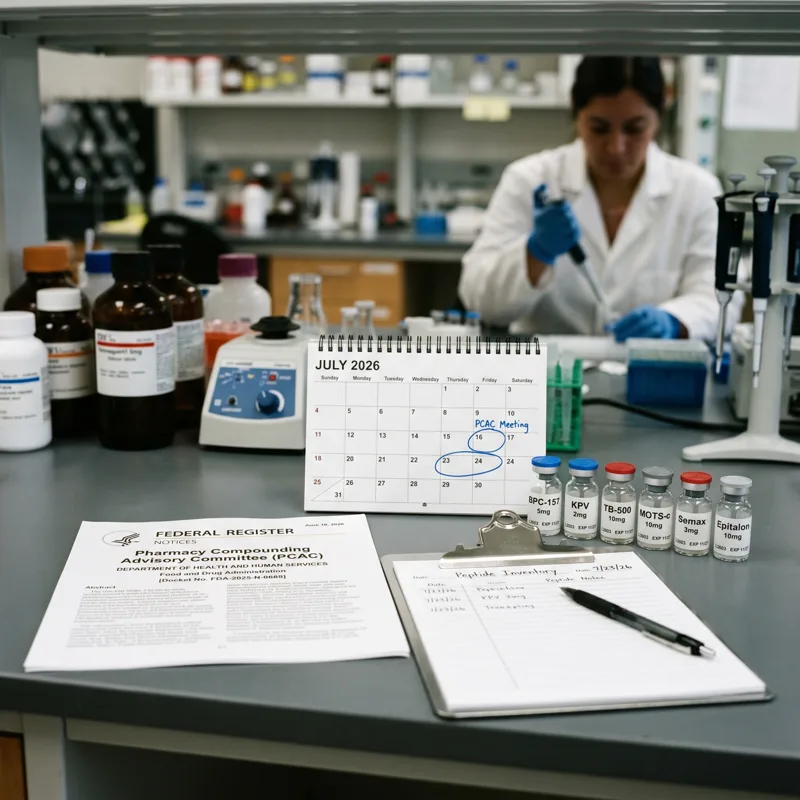
- The six covered peptides are the six the FDA's advisory committee backed in July: BPC-157, KPV, TB-500, MOTS-c, Epitalon and Semax. Emideltide (DSIP), which the panel rejected, is not included.
- The policy is interim. It ends for each peptide once FDA finalizes a rule adding it to, or keeping it off, the 503A bulks list. None of the six is on that list today, and none is FDA-approved.
- Reported conditions include one unapproved peptide per product, a certificate of analysis from the bulk supplier, adverse event reporting to FDA, specific labeling, and FDA-cleared syringes only.
- The AMA has called for the policy to be rescinded and PhRMA has objected. Hims & Hers launched a "Peptides+" line on November 18, starting with products outside the six.
What HHS Announced
Four months after the FDA's Pharmacy Compounding Advisory Committee (PCAC) voted to recommend six peptides for compounding, the Department of Health and Human Services has acted on that vote without waiting for the FDA rulemaking it would normally require. A notice in the Federal Register on October 30, 2026 (Docket No. HHS-OASH-2026-0496), signed by HHS Secretary Robert F. Kennedy Jr., announced the availability of an "Enforcement Discretion Policy Regarding 503A Compounding Using Certain Peptide Bulk Drug Substances."
The operative sentence is short. Citing the PCAC meetings and "data regarding utilization of peptides," the notice says that "to expand and improve patient access, HHS does not intend to take enforcement action against a State-licensed pharmacy, Federal facility, or licensed physician compounding a drug product using a peptide bulk drug substance found in Appendix A."
The notice also states what the policy is not. It "does not establish any rights for any person and is not binding on HHS or the public," and HHS "may revisit application of this interim policy (in whole or in part) if, among other things, a safety signal or product quality issue arises." The notice repeats the standard caution that compounded drugs "are not FDA-approved, which means FDA does not review their safety, effectiveness, or quality before they are marketed."
Written comments were accepted for two weeks after publication, through about November 13. The notice is issued by the Office of the Secretary, not by the FDA, which is unusual for compounding policy: the FDA has historically written and enforced the rules for which bulk substances 503A pharmacies may use.
Which Peptides the Policy Covers
According to the law firm Mintz, which reviewed the policy and its appendices, Appendix A lists the same six peptides the PCAC recommended in July. The table below pairs each one with the July vote and the indication FDA reviewers evaluated.
| Peptide | PCAC vote (July 2026) | Indication FDA reviewed | Covered by HHS policy? |
|---|---|---|---|
| BPC-157 | 8 yes, 6 no, 1 abstain | Ulcerative colitis | Yes |
| KPV | Recommended (tally reported with BPC-157) | Wound healing, inflammatory conditions | Yes |
| TB-500 | Recommended (8-6-1 per PharmExec and AJMC) | Wound healing | Yes |
| MOTS-c | 7 yes, 5 no, 2 abstain | Obesity, osteoporosis | Yes |
| Epitalon | Recommended by a narrow margin | Not reported in coverage | Yes |
| Semax | Recommended by a narrow margin | Not reported in coverage | Yes |
| Emideltide (DSIP) | Rejected, 7 no, 6 yes, 1 abstain | Narcolepsy or insomnia; opioid withdrawal | No |
Published tallies for the July meeting do not all agree. PharmExec described a 14-member panel, yet the 8-6-1 BPC-157 vote adds up to 15, which may reflect temporary voting members the FDA added the week before the meeting. KPV, Epitalon and Semax did not get separately reported numbers in the coverage we reviewed. Our earlier analysis of the FDA briefing documents covers the staff reviews in detail.
The Conditions Pharmacies Must Meet
The enforcement discretion is conditional. Mintz's November 2026 FDA in Flux newsletter summarizes the requirements, which apply on top of the existing section 503A rules, including the requirement for a patient-specific prescription:
- Identity specifications. Each peptide must meet the chemical and molecular identity specifications in Appendix B, along with any route-of-administration limits listed there.
- Certificate of analysis. The bulk peptide manufacturer must give the compounder a valid certificate of analysis covering every analytical test in Appendix B and must identify where the substance was physically made.
- Adverse event reporting. Compounders must report serious adverse events tied to the compounded product to FDA.
- Labeling. Labels must read "This is a compounded drug product. Not for resale," and must tell patients how to report product problems to the pharmacy.
- One peptide per product. Each product may contain only a single unapproved peptide from Appendix A. Mintz notes this makes it easier to attribute adverse events or outcomes to a specific substance. It also rules out pre-mixed blends such as a single-vial BPC-157 and TB-500 "Wolverine" stack (see our stacking guide for how those combinations are usually described).
- FDA-cleared syringes. Only FDA-cleared syringes may be dispensed with the product.
The policy covers 503A only: state-licensed pharmacies and physicians compounding against individual prescriptions. Nothing we reviewed extends it to 503B outsourcing facilities, which make larger batches without patient-specific prescriptions.
HHS gave its own reason for the certificate-of-analysis and identity requirements. As quoted by Mintz, the Secretary determined that the policy "will discourage the continued, widespread use of certain research-use-only peptides supplied by foreign manufacturers that pose a safety risk to US patients." That ties the policy to the supply-chain problem FDA has been working on all year, including Import Alert 66-80 on peptide bulk substances and the April warning letters to "research peptide" sellers.
How We Got Here: April to October 2026
| Date | Event |
|---|---|
| April 2026 | FDA removes 12 peptides from Category 2 of its bulk substances categories, the "do not compound" group created in 2023 (our coverage). |
| June 2026 | FDA appoints eight new PCAC members. Reuters and ABC News reported that six of them run or work for clinics offering peptides. |
| June 29, 2026 | FDA posts briefing documents. Staff reviewers recommend against all seven peptides on the agenda. |
| July 23–24, 2026 | PCAC votes to recommend six of the seven for the 503A bulks list; emideltide is rejected. |
| October 30, 2026 | HHS publishes the enforcement discretion policy for the six peptides. |
| November 13, 2026 (approx.) | Two-week comment period closes. |
| Before end of February 2027 | A second PCAC review is expected for LL-37, GHK-Cu, dihexa, melanotan II and PEG-MGF. No date has been set (background). |
The July meeting was contentious. FDA's Russell Wesdyk told the committee, as quoted by ABC News, "If you don't know what it is and I don't know what it is, how do I put it on the list?" Committee member Dr. Elizabeth Rebello of MD Anderson told TIME, "I'm concerned that we're responding to a market-induced demand rather than a decision based in solid science." On the other side, David Pope of XiFin Pharmacy Solutions said he voted yes "because it's time to put this decision back in the hands of the physician and pharmacist," according to RAPS.
An HHS spokesperson, Emily Hilliard, told PharmExec that "all committee members underwent the same ethics review and vetting process required of all FDA advisory committee members."
After the vote, attorney Dustin Robinson of LumaLex Law told PharmExec that the recommendation "still triggers a formal rulemaking cycle that realistically runs eight to twelve months." The HHS policy is a way to allow compounding during that cycle rather than after it.
Reactions From Medicine, Industry and Lawyers
Physicians. The American Medical Association called for the policy's rescission in a November statement. As reported by South Florida Hospital News, the AMA's president said, "We should not bypass the science and put patients at risk by making them guinea pigs for unapproved drugs."
Drugmakers. PhRMA published a statement objecting to the policy.
Regulatory lawyers. Mintz described the policy as "an action that threatens to undermine the consumer protection goals" of the Food, Drug, and Cosmetic Act. The firm also advised companies to avoid claims about "FDA compliance" or the overall legality of an unapproved peptide. In New Hope Network, attorney Ashish Talati said, "If legitimate access expands, some of that demand will move into regulated channels," and added, "But there will always be sellers offering cheaper products or peptides that are not otherwise available."
Supplements. The policy does not touch dietary supplements. Consultant Michael Levin told New Hope that selling peptides as supplements is "illegal. Hard stop." Talati made the same point about labels: "Calling an unapproved drug a supplement, a research chemical or RUO does not change what it is."
Telehealth Moves First: Hims & Hers "Peptides+"
On November 18, Hims & Hers launched what it calls Peptides+, according to CNBC. The first five compounded products are sermorelin, glutathione, NAD+, vitamin B-12 and L-carnitine. None of them is among the six peptides in the HHS policy. The company has said BPC-157 and TB-500 will follow "when the regulatory environment permits."
CNBC reported that members start with an assessment by a licensed provider "trained in peptide therapies," that people with serious cardiovascular, liver or kidney disease are not candidates for now, and that more than 10,000 people joined an early-access list within 15 days of its late-October opening. CNBC's headline noted the company launched "while admitting there's more to learn about efficacy." Pricing was not disclosed in the coverage we reviewed.
Hims has been tied to this story since the summer. TIME reported that its chief medical officer, Dr. Anant Vinjamoori, spoke in favor of compounding at the July meeting, and that the company's stock rose more than 10% after the BPC-157 vote.
What the Policy Does and Does Not Change
| Question | Before October 30 | Under the HHS policy |
|---|---|---|
| Are the six peptides FDA-approved? | No | No |
| Are they on the 503A bulks list? | No | No. That still requires an FDA final rule. |
| Can a 503A pharmacy compound them against a prescription? | Legally risky; enforcement possible | HHS says it will not take enforcement action if the conditions are met |
| Can a product combine two of them? | N/A | No. One unapproved peptide per product. |
| Are "research use only" vials legal for human use? | No | No. The policy is aimed at reducing their use. |
| Do state rules still apply? | Yes | Yes. For example, Alabama's medical board bars physicians from prescribing non-FDA-approved peptides. |
Three limits matter most for patients and clinics.
The evidence has not changed. FDA's own reviewers found the human data thin for every peptide on the July agenda. TIME reported that the only BPC-157 ulcerative colitis trial FDA identified was a 46-person meeting abstract using an enema, not an injection, and that none of the KPV studies FDA found were in humans. Research on these peptides is still largely preclinical, and our BPC-157 profile reflects that.
The policy can be withdrawn. HHS says it may revisit the policy if a safety signal or quality issue appears. It is guidance, not a rule, and a future administration could reverse it quickly.
State law sits on top. Federal enforcement discretion does not override state pharmacy or medical board rules. State boards have been active this year, as our state enforcement roundup shows.
What to Watch Next
- FDA proposed rules. The policy ends for each peptide when FDA finalizes a rule on it. A proposed rule with its own comment period would come first.
- The second PCAC meeting. LL-37, GHK-Cu, dihexa, melanotan II and PEG-MGF are expected before the end of February 2027. If the panel backs them, a similar policy could follow.
- Adverse event data. The reporting requirement means FDA should start receiving structured safety reports on compounded versions of these peptides. A safety signal is the stated trigger for revisiting the policy.
- Litigation. New Hope reported that legal experts expect "a contested rulemaking or guidance process," and possible court challenges.
Frequently Asked Questions
Is BPC-157 legal now?
Not in the sense of being approved. BPC-157 is not FDA-approved and is not on the 503A bulks list. Under the October 30, 2026 HHS policy, HHS says it does not intend to take enforcement action against a state-licensed pharmacy or physician that compounds BPC-157 against a patient-specific prescription, provided the policy's conditions are met. "Research use only" BPC-157 sold for human use is not covered.
Which peptides are covered by the HHS enforcement discretion policy?
Six: BPC-157, KPV, TB-500, MOTS-c, Epitalon and Semax. These are the six the FDA's Pharmacy Compounding Advisory Committee recommended in July 2026. Emideltide (DSIP), which the committee rejected, is not covered.
Can a pharmacy compound a BPC-157 and TB-500 blend?
Not under this policy. According to Mintz's summary, each compounded product may contain only one unapproved peptide from the covered list, so single-vial blends fall outside the policy.
Does the policy apply to 503B outsourcing facilities?
No. The Federal Register notice covers compounding under section 503A, meaning state-licensed pharmacies, federal facilities and licensed physicians working from individual prescriptions.
When does the policy end?
It has no fixed end date. It stops applying to a given peptide once FDA finalizes a rule adding that peptide to the 503A bulks list or declining to. HHS can also revise or withdraw it at any time, including if a safety signal emerges.
Is the policy the same as FDA approval?
No. Compounded drugs are not FDA-approved, and the notice itself says the FDA does not review their safety, effectiveness or quality before they are marketed. Marketing that describes these products as "FDA approved" or "FDA compliant" would be misleading.
Sources
- U.S. Department of Health and Human Services. "Enforcement Discretion Policy Regarding 503A Compounding Using Certain Peptide Bulk Drug Substances." Federal Register, Vol. 91, No. 209, October 30, 2026.
- Mintz. "FDA in Flux — November 2026 Newsletter." November 2026.
- CNBC. "Hims & Hers launches new peptide treatments — while admitting there's more to learn about efficacy." November 18, 2026.
- New Hope Network. "FDA's peptide rule blurs drug-supplement lines." November 20, 2026.
- American Medical Association. "AMA adopts new policies to protect patients and strengthen public health." November 2026.
- PhRMA. "PhRMA statement on HHS enforcement discretion policy." 2026.
- ABC News. "FDA advisers narrowly vote to add 6 peptides to a drug compounding list. What's next?" July 24, 2026.
- TIME. "An FDA Committee Just Voted in Favor of Peptides—Despite the Agency's Opposition." July 23, 2026.
- RAPS. "FDA advisory committee backs two controversial peptides." July 23, 2026.
- PharmExec. "FDA Panel Votes to Loosen Restrictions for Four Peptides." July 24, 2026.
- AJMC. "FDA Panel Backs 6 Peptides for Compounding." July 31, 2026.
- U.S. Food and Drug Administration. "July 23–24, 2026 Meeting of the Pharmacy Compounding Advisory Committee."