Cortagen
Also known as: Ala-Glu-Asp-Pro, Brain cortex bioregulator
Overview
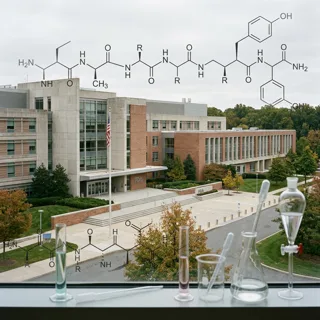
Cortagen is a synthetic tetrapeptide (Ala-Glu-Asp-Pro) bioregulator developed by Professor Vladimir Khavinson based on amino acid analysis of cortexin, a polypeptide preparation from the cerebral cortex with neurotrophic activity. It is classified as a cytogen that interacts directly with DNA to influence gene expression in neural tissue. Research focuses particularly on its regenerative effects on peripheral nerve tissue, with studies demonstrating axonal regeneration and functional recovery after sciatic nerve injury.
Mechanism of Action
Cortagen functions as a DNA-interacting cytogen, binding gene regulatory regions to activate transcription of previously repressed genes in aged neural tissue. It increases ribosomal gene activity through decondensation of nucleolus organizer regions (NORs), and unpacks age-condensed chromatin fibrils to release previously silenced genes. This mechanism is distinct from Pinealon (similar sequence but different target tissue) and allows targeted regulatory effects in cortical neural tissue. Research indicates it activates genes relevant to protein synthesis and cellular regeneration in neurons.
Potential Benefits
- Neural regeneration after peripheral nerve injury
- Axonal regrowth and functional recovery in nerve damage models
- Chromatin remodeling in aged neural cells releasing silenced genes
- Increased ribosomal gene activity supporting protein synthesis
- Complementary to Pinealon (cortagen provides regeneration, pinealon provides protection)
- Potential support for cortical neural tissue health in aging
Dosage Protocols
The following reflects doses used in published research studies. This is not medical advice. Consult a qualified healthcare professional.
| Beginner | 50 mcg daily for 10 days |
| Intermediate | 100 mcg daily for 15 days |
| Advanced | 200 mcg daily for 20 days, repeat every 6 months |
| Cycle Duration | 10-20 days |
Khavinson tetrapeptide (Ala-Glu-Asp-Pro). Cortex bioregulator.
Use our Reconstitution Calculator to determine exact syringe units for your protocol.
Routes of Administration
Subcutaneous Injection High
Primary Russian protocol route.
Intranasal Moderate — preferred for CNS
Used for cognitive targeting.
Read our full Routes of Administration Guide for detailed comparison of all delivery methods.
Stacking Protocols
Popular research stacks involving Cortagen:
Cognitive Bioregulator Stack
Cortex + pineal + BDNF induction for cognitive optimization.
Explore our complete Peptide Stacking Guide for more combinations and safety considerations.
Reconstitution
| Storage | Refrigerate at 2-8°C after reconstitution. Do not freeze reconstituted solution. |
|---|
Typical vial sizes: 2-5 mg. Add bac water slowly down the side of the vial, swirl gently — do not shake. Use insulin syringe for precise dosing.
Need exact syringe measurements?
Amino Acid Sequence
Ala-Glu-Asp-Pro (AEDP)
Side Effects & Safety
- Generally well-tolerated based on available data
- Minimal adverse events reported in Khavinson research
Safety & Contraindications
This information is for educational purposes only. Consult a qualified healthcare provider before using any peptide.
Pregnancy / Lactation
Bleeding Disorders
Active Skin Infection at Injection Site
Pharmacokinetics
| Half-Life | Not well characterized for this peptide; consult primary literature |
|---|---|
| Storage | Store lyophilized peptide at -20°C (long-term) or 2-8°C (short-term, under 30 days). Reconstituted: refrigerate at 2-8°C and use within 28-30 days. Protect from light. Do not freeze reconstituted solution. |
Synergistic Compounds
The following compounds have been studied alongside Cortagen for potential complementary or synergistic effects:
Learn More
References & Further Reading
Latest News & Research
View all articles →
FDA Staff Reviewers Say ‘No’ to 7 Compounded Peptides Ahead of July PCAC Vote
FDA staff reviewers urged against adding seven popular peptides to the 503A bulks list ahead of the July PCAC meeting, citing weak human data and safety uncertainty.

FDA reviewers urge ‘no’ on BPC-157, TB-500, MOTS-c ahead of July 2026 compounding vote
FDA reviewers’ June 29 briefings recommend against listing seven popular peptides for 503A compounding, citing limited human data and immunogenicity risk.

Medicare Starts Paying for Obesity Drugs Today — Bridge Program Opens $50 Access for Millions
Medicare's new $50 Bridge program covering Wegovy, Zepbound, Foundayo, and oral Wegovy for obesity launched July 1 — the first Medicare weight-loss benefit.
FDA staff urges caution on compounded peptides ahead of July advisory meeting
Ahead of the July 23–24 Pharmacy Compounding Advisory Committee meeting, FDA staff briefings recommend against listing seven popular peptides for compounding.