Cortistatin
Also known as: CST-14, CST-17, CST-29
Overview
Cortistatin is a neuropeptide related to somatostatin that is expressed predominantly in cortical interneurons. Unlike somatostatin, cortistatin binds with high affinity to all five somatostatin receptors (SSTR1-5) as well as to MrgX2/MRGPRX2 and the ghrelin receptor (GHS-R1a). In addition to neuroendocrine regulatory functions, cortistatin has potent and novel anti-inflammatory properties mediated through MRGPRX2, making it a research target for inflammatory and autoimmune diseases. Cortistatin-14 is the predominant C-terminal form active in the brain.
Mechanism of Action
Cortistatin activates SSTR1-5 (shared with somatostatin), GHS-R1a (ghrelin receptor), and MRGPRX2. Through SSTR2/SSTR5, it inhibits adenylyl cyclase and suppresses GH/ACTH secretion similar to somatostatin. Via GHS-R1a, it competes with ghrelin and modulates appetite and GH pulsatility. The MRGPRX2 interaction mediates potent anti-inflammatory effects including macrophage deactivation, reduction of IL-12, TNF-α, and IFN-γ production, and promotion of IL-10 and TGF-β tolerogenic cytokines. These anti-inflammatory properties are uniquely cortistatin-specific and not shared by somatostatin.
Potential Benefits
- Anti-inflammatory effects via MRGPRX2 independent of somatostatin receptors
- Neuroprotection in inflammatory brain conditions
- Modulation of cortical excitability and sleep-wake cycles
- GH and ACTH regulatory activity
- Potential in rheumatoid arthritis, inflammatory bowel disease, and sepsis models
Dosage Protocols
The following reflects doses used in published research studies. This is not medical advice. Consult a qualified healthcare professional.
| Beginner | Research only |
| Intermediate | N/A |
| Advanced | N/A |
| Cycle Duration | Preclinical durations |
Endogenous neuropeptide related to somatostatin. Research for sleep, inflammation, autoimmune disease.
Use our Reconstitution Calculator to determine exact syringe units for your protocol.
Routes of Administration
Subcutaneous / IV (research) Moderate
Preclinical research use.
Read our full Routes of Administration Guide for detailed comparison of all delivery methods.
Stacking Protocols
Popular research stacks involving Cortistatin:
Explore our complete Peptide Stacking Guide for more combinations and safety considerations.
Reconstitution
| Storage | Refrigerate at 2-8°C after reconstitution. Do not freeze reconstituted solution. |
|---|
Typical vial sizes: 0.5-1 mg (research). Add bac water slowly down the side of the vial, swirl gently — do not shake. Use insulin syringe for precise dosing.
Need exact syringe measurements?
Amino Acid Sequence
Pro-Cys-Lys-Asn-Phe-Phe-Trp-Lys-Thr-Phe-Ser-Ser-Cys-Lys (CST-14, cyclic)
Side Effects & Safety
- Potential hypotension at high doses
- GH suppression
- Appetite effects via GHS-R1a
Safety & Contraindications
This information is for educational purposes only. Consult a qualified healthcare provider before using any peptide.
Pregnancy / Lactation
Bleeding Disorders
Active Skin Infection at Injection Site
Pharmacokinetics
| Half-Life | Not well characterized for this peptide; consult primary literature |
|---|---|
| Storage | Store lyophilized peptide at -20°C (long-term) or 2-8°C (short-term, under 30 days). Reconstituted: refrigerate at 2-8°C and use within 28-30 days. Protect from light. Do not freeze reconstituted solution. |
Synergistic Compounds
The following compounds have been studied alongside Cortistatin for potential complementary or synergistic effects:
Learn More
References & Further Reading
Latest News & Research
View all articles →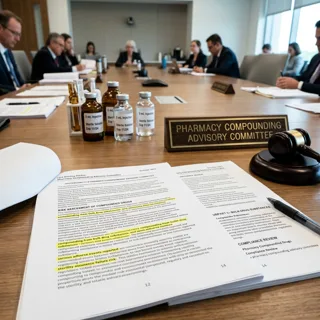
FDA Staff Reviewers Say ‘No’ to 7 Compounded Peptides Ahead of July PCAC Vote
FDA staff reviewers urged against adding seven popular peptides to the 503A bulks list ahead of the July PCAC meeting, citing weak human data and safety uncertainty.

FDA reviewers urge ‘no’ on BPC-157, TB-500, MOTS-c ahead of July 2026 compounding vote
FDA reviewers’ June 29 briefings recommend against listing seven popular peptides for 503A compounding, citing limited human data and immunogenicity risk.

Medicare Starts Paying for Obesity Drugs Today — Bridge Program Opens $50 Access for Millions
Medicare's new $50 Bridge program covering Wegovy, Zepbound, Foundayo, and oral Wegovy for obesity launched July 1 — the first Medicare weight-loss benefit.
FDA staff urges caution on compounded peptides ahead of July advisory meeting
Ahead of the July 23–24 Pharmacy Compounding Advisory Committee meeting, FDA staff briefings recommend against listing seven popular peptides for compounding.